NAO warns on uneconomic building renovations
The National Audit Office is warning that millions of building renovations risk being approved even when they are no longer economically justified, a caution that matters because higher borrowing costs, weaker property values and tighter public budgets are forcing investors and governments to reassess whether refurbishment still beats replacement.
The core issue is not simply that renovation is expensive, but that the economics have changed. Projects once pencilled in on the assumption of cheap financing and steady asset appreciation now face a tougher hurdle: labour, materials, compliance and energy-upgrade costs have risen, while the discount rate applied to future benefits has gone up. In that environment, a renovation can look sensible on paper yet destroy value in practice if expected rent, resale or social benefit gains fail to cover the full life-cycle bill.
That recalibration has wide implications for real estate owners, contractors and lenders. For landlords, especially in commercial property, the risk is stranded capex: money spent on assets that cannot generate enough cash flow to justify the outlay. For policymakers, the warning points to a potential misallocation of public funds, as governments push retrofits and housing upgrades to meet climate and safety targets. If projects are being approved without robust returns testing, scarce capital may be diverted from the buildings where it has the biggest economic payoff.
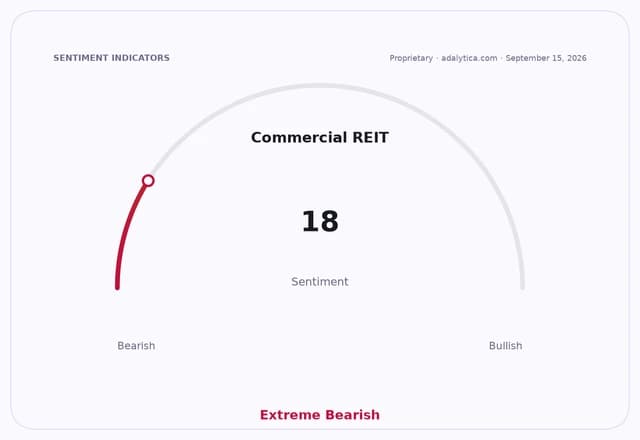
The message also lands in a fragile property market. Adalytica’s Commercial REIT Sentiment gauge shows fear at 18, down 57 points over 30 days, while VNQ has slipped to $94.10 from a recent peak above $98 and is now below its 50-day moving average, with a sharply negative RSI reading. That does not prove the NAO warning is driving prices, but it does show investors are already more cautious about the sector’s ability to absorb higher capex and still deliver returns.
Homebuilders and residential developers face a related, though not identical, calculus. LEN has fallen to $80.07 from above $130 in December and remains well below its longer-term moving average, reflecting how sensitive housing economics are to funding costs and affordability. A market that is already re-rating growth and margins is likely to punish any renovation pipeline that depends on optimistic assumptions about future demand, financing costs or public support.
There is a bull case, of course. Renovation can still be cheaper and faster than demolition and rebuild, and in energy efficiency terms it may be the only viable route for older stock. A well-targeted retrofit can preserve urban fabric, reduce emissions and lift long-term asset values. But the bearish case is that too many schemes are being approved because they are politically easier than hard choices about closure, redevelopment or phased asset disposal.
For investors, the key question is whether renovation spending is being disciplined enough to clear a higher cost of capital. If not, the next round of asset write-downs may not come from vacancy or weak rents alone, but from capital projects that were never economic to begin with.
| Entity | Gains | Losses |
|---|---|---|
| Property owners with high-quality assets | ▲Selective value uplift | ▼Uneconomic capex risk |
| Contractors and renovation suppliers | ▲Near-term project flow | ▼Delayed or cancelled work |
| Governments and municipalities | ▲Lower-emission upgrades | ▼Budget overruns |
| REIT investors | ▲Disciplined capital allocation | ▼Lower returns on renovation-heavy portfolios |