Nvidia AI Capex Trade Faces Bubble Risk

Ray Dalio’s latest warning lands at exactly the wrong time for the AI trade: Nvidia and the rest of the semiconductor complex are still richly valued, hyperscalers are still spending at a breakneck pace, and the market is still pricing the boom as if capital intensity will never matter.
That is the real economic risk. The AI revolution itself is not the issue. The issue is the price investors are paying for the companies that are supposed to monetize it, while the buildout is being financed through one of the largest capex waves in modern market history. Dalio’s point is that technological progress can be genuine and still produce disastrous returns if investors confuse innovation with valuation.

Bridgewater’s founder compared the current enthusiasm to the late 1920s, when electricity, radios, cars and other breakthrough technologies transformed daily life even as the market eventually imploded. In his view, the same mistake is being repeated now: investors are bidding up the stocks tied to artificial intelligence without sufficiently asking who captures the profits and whether the spending pays for itself.
The scale of the current buildout helps explain why the warning resonates. Amazon, Microsoft, Alphabet and Meta are expanding data centers at record speed. Apollo Global Management chief economist Torsten Slok has estimated the US hyperscalers could invest about $916 billion over the next 12 months, pushing data-center spending to roughly 3.1% of US GDP by 2027, nearly three times the peak of the telecom buildout during the dot-com era.
For investors, that cuts two ways. The first beneficiaries are obvious: Nvidia, as well as the broader chip and equipment ecosystem, continues to sit at the center of the spending cycle. The second-order winners are the infrastructure names supplying power, networking, cooling and construction. But the same capex binge also creates the conditions for a violent unwind if returns disappoint or if one of the hyperscalers slows its forecast. When the marginal buyer of AI infrastructure is also helping finance its own expansion, the cycle becomes more fragile, not less.
That fragility is already showing up in the tape. Nvidia shares closed at $219.61 on Sept. 17, above its 50-day moving average of $213.68 and well above the 200-day average of $197.81, but the stock has been volatile and the short-term momentum indicators have cooled. The broader semiconductor ETF SOXX finished at $519.06, still above its 50-day average of $526.32 in the recent data series but far below the June surge that briefly pushed it above $650. SMH, another proxy for the chip trade, has also come off its highs. In other words, the market is no longer moving in a straight line higher, even if the secular AI narrative remains intact.
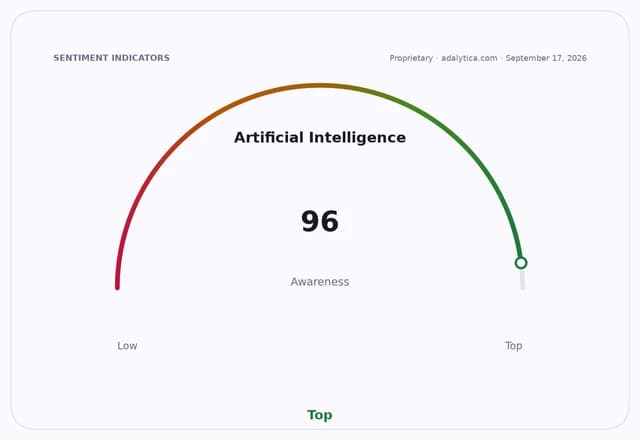
Adalytica’s sentiment snapshot for Nvidia shows “Extreme Fear,” with sentiment at 4.0, while the AI basket carries “Extreme Fear” sentiment despite very high awareness. That does not prove a bubble, but it does show how quickly conviction can vanish when a crowding trade starts to wobble. When fear rises even as attention stays elevated, the market is usually close to a judgment point rather than a resolution.
The Bank of England has already warned that valuations across AI-linked stocks are stretched, noting that the cyclically adjusted earnings yield on the S&P 500 has approached dot-com-era extremes and that the weight of AI-related companies in the index has roughly doubled since 2022. It also flagged a sharp rise in hedge-fund leverage. That matters because bubbles do not need a recession to break; they only need financing to tighten or expectations to reset.
Dalio is not telling investors to dump AI stocks blindly. He made a similar point last year: a bubble is not the same as an immediate sell signal. History suggests these episodes can last for years before they rupture. But that is precisely why the opportunity is now in positioning, not in denial.
| Entity | Gains | Losses |
|---|---|---|
| Nvidia | ▲AI capex cycle | ▼Bubble repricing risk |
| Hyperscalers | ▲Data-center scale | ▼Return-on-capex scrutiny |
| Chip equipment/infrastructure suppliers | ▲Spending surge | ▼Demand slowdown |
| Short sellers/cash skeptics | ▲Volatility spike | ▼Missing secular upside |