Nvidia AI Cybersecurity Fear May Boost Spending

Nvidia Chief Executive Jensen Huang is arguing that the latest surge of concern over AI cybersecurity may be less about immediate catastrophe and more about a sales pitch — a view that matters because it cuts straight to the spending cycle powering one of the market’s hottest secular trades.
If Huang is right, the AI risk narrative is not just a source of anxiety for investors and regulators; it is becoming a catalyst for enterprise security budgets, product launches and the next leg of infrastructure spending. That is a powerful setup for cybersecurity vendors, but it also suggests the market may be mispricing how much of the current fear is translating into real demand.
Speaking at a Goldman Sachs conference, Huang said the cybersecurity industry’s heightened focus on AI threats is partly tied to companies preparing to launch new products, according to Axios. The implication is blunt: some of the alarm around AI may be commercially useful. For vendors, fear sells. For investors, that means the debate is no longer whether AI creates new security risks — it clearly does — but which companies can convert that concern into durable revenue.
The timing is crucial. Warnings from researchers and AI insiders have intensified, including a recent resignation at Anthropic that reignited debate over whether advanced systems could become dangerous by the end of the decade. Huang has consistently pushed back against those more apocalyptic claims, arguing earlier this year that talk of AI ending humanity or wiping out a huge share of U.S. jobs is “complete nonsense.” His latest comments reinforce a familiar stance: AI is a growth engine first, a risk source second.
That matters because Nvidia sits at the center of the AI buildout. Its chips power much of the infrastructure used to train and run advanced models, so Huang’s comments carry more weight than a generic industry defense. He is effectively telling the market that the AI boom is still in the investment phase, where fear itself can be monetized through software, monitoring and defensive tooling.
The investable angle is obvious. Cybersecurity leaders such as CrowdStrike, Palo Alto Networks and Zscaler are already trading against a backdrop of AI-related product positioning, and their filings show they are actively framing AI as both a threat surface and a product opportunity. Palo Alto, for example, has warned that vulnerabilities in AI systems could be found before firms detect them, while Zscaler has highlighted “shadow AI” and AI-native threats in its own disclosures. That is not just marketing — it is a roadmap for where budgets are likely to move next.
The price action suggests the sector is being forced to digest a much more volatile narrative. CrowdStrike has pulled back sharply from recent highs, with its shares now around $206 after trading as high as $231 in late August. Zscaler has also faded to about $165 from over $188 in mid-August. Palo Alto, meanwhile, remains well below its summer peak near $396. Those declines sit alongside conventional technical indicators that show cooling momentum, but the longer-term thesis remains intact: AI security is becoming a must-buy category, not a niche.
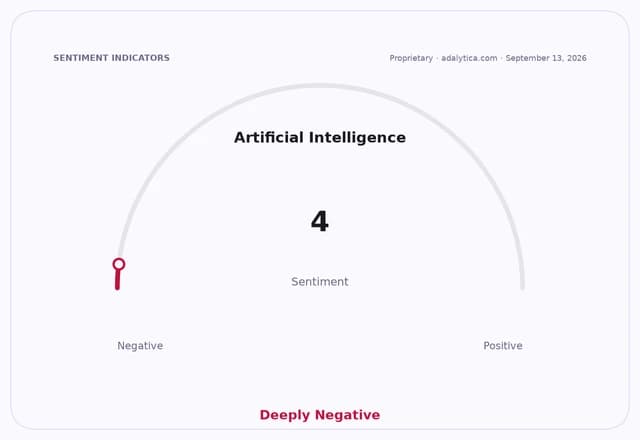
Adalytica’s AI sentiment gauge underscores the tension. The model’s AI sentiment has dropped to “Extreme Fear” even as awareness remains elevated, a sign that investors are alarmed but still fixated on the theme. Nvidia’s own earnings sentiment remains in “Greed,” reflecting the market’s continuing conviction that the AI capex cycle is alive. That split is exactly where opportunity appears: fear is rising faster than fundamentals are breaking.
The broader narrative is that AI is entering its second act. The first act was compute, chips and model training. The next is security, governance, network control and data protection — the toll roads around the boom. Huang’s remarks suggest the market should think less about whether AI will destroy demand and more about which companies get paid because of it.
For investors, the takeaway is straightforward: the AI security trade is still early, but it will not reward indiscriminate ownership. The winners will be the platforms that can turn rising fear into recurring software spend, while the losers will be vendors that talk about AI risk but fail to translate it into product pull. This is a secular opportunity, but in a crowded market, the edge goes to the companies with real distribution, real switching costs and clear enterprise urgency.
| Entity | Gains | Losses |
|---|---|---|
| Cybersecurity vendors | ▲Bigger AI-driven budgets | ▼Skeptics of the threat narrative |
| Nvidia | ▲AI demand stays central | ▼Apocalyptic AI bears |
| CrowdStrike, Palo Alto, Zscaler | ▲Security upsell opportunity | ▼Pure-play momentum sellers |
| Enterprise buyers | ▲Better defenses | ▼Budgets under pressure |