Nvidia’s reported decision to halve its list of approved Asia-based buyers in China is a sharp reminder that the world’s hottest growth story is still hostage to politics, and that matters far beyond one company’s sales.
Nvidia China Limits Highlight Policy Risk
For investors, the significance is simple: China remains a large, strategic market for advanced chips, but it is also the most exposed to U.S. export restrictions and escalating scrutiny from Washington. If Nvidia has to narrow who can buy its products, that is not just a compliance tweak. It is a sign that the company’s addressable market in China may be shrinking again, even as demand for AI accelerators elsewhere stays strong.
That tension helps explain why semiconductor stocks can swing hard even when the long-term AI investment case remains intact. Nvidia shares have been volatile around the low $200s recently, with standard technical indicators showing the stock trading near its 50-day moving average and well above its 200-day average, a pattern that suggests the longer-term uptrend is still intact but momentum has cooled. The SOXX semiconductor ETF has also pulled back from recent highs, underscoring how quickly the market re-rates chip names when policy risk flares.
The bigger economic story is that chip supply chains are being redrawn by governments, not just customers. Washington is still encouraging domestic and allied semiconductor investment, while tightening the rules on what can flow to China. That is good for U.S. industrial policy and for companies building capacity outside China, but it also means higher friction, more paperwork and fewer easy wins for the biggest AI chip vendor in the world.
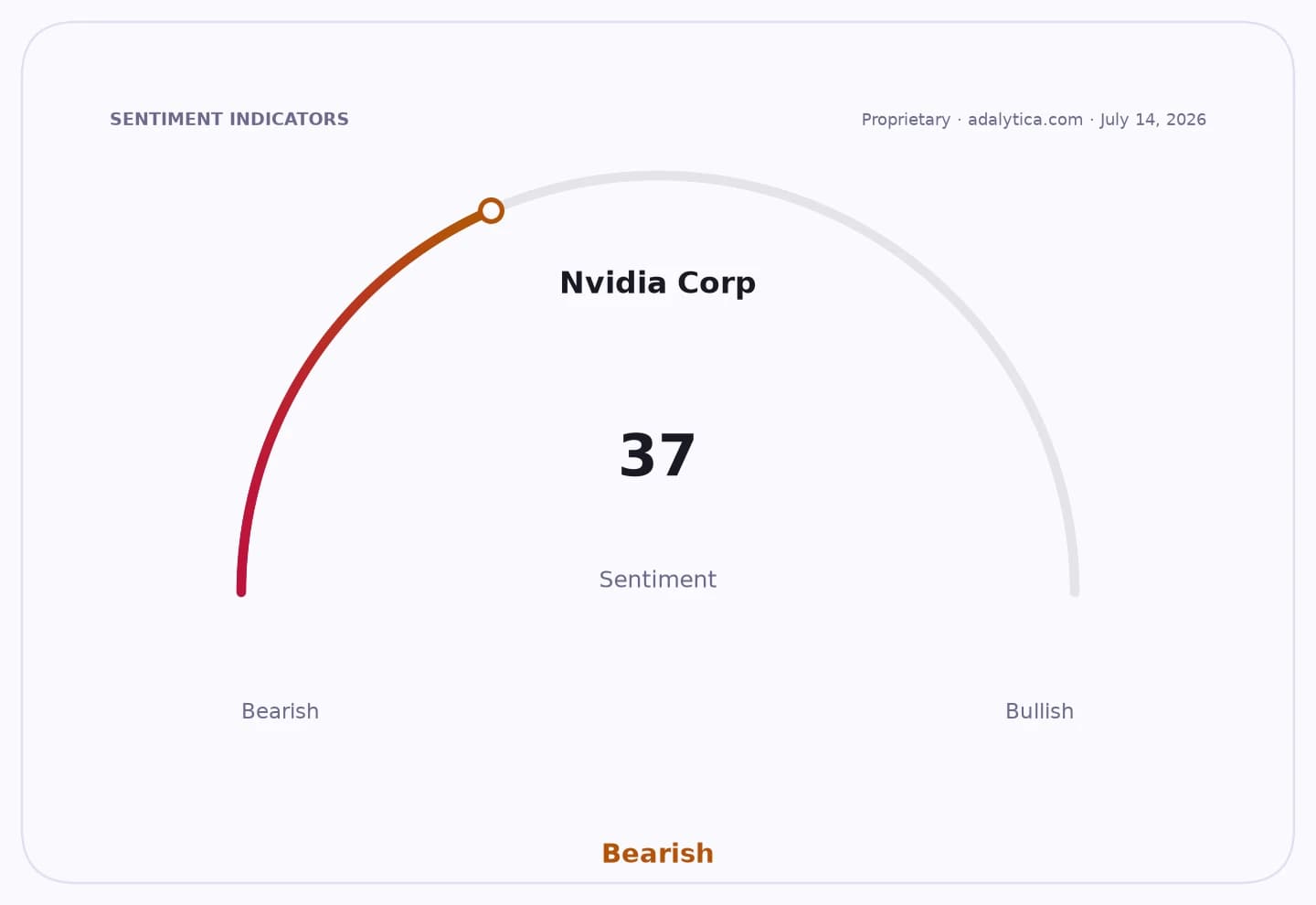
Nvidia Corp — 30-day sentimentadalytica.com
Explore this data interactively — full history, time series and cross-market comparisons.Open AlphaPulse
Nvidia is not alone in feeling the strain. Taiwan Semiconductor Manufacturing, its key foundry partner, has seen its own shares remain elevated, reflecting continued AI demand and the market’s belief that leading-edge manufacturing remains indispensable. But even TSMC’s scale does not insulate the ecosystem from trade controls that can change which customers can access the most advanced chips. The result is a semiconductor industry that is still growing fast, yet increasingly segmented by geopolitics.
That is why investors should focus on the long game. Nvidia’s leadership in AI hardware, software and developer adoption still gives it one of the strongest moats in technology. But if China access keeps narrowing, the company’s growth will have to come even more from the U.S., Europe and the rest of Asia — and from new waves of AI spending in data centers, robotics and enterprise software. In the near term, headlines like this can pressure sentiment. Over three to 10 years, they mostly reinforce one lesson: even the most unstoppable growth stock needs a durable, diversified demand base.
For long-term investors, this is not a reason to panic. It is a reason to watch valuation, watch policy, and stay diversified across the semiconductor supply chain. Nvidia still looks like a core AI winner, but the China crackdown is a reminder that the road to compounding is rarely smooth. Worth keeping on the watchlist, and worth holding if you can think in years, not days.
| Entity | Gains | Losses |
|---|---|---|
| Nvidia’s non-China business | ▲More focus on core AI demand | ▼Less dependence on China |
| China-based buyers | ▲Limited access to advanced chips | ▼Smaller supplier choice |
| U.S. policymakers | ▲Stronger export control leverage | ▼Short-term industry friction |
| TSMC and chip suppliers outside China | ▲Continued AI fab demand | ▼Policy-driven volatility |