Nvidia earnings week tests AI spending growth

Nvidia enters its earnings week as the clearest test of whether AI spending is still translating into market-leading growth, with Salesforce and Intuit also set to show whether enterprise software can defend margins and justify valuations after a volatile summer in tech.
For investors, the question is no longer whether AI is driving capital expenditure. It is whether that spending is still producing enough revenue and earnings momentum to support the group of stocks that has carried much of the S&P 500 this year. Nvidia sits at the center of that trade. Its shares closed at $214.72 on Aug. 21, up sharply from a recent low near $177 in late February, but the stock has also slipped from an August peak above $223, leaving it sensitive to any sign that demand is normalizing or that hyperscale buyers are becoming more disciplined.
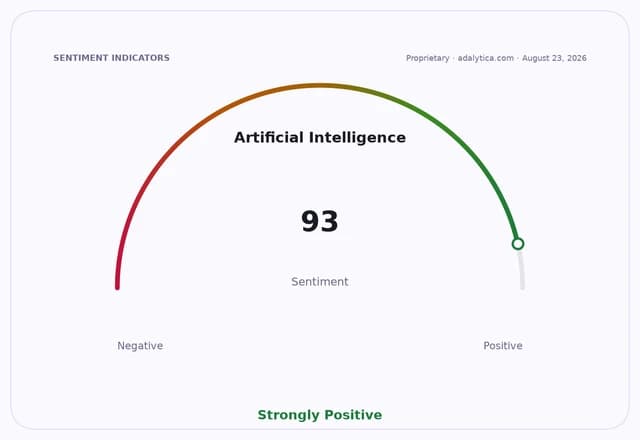
The market backdrop is mixed rather than euphoric. Adalytica’s AI sentiment gauge is at 93, in “Extreme Greed,” while awareness is just 4, a combination that points to elevated enthusiasm but limited breadth. The S&P 500 trade-signal snapshot shows sentiment at 26, or “Fear,” even as awareness remains high, underscoring a market that still wants AI exposure but is less willing to chase the broader index. Nvidia’s own sentiment reading has cooled from 100 a day earlier to 64, suggesting expectations have reset quickly ahead of the report.
Technically, Nvidia remains stronger than it was in the spring, with the shares above both the 50-day and 200-day moving averages, but momentum has moderated. The relative strength index has eased to 59.5 from overbought levels above 70 earlier in the month, and the MACD has rolled lower from recent highs. That does not imply a trend break, but it does suggest the stock is no longer priced for an easy upside surprise.
That makes the earnings print important well beyond one company. Nvidia’s results will help determine whether the AI infrastructure build-out remains in the early innings, or whether the pace of spending is shifting from explosive to simply strong. The distinction matters because Nvidia’s growth has become a proxy for capex plans across cloud providers, chipmakers, server makers and software vendors tied to model deployment. A clean beat and confident guidance would reinforce the bull case that AI monetization is still outpacing skepticism. A narrower beat, softer data-center commentary or signs of customer digestion would fuel the bear argument that the trade is becoming crowded and that revenue growth is eventually catching up with expectations.
Salesforce and Intuit matter for a different reason: they show how the AI story is filtering into software profitability. Salesforce shares have rebounded to $209.17 from a low near $164 in April, with the stock now above its 50-day and 200-day moving averages and its RSI in the low 70s, a sign of renewed optimism. But the company is still being judged on whether AI features can accelerate growth without forcing higher spending on sales, development and integration. Intuit is even more sensitive to that question. The stock has recovered to $367 from a February trough below $380 after a brutal drawdown, but it remains far below its 200-day average near $440. Investors will be looking for evidence that AI can lift conversion rates and efficiency in tax, accounting and small-business software rather than simply add cost.
The three names together frame a single market narrative: AI is moving from a story about demand to a test of economic returns. Nvidia is the infrastructure barometer, Salesforce is the enterprise adoption test and Intuit is the productivity case. If all three firms show resilient demand and margin discipline, it would support the idea that AI is still broadening earnings leadership rather than just inflating a few mega-cap valuations. If not, the market may begin to question how long capital-intensive AI growth can outrun the profit math.
For now, investors appear willing to give the sector the benefit of the doubt. But with sentiment crowded in AI and the broader market showing more caution, the earnings season ahead is likely to decide whether that confidence turns into another leg higher — or a period of valuation compression.
| Entity | Gains | Losses |
|---|---|---|
| Nvidia bulls | ▲Strong guide | ▼Any capex slowdown |
| Nvidia bears | ▲Softer demand print | ▼Renewed AI acceleration |
| Salesforce investors | ▲AI-led revenue upside | ▼Rising spend pressure |
| Intuit shareholders | ▲Efficiency gains | ▼Margin dilution from AI rollout |