Nvidia H200 Shipments Resume to China
Nvidia has started sending H200 artificial-intelligence chips to China in limited quantities after reaching an arrangement with Washington, a partial loosening of export curbs that keeps the world’s most valuable semiconductor company in one of its largest foreign markets while preserving US leverage over advanced AI hardware.
The move matters because China remains a critical end market for AI infrastructure demand, and even a narrow reopening can shift near-term revenue expectations for Nvidia, its foundry partner Taiwan Semiconductor Manufacturing Co and the broader semiconductor supply chain. It also suggests Washington is willing to calibrate restrictions rather than maintain a blanket shutdown, reflecting the balance policymakers are trying to strike between national security and the commercial interests of US chipmakers.
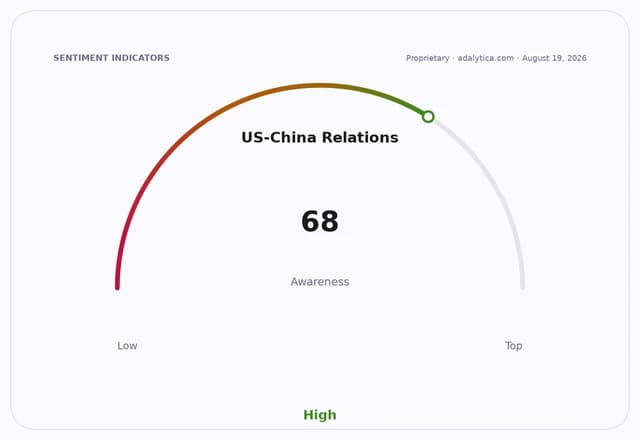
For investors, the development is a reminder that China exposure has not disappeared from the AI trade — it has become more episodic and policy-dependent. Nvidia shares were trading around $219.74 on Aug. 18, down from $225.01 a day earlier, with the stock still well above its 50-day moving average near $206.94 and the 200-day average near $194.93. The pullback came after a sharp run that left the shares with a relative strength index of 77.4, a level that typically points to an overbought market, even as momentum indicators remained positive.
The broader semiconductor complex was similarly bid up on hopes that AI demand can absorb continued policy friction. The iShares Semiconductor ETF, SOXX, has surged from $271.30 in October to above $531, although it fell 4.9% on Aug. 18. TSMC, which manufactures Nvidia’s most advanced chips, slipped to NT$413.41 in Taipei after touching NT$430.97 a day earlier, still comfortably above its 50-day and 200-day moving averages. That suggests the market is willing to look through short-term volatility as long as the AI buildout remains intact.
The policy shift comes as China has continued to nurture its own chip ecosystem under pressure from US sanctions and export controls. Domestic players including memory-chip maker CXMT and YMTC have gained traction with state support, while the broader Chinese semiconductor sector has rallied on AI-related demand. That creates a two-track market: US suppliers can still monetize China in selected categories, but Beijing is simultaneously accelerating efforts to reduce dependence on foreign technology.
The case for Nvidia is that limited H200 shipments can add incremental sales without materially changing the strategic contest. The bear case is that the arrangement remains fragile, subject to political reversal and licensing bottlenecks, and may not restore access to the fastest-growing Chinese AI customers at the scale investors would want. Either way, the message from Washington and Beijing is the same: advanced chips are now a negotiating tool as much as a product.
What investors should watch next is whether the H200 exception expands, whether other Nvidia products receive similar treatment, and whether Beijing allows more inbound technology as part of a broader thaw. Until then, the China market remains a source of upside for Nvidia, but one that can only be monetized in small, policy-approved doses.
| Entity | Gains | Losses |
|---|---|---|
| Nvidia | ▲Small China sales rebound | ▼Ongoing policy risk |
| TSMC | ▲More wafer demand | ▼Export-control uncertainty |
| Chinese buyers | ▲Access to H200 supply | ▼Limited volumes |
| US policymakers | ▲Leverage over tech trade | ▼Less-than-total restriction |