Nvidia Hugging Face deal could value platform at $12.9B

Nvidia is being cast as a potential buyer of Hugging Face in a deal that could value the AI platform at about $12.9 billion, a move that would deepen the chipmaker’s reach into the software layer of the artificial-intelligence stack and strengthen its grip on the market that is driving its growth.
The appeal is strategic rather than cosmetic. Nvidia already sits at the center of AI infrastructure, but owning a platform used by developers to build and distribute models would give it a closer relationship with customers, more visibility into usage trends and a better way to defend its ecosystem against rivals trying to commoditize AI hardware. For investors, that matters because the biggest question around Nvidia is no longer whether demand exists, but how long the company can keep translating that demand into pricing power and margin expansion as AI spending broadens beyond training clusters and into software and deployment.
Hugging Face has become one of the more important neutral venues in AI development, with a large community of developers and enterprises using its tools to share models and experiment with open-source AI. For Nvidia, that makes the platform a potential strategic bridge between the hardware market it dominates and the software market where future AI value may increasingly be captured. A purchase would also fit a wider industry pattern in which major technology companies are moving to secure talent, platforms and distribution as AI shifts from infrastructure buildout to productization.
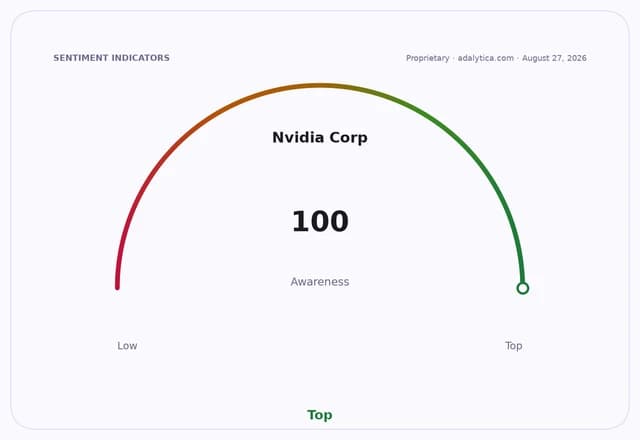
The market backdrop helps explain why such a deal would be read as more than just another acquisition rumor. Nvidia’s shares have been volatile but remain near record levels after a sharp rebound, with the stock closing at $227.98 on Aug. 27, above its 50-day moving average of $208.16 and its 200-day moving average of $195.57. The bounce came alongside heavy trading volume of 297.2 million shares, while the relative strength index at 53.5 suggests the stock is not yet technically overextended. Even so, the recent spike in Adalytica’s proprietary Nvidia earnings sentiment gauge to “Extreme Fear” underscores how quickly expectations can swing when investors start debating whether AI leaders are buying growth or defending it.
For Nvidia, the bull case is that a platform like Hugging Face would help lock in developers, reinforce the company’s software moat and create a more durable commercial funnel for its GPUs and networking gear. The bear case is that any large acquisition would bring integration risk, regulatory scrutiny and the possibility that Nvidia would be paying a premium for an asset whose value depends partly on remaining broadly trusted and relatively independent. A move into a highly visible AI distribution platform could also sharpen antitrust concerns at a time when regulators are already watching the sector closely.
The bigger narrative is that AI is moving up the stack. The first phase of the boom was about chips, data centers and power; the next will be about platforms, model distribution and enterprise workflows. If Nvidia does move on Hugging Face, investors would likely read it as an attempt to control more of that transition and reduce dependence on a single layer of the AI value chain. What matters now is whether the company is preparing for a market that is becoming less about selling compute and more about owning the relationships that sit on top of it.
| Entity | Gains | Losses |
|---|---|---|
| Nvidia | ▲Developer reach; software moat | ▼Cash; antitrust risk |
| Hugging Face | ▲Scale; capital access | ▼Independence; neutrality |
| AI developers | ▲Better tooling; broader distribution | ▼Less platform neutrality |
| GPU rivals | ▲Little, if any | ▼Ecosystem share; customer access |