NVIDIA and LG Electronics expand robotics cooperation

LG Electronics is strengthening cooperation with NVIDIA in robotics, a move that underscores how the AI boom is widening from semiconductors into physical machines, industrial automation and connected mobility.
That matters because the next leg of artificial intelligence growth is increasingly about deployment, not just model training. If NVIDIA can turn its graphics processors and software stack into a platform for robots, factories and autonomous systems, it gains a larger and more durable market than chip sales alone. For LG, the tie-up offers a way to pull more value from its electronics and appliance base by embedding AI into products that can see, move and respond in the real world.
The partnership also reinforces a broader industry shift. Companies from consumer electronics makers to industrial suppliers are rushing to integrate AI into security robots, service robots and mobility platforms. LG CNS has already introduced a security robot as part of its own AI and robotics push, while the wider sector is seeing renewed capital and strategic attention as firms look for practical uses beyond chatbots and cloud inference. That is important for investors because robotics could become a new demand center for high-end computing, sensors, edge software and systems integration.
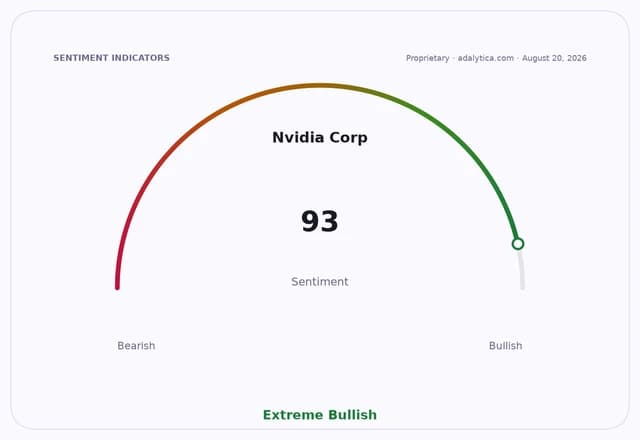
NVIDIA has been trying to position itself as the operating layer for that transition. Its shares have risen sharply this year, with the stock trading at $217.56 in the latest session, above both its 50-day moving average of $207.12 and its 200-day moving average of $195.01. Standard technical indicators still show momentum is stretched rather than weak: RSI was 71.9, suggesting the stock is overbought, even as the MACD remains positive. Adalytica’s NVIDIA earnings sentiment gauge also reads 93, or “Extreme Greed,” indicating very strong enthusiasm around the company’s earnings and growth profile.
For investors, the key question is whether robotics can expand NVIDIA’s addressable market enough to justify sustained premium multiples. The bull case is that a successful push into robots and industrial AI creates repeatable, ecosystem-driven revenue and lowers dependence on the lumpy cadence of data-center spending. The bear case is that robotics adoption may take longer than the market expects, with integration costs, slower customer rollout and competition from other compute platforms limiting the near-term payoff.
For LG Electronics, deeper cooperation with NVIDIA could help differentiate its consumer and industrial products at a time when hardware margins are under pressure. It also gives the South Korean group a stronger position in an emerging market where software capability, not just manufacturing scale, may define winners. The next catalyst will be whether the two companies translate the partnership into concrete products and commercial deployments, rather than broad strategic language alone.
| Entity | Gains | Losses |
|---|---|---|
| NVIDIA | ▲Expanded robotics platform | ▼Short-term valuation risk |
| LG Electronics | ▲AI product differentiation | ▼R&D and integration costs |
| Robotics customers | ▲More capable systems | ▼Higher upfront spending |
| Rival chipmakers | ▲Slower ecosystem momentum | ▼NVIDIA platform pull |