Nvidia, Microsoft AI labor costs draw scrutiny

The AI industry’s fastest-growing cost may be the human labor it prefers to keep invisible: hundreds of thousands of low-paid contractors who label data, rank chatbot answers and moderate content, even as the biggest technology companies pour billions into artificial intelligence infrastructure.
That matters because the economics of AI are being built on a widening gap between rising capital spending and precarious labor. Pope Leo XIV’s warning about a “chain of exploitation” hidden inside the digital economy lands as investors continue to reward the companies most exposed to AI buildout — even though the model-training workforce remains fragmented, lightly protected and largely off balance sheet.
The issue is not simply ethical. It goes to the durability of the AI profit pool. If model performance depends on armies of taskers working on stop-start contracts, often unpaid for onboarding and with little visibility into assignments or evaluation criteria, then the true cost of AI is being understated. That can eventually show up in margin pressure, supply bottlenecks, regulatory scrutiny or reputational damage, especially as policymakers and “responsible AI” programs take a closer look at how the systems are made.
The labor debate also arrives against a macro backdrop in which the broader workforce is already under strain. U.S. unemployment has drifted to 4.1% in the latest reading, with a forecast of 4.09% next month, while inflation remains sticky enough to keep pressure on real wages. For many younger workers, the AI economy is not creating high-skill prosperity at the pace its backers promise; instead it is generating short-term, insecure work that can be scaled up and discarded as projects change.
That helps explain why the story resonates beyond academia and advocacy circles. A university strike in Sydney over AI-related job fears, and warnings from labor leaders that entry-level opportunities are being squeezed, point to a broader political risk for AI adopters. The more companies sell automation as a productivity miracle, the more they invite questions about who absorbs the human and social costs of making that technology work.
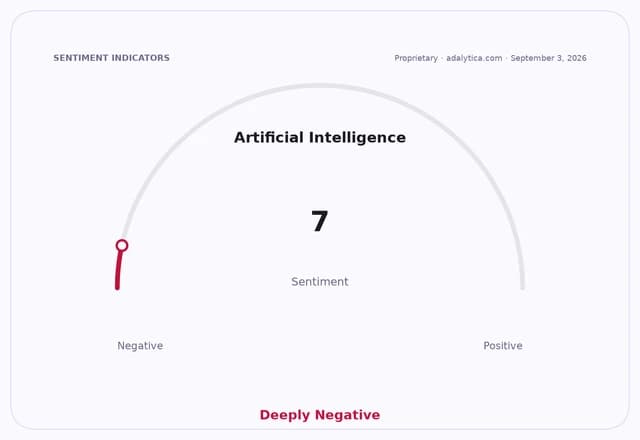
For investors, the near-term market message is more complicated. Nvidia, Microsoft and Meta remain central beneficiaries of the AI spending cycle, and their shares have reflected that even as sentiment has swung sharply. Nvidia’s conventional technical signals still show strength, with the stock above both its 50-day and 200-day moving averages and an RSI near neutral after a strong rebound. Microsoft has also reclaimed its 200-day moving average after a steep spring selloff. But the Adalytica sentiment gauges show how fragile confidence can be: Nvidia sits in “Extreme Greed,” while Microsoft has fallen back into “Extreme Fear,” underscoring how quickly the market can rotate from euphoria to skepticism when AI economics come under scrutiny.
The bear case is that AI’s labor model is a hidden liability, not a feature. The bull case is that tasking work is simply the transitional cost of a new industrial stack, and that scale will eventually reduce the need for human intervention. Both can be true at once. But the present reality is that much of AI’s output still depends on low-security labor that is increasingly hard to defend in public and increasingly relevant to earnings quality.
As AI capex continues to rise, investors should watch not only chip demand and cloud growth, but also whether the human infrastructure behind model training becomes more expensive, more regulated or more visible. If it does, the winners will still be the companies that control the platforms and compute. The losers may be the contractors doing the work, and eventually the margins that were assumed to be effortless.
| Entity | Gains | Losses |
|---|---|---|
| Nvidia, Microsoft, Meta | ▲AI revenue growth | ▼Labor-cost scrutiny |
| Taskers / contractors | ▲Short-term income | ▼Low pay, weak protection |
| Investors in AI leaders | ▲Capex-driven upside | ▼Margin and reputational risk |
| Universities and workers | ▲Visibility for labor issues | ▼Entry-level job insecurity |