Nvidia, Microsoft, Alphabet Rise on AI Infrastructure

AI’s critics are getting louder, but the market’s winners are still the companies selling the shovels.
That is the clearest read from the latest price action in Nvidia, Microsoft and Alphabet, where investors continue to buy exposure to the infrastructure layer even as concerns mount over regulation, job displacement, model risk and the broader social backlash against artificial intelligence. The narrative around AI has turned more combative, but the capital allocation story has not changed: enterprises are still spending on compute, cloud and automation because that is where the productivity gains and strategic leverage sit.
Nvidia is the sharpest expression of that trade. The stock closed at $225.30, just below its recent highs, after rebounding from a late-July pullback that briefly pushed it to $190.01. The shares are now comfortably above the 50-day moving average at $206.31 and the 200-day at $194.58, with RSI readings in the low-60s and a positive MACD signal that points to renewed momentum. In other words, the market is not pricing in retreat — it is pricing in another leg of capex.
That matters because the backlash against AI is increasingly aimed at the consumer layer and the social consequences of automation, while the profit pools remain concentrated in the infrastructure stack. Chipmakers, cloud platforms and software vendors are the toll roads of the AI buildout. Even as companies acknowledge legal, regulatory and reputational risks in recent filings, they are still expanding AI budgets, embedding model capabilities and chasing industrial use cases. LG’s expanded partnership with Nvidia on humanoid robots and AI-driven factories is the kind of second-order development that shows how the spending cycle is moving from hype to deployment.
Microsoft and Alphabet tell a similar story. Microsoft closed at $496.88, far above its 50-day moving average of $411.41, while Alphabet ended at $346.36, also above its 50-day average of $354.14 and 200-day average of $330.72. Microsoft’s chart shows a powerful rebound from a June low near $352.83, and Alphabet has steadied after a volatile summer. Both names remain tied to AI monetization across cloud, search and enterprise software, and both face the same reality: regulation may slow the narrative, but it has not yet slowed spending.
For investors, the key is to separate backlash from withdrawal. Public resistance to AI can pressure sentiment, invite rulemaking and raise the cost of compliance, but it does not eliminate the economic incentive to automate, scale inference and build specialized compute. If anything, the more intense the debate gets, the more likely large firms are to keep investing to avoid falling behind rivals. That favors Nvidia, Microsoft and Alphabet over speculative application plays that depend on loose capital markets and easy adoption.
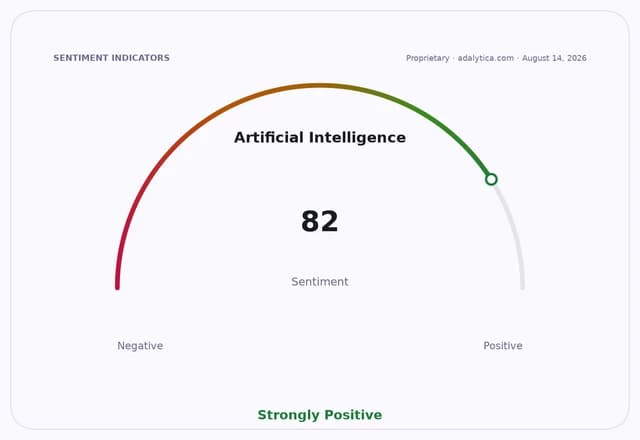
The trade also looks attractive on a relative basis. Nvidia’s recent move comes with improving momentum and still leaves room before the upper Bollinger Band, while Microsoft and Alphabet have both recovered from deep drawdowns that reset expectations. Adalytica’s proprietary AI sentiment reading has jumped to 82, or “Greed,” after a sharp one-day surge, suggesting the market is again leaning into the theme rather than abandoning it. The broader message is that AI remains one of the few secular growth engines strong enough to overpower the noise.
The backlash is real, but so is the spending. The investors who win here will be the ones who buy the infrastructure beneficiaries before the next wave of enterprise AI demand is fully reflected in earnings.
| Entity | Gains | Losses |
|---|---|---|
| Nvidia | ▲AI infrastructure demand | ▼Backlash-driven short sellers |
| Microsoft | ▲Cloud AI monetization | ▼Slow-growth software peers |
| Alphabet | ▲Search and AI scale | ▼Consumer-facing AI skeptics |