Nvidia, SOXX and AI stocks face forced-selling risk

Forced selling, not a gradual repricing of AI winners, is the market risk investors should be focused on as crowded positions start to meet thinner liquidity and a more fragile funding backdrop.
The danger is simple: when a heavily owned trade begins to crack, margin calls and carry-trade reversals can turn a normal pullback into a disorderly unwind. That is the setup the market is flirting with now. U.S. two-year and 10-year yields have climbed back to about 3.6% and 4.7%, respectively, while high-yield spreads remain relatively contained around 2.7%, suggesting investors have not yet fully priced the possibility of a forced deleveraging event rather than just a valuation reset.

That matters because AI has become the market’s most crowded growth trade. Nvidia, the bellwether for the theme, is still trading well above both its 50-day and 200-day moving averages, but the stock’s recent swings show how fast momentum can reverse even when the long-term story remains intact. Nvidia closed at $217.56 on Aug. 19, after touching $225.01 two sessions earlier, while its relative strength index cooled from overbought territory to 71.9. The SOXX semiconductor ETF, meanwhile, has been far more erratic, falling to $519.67 on Aug. 19 after a sharp surge and retreat that left it only modestly above its 50-day average. QQQ is still elevated near $716, but its own technical readings show the rally has become stretched and vulnerable to any liquidity shock.
The real issue is not whether AI capex remains powerful — it does. The issue is whether the market can absorb a disorderly de-grossing if investors are forced to sell winners into a downturn. That is where leverage becomes the accelerant. In a crowded trade, the first sellers are often voluntary; the next wave is not. When volatility jumps, lenders tighten, and investors who financed exposure with cheap funding are pushed to liquidate the most liquid names first. That can drag down the very stocks that had been acting as indexes of market strength.
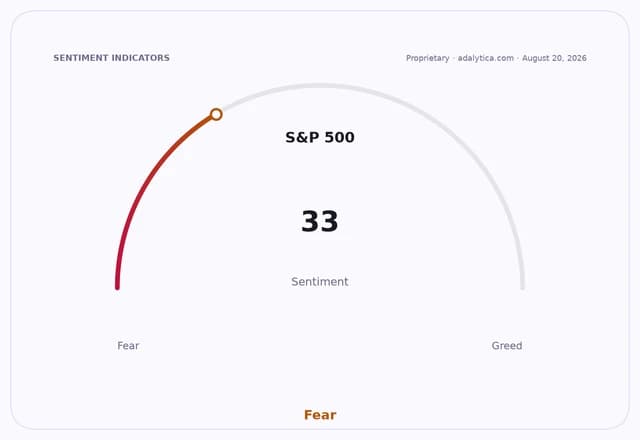
The backdrop is not benign. Liquidity sentiment tracked by Adalytica.com has fallen to 29, labeled fear, with the one-day move sharply weaker and the seven-day decline deep. FX volatility sentiment is in extreme fear at 11, a sign that funding markets and cross-asset positioning are already more unstable than equity prices alone imply. At the same time, the S&P 500 trade-signal snapshot still shows greed-level awareness, which is exactly the kind of complacency that can leave portfolios exposed if the unwind becomes mechanical rather than discretionary.
Investors should read this as a warning about second-order effects, not a verdict on AI fundamentals. The megatrend is intact, but the market’s path may be far more violent than the story suggests. In these conditions, the winners are likely to be the infrastructure and cash-rich names with real balance-sheet resilience, while the losers are the most crowded levered longs, speculative semiconductor beta and any trade dependent on easy funding and perpetual risk appetite.
That argues for staying invested in AI, but leaning harder into the picks-and-shovels names with durable free cash flow, strong balance sheets and less dependence on momentum alone. The market underestimates how quickly a crowded AI trade can turn into a forced-selling event once margin pressure and funding stress arrive together. The next catalyst is not another earnings beat — it is whether liquidity holds when the first real de-grossing starts.
| Entity | Gains | Losses |
|---|---|---|
| Cash-rich AI infrastructure leaders | ▲Relative resilience | ▼Less immediate upside |
| Nvidia and SOXX | ▲Continued secular demand | ▼Sharp drawdown risk |
| Leveraged growth funds | ▲None | ▼Margin-call pressure |
| Dollar-funded carry trades | ▲None | ▼Forced unwinding |