Nvidia Weakness Looks Like a Reset, Not a Breakdown
Nvidia’s underperformance against the broader market in 2026 looks less like a broken growth story and more like a reset before the next leg higher, with AI chip demand still tight enough to lift pricing across the industry and keep the company’s second-half setup intact.
That matters because the market is starting to price Nvidia like a mature winner, even as the economics of AI infrastructure still look like an early-cycle capex boom. Intel has already raised prices on server chips as demand for AI processing power strains supply chains, a sign that compute remains scarce, not commoditized. When supply is tight and every hyperscaler, startup and sovereign buyer is chasing the same hardware, the beneficiaries are the companies with scale, supply-chain leverage and the highest-performance chips. Nvidia remains the clearest toll road in that system.

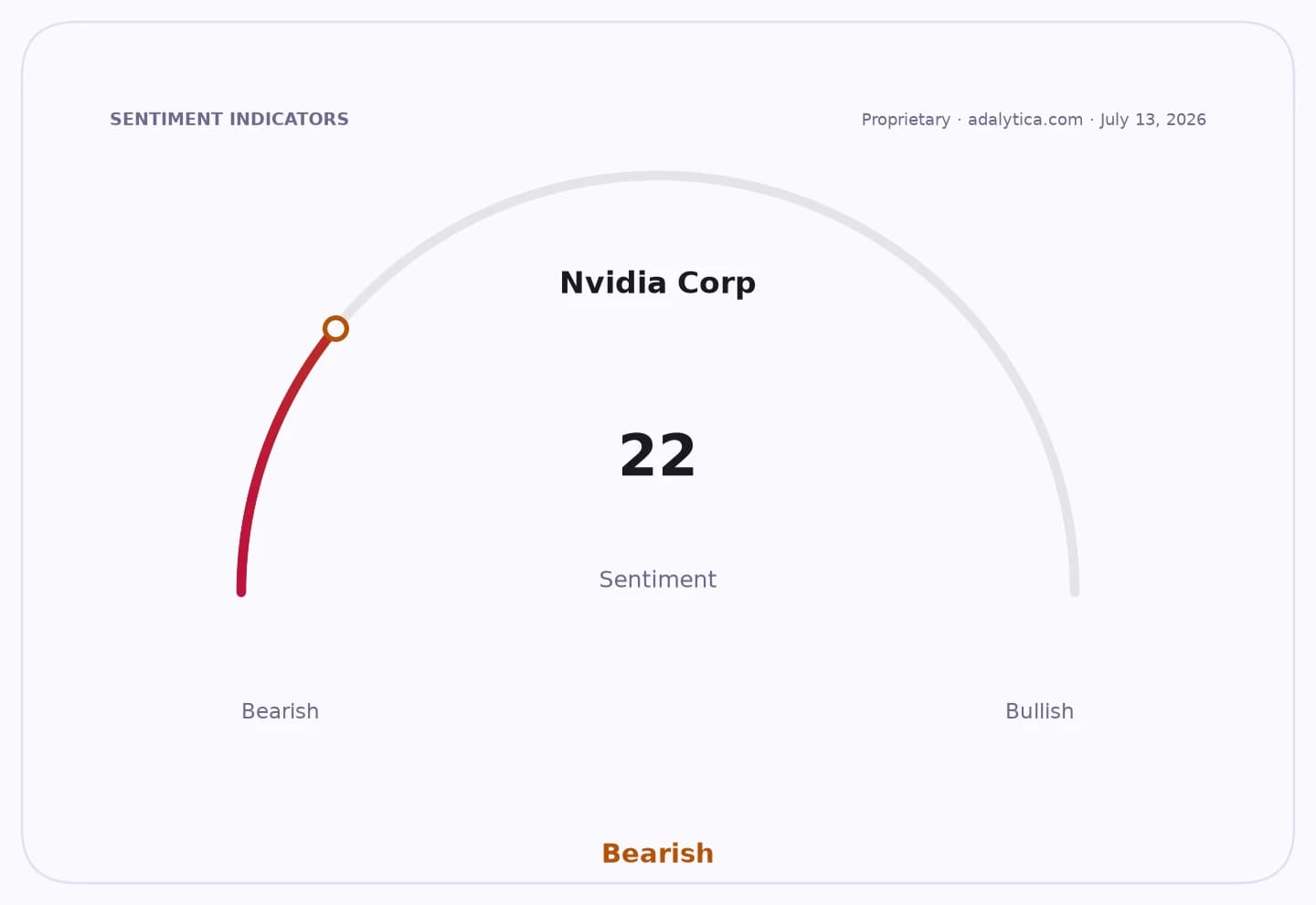
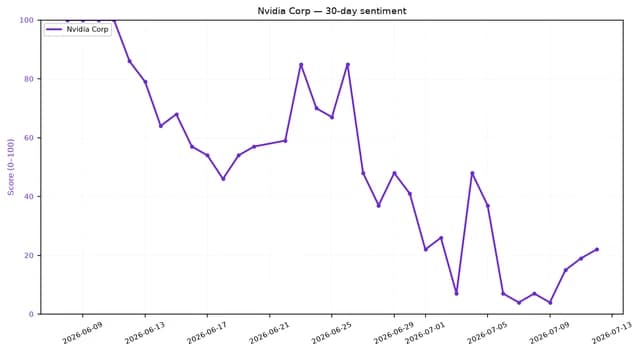
The stock’s path this year reflects the tug of war between that long-term demand and short-term valuation fatigue. Nvidia fell back to $202.78 on July 9 after closing at $210.96 on July 10, still below its 50-day moving average around $209.07, but above the 200-day average near $191.47. That is not the look of a broken trend; it is the look of a stock digesting a massive prior move while the business keeps compounding underneath it. The conventional technical picture is mixed, with RSI readings near neutral and MACD still below the signal line, but those indicators matter more for trading than for the structural thesis. What matters more is that Nvidia’s sentiment reading on Adalytica sits in fear territory even as awareness remains high, a setup that often marks skepticism, not exhaustion.
Investors are also overlooking the second-order effect of “chipflation.” If AI accelerators stay constrained, pricing power does not stop at the chipmaker. It spreads through the ecosystem, from foundries to networking to power and cooling. That is why the real trade here is not just Nvidia stock in isolation, but the entire AI infrastructure complex. Taiwan Semiconductor Manufacturing, Nvidia’s essential manufacturing partner, remains a key proxy for the foundry bottleneck, while Microsoft captures the downstream monetization of AI spending through cloud demand and enterprise deployment. The fact that Microsoft has also been volatile this year only reinforces the point: the AI buildout is not a straight line, but the capex supercycle is still alive.
The broader narrative is simple. The market spent much of 2025 and early 2026 rewarding anything tied to AI. Now it is asking whether the spending can keep up. The answer, for now, is yes. SK Telecom’s massive long-term AI data-center plan and the emergence of new AI processor competitors in Asia show that the race is widening, not ending. That keeps global demand for advanced chips elevated, and it keeps Nvidia positioned at the center of the expenditure cycle.
For long-term investors, the key question is not whether Nvidia is “cheap” today. It is whether the company will still be one of the few names with the pricing power, ecosystem control and profit conversion to dominate the next phase of AI buildout. I believe the answer is yes. If you already own it, this weakness looks like a hold-and-accumulate moment. If you do not, the better risk/reward is to buy before the next earnings catalyst forces the market to remember that the AI infrastructure story is still early.
| Entity | Gains | Losses |
|---|---|---|
| Nvidia | ▲AI demand leverage | ▼Near-term momentum traders |
| TSMC | ▲Foundry utilization | ▼Chip buyers facing higher costs |
| Microsoft | ▲AI cloud monetization | ▼Margin-sensitive customers |
| Hyperscalers & startups | ▲Faster AI deployment | ▼Capex budgets under pressure |