Office REITs Gain as New Supply Slows

Office landlords are getting a reprieve from the “office is dead” trade, with new construction grinding lower and leasing showing signs of stabilization even as financing costs stay elevated. That shift matters because it is helping the sector move from a wholesale pricing collapse to a more selective market where well-capitalized owners and better-located buildings can win tenants and recover rent power.
The evidence is showing up in both fundamentals and share prices. Boston Properties said in its latest 10-Q that new office construction has “effectively slowed to a halt” across most of its markets, a supply backdrop that should improve long-term occupancy economics for institutional assets. Vornado Realty Trust has also pointed to a “more measured pace of leasing activity,” while noting that elevated borrowing costs and economic uncertainty are still shaping tenant decisions.
Investors are already differentiating winners from laggards. Vornado’s shares closed at $38.20 on Aug. 28, down from a recent high near $40.91, but still well above the lows seen earlier this year. Boston Properties ended at $69.32 after a run-up to $72.97 in late July. SL Green Realty, which is more exposed to Manhattan office, has also rebounded sharply, closing at $57.54 after trading as low as $36.40 in March.
The broader macro backdrop is helping the narrative. The 10-year Treasury yield was around 4.63% to 4.67% in late August, leaving financing costs far from benign, but the absence of fresh supply is starting to offset some of the pressure from higher rates. That combination is especially important for office REITs, where valuation depends as much on cap rates and refinancing risk as on rent growth.
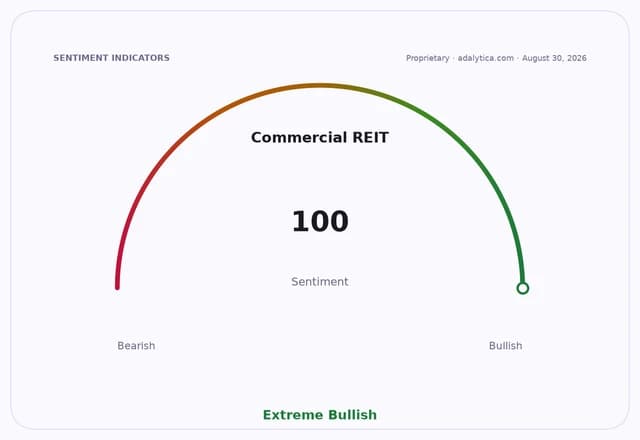
The market is also rewarding quality over quantity. Buildings with strong balance sheets, prime locations and modern amenities are better positioned to capture tenants from weaker properties, while older stock and heavily leveraged owners remain under pressure. A separate commercial REIT sentiment gauge from Adalytica shows extreme greed in the broader listed property space, suggesting investors are leaning into the idea that the worst of the office downdraft may be behind them.
For investors, the next catalyst is whether leasing momentum can hold through the fall and whether higher-for-longer yields keep compressing valuations. If demand remains steady and construction stays muted, the office sector’s recovery could be less a comeback story than a long, uneven re-pricing.
| Entity | Gains | Losses |
|---|---|---|
| BXP | ▲tighter office supply | ▼slower rent recovery |
| VNO | ▲stabilized leasing market | ▼higher refinancing costs |
| SLG | ▲rebound in prime Manhattan demand | ▼weaker secondary office assets |
| Tenants | ▲more negotiating power | ▼fewer cheap new buildings |