Pacific Security Shift Raises Defense Spending

New Zealand shouldn’t let any objection from China slow its move toward a tighter Pacific defense alliance, because the real economic risk for investors is not diplomacy alone but a more fragmented Indo-Pacific that forces countries to spend more on security, diversify trade and harden supply chains.
That is the big story behind a wave of new security agreements across the region, including New Zealand and India’s 18 pact bundle covering defense and maritime cooperation. The message is that smaller economies are no longer treating the Pacific as a low-stakes neighborhood. They are acting as if the region is becoming a strategic front line, and that shift has consequences well beyond the military balance.
For investors, that matters because geopolitics increasingly shapes everything from commodity flows to currency stability to capital allocation. A more organized Pacific security architecture can help deter coercion, but it also raises the odds of a world where firms must price in higher defense budgets, more resilient logistics and a lower tolerance for concentration risk in China-linked supply chains. In plain English: the premium for certainty is rising, and that can support spending in defense, cyber, shipping, critical infrastructure and domestic manufacturing.
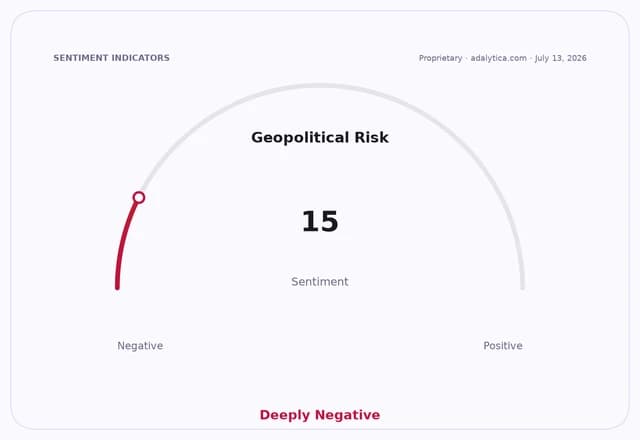
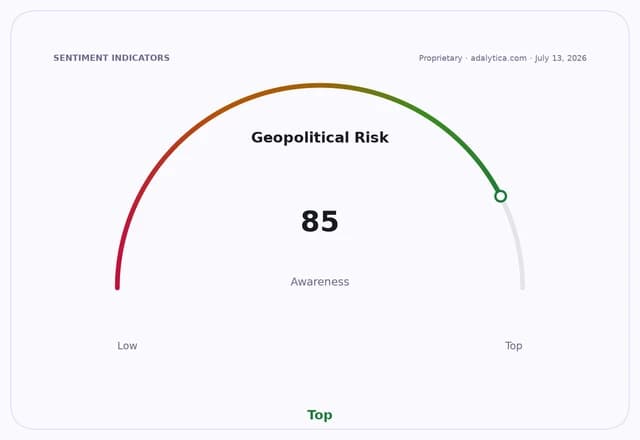
The market backdrop underscores how elevated the tension has become. Adalytica’s Global Stability Sentiment gauge is deep in “Extreme Fear,” while its China policy direction measure sits near neutral after a sharp drop over the past month, suggesting investors and policymakers are still struggling to handicap Beijing’s next move. At the same time, the U.S. 10-year Treasury yield has climbed back to around 4.58%, a reminder that governments are already paying more to borrow just as they contemplate higher outlays on security and resilience.
That combination is important. Higher long-term yields can make public spending more expensive, but they also reinforce the case for companies with durable cash generation, pricing power and exposure to long-duration strategic themes rather than cyclical trade. Defense contractors, infrastructure suppliers and technology companies with secure government relationships tend to benefit when countries decide that resilience is worth the cost.
The latest price action in the broader market tells a similar story about where capital is looking. Apple has stayed strong, but Alibaba has remained under pressure, reflecting the market’s preference for businesses less exposed to policy risk from China and the kind of geopolitical uncertainty now hanging over the Indo-Pacific. The New Zealand dollar, meanwhile, has been relatively steady around 0.58 against the U.S. dollar, showing that markets are not panicking — but they are clearly not ignoring the shift either.
None of this means China’s views are irrelevant. They are very relevant. But New Zealand’s strategic calculus is changing because the cost of doing nothing may be higher than the cost of drawing Beijing’s displeasure. As Pacific governments deepen security ties, they are effectively buying insurance against a more volatile region.
For long-term investors, that is the real takeaway. The world is moving toward more alliances, more defense spending and more redundancy in critical systems. That is not a reason to chase headlines. It is a reason to favor businesses and funds that can compound through geopolitical noise — and to keep Pacific security, not just Pacific trade, on the watchlist.
| Entity | Gains | Losses |
|---|---|---|
| New Zealand and Pacific partners | ▲Stronger deterrence | ▼More pressure from China |
| Defense and security contractors | ▲Higher spending | ▼Peace dividend |
| Importers dependent on China | ▲More supply-chain resilience | ▼Higher logistics costs |
| China | ▲Regional leverage challenged | ▼Influence over smaller states |