Poland growth outlook lifts EPOL and zloty
Poland is on track to be the European Union’s growth leader again this year, but the real story for investors is how much of that advantage depends on energy prices, German fiscal stimulus and the AI investment boom not going into reverse.
EY now expects Poland’s economy to expand by 3.9% in 2026, roughly three times faster than the euro zone’s 1.2% and above last year’s pace, even as the region absorbs global trade tensions, weaker Chinese demand and still-fragile confidence. That makes Poland one of the clearest secular growth trades in Europe, especially compared with slower-moving core markets where momentum is more dependent on rate cuts than real demand.

The significance goes beyond one-year GDP forecasts. Poland’s growth is still broad-based, supported by consumption, investment, public spending and exports, while the euro zone’s resilience has so far rested on trade resistance, AI-related capital expenditure and Germany’s fiscal expansion. EY says that German infrastructure spending could add as much as 0.8% to Poland’s GDP by 2029, underscoring how closely the Polish cycle is tied to industrial and supply-chain spillovers from its largest trading partner.
That is why the upside looks attractive, but not unbreakable. EY’s economists say the risk balance is “strongly asymmetric,” with the more likely outcome being worse than their base case. A prolonged disruption in the Strait of Hormuz or a renewed jump in oil prices would feed straight into inflation, delay policy easing and squeeze consumer demand across Europe. In a severe scenario, euro zone inflation could reaccelerate sharply, while Poland’s own inflation could climb back above 4.5% in 2027 and even force the central bank to consider rate hikes rather than cuts.

For investors, that creates a split-screen opportunity. Poland still offers the region’s most compelling growth profile, and the zloty and Polish equities have the makings of a catch-up trade if energy markets stay contained and Germany’s stimulus starts to bite. The EPOL ETF has already moved higher, with its conventional technical indicators showing the fund back above its 50-day and 200-day moving averages and RSI near 60, a sign momentum is improving rather than overheating. That matters because markets often price the macro story only after the earnings and capital-flow benefits become visible.
The longer-term question is whether Poland can keep compounding once the current tailwinds fade. EY sees growth slowing to 2.7% in 2027 and around 2.5% in 2028-2029 as investment cools and demographic headwinds intensify, with more than 380,000 people expected to leave the working-age population over that period. That is why the next phase of the story is not just cyclically bullish Poland, but whether automation, robotics and artificial intelligence can extend the country’s edge.
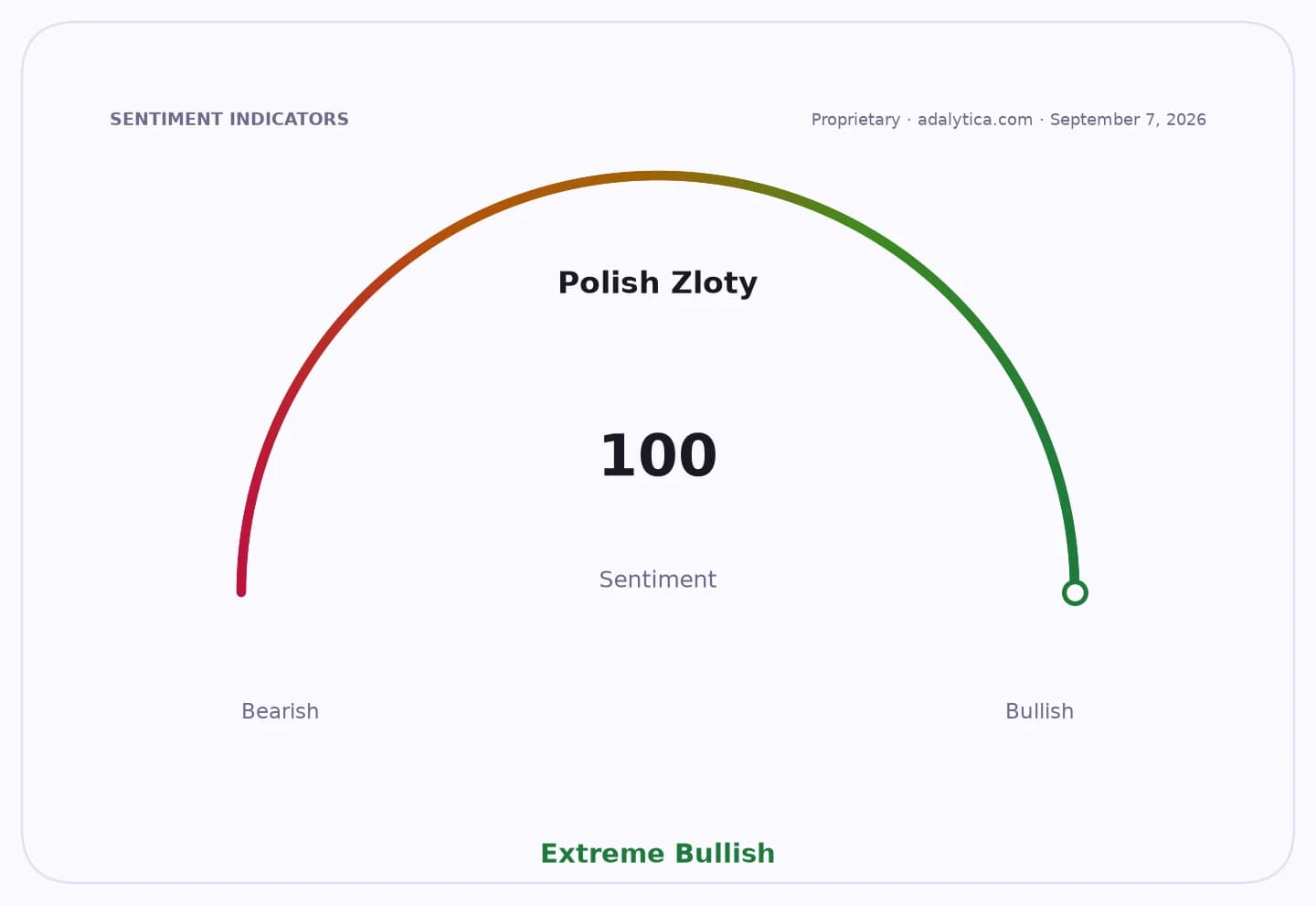
EY estimates AI has already lifted Polish GDP by about 1%, mostly through external demand, and could add another 0.5% to productivity by 2029. On Adalytica’s trade snapshot, the zloty is showing “Extreme Greed,” while the euro also sits in greed territory, a reminder that investors are beginning to lean into the Europe recovery trade. My view is that the market still underestimates how much Polish assets can benefit if the energy shock never fully returns and German capex turns into real orders.
The investment case is straightforward: stay constructive on Poland, but own it through beneficiaries of trade, infrastructure, automation and domestic demand rather than assuming the macro window stays open forever.
| Entity | Gains | Losses |
|---|---|---|
| Poland / Polish equities | ▲Faster GDP growth, capital inflows | ▼Energy shock, demography |
| EPOL ETF | ▲Catch-up momentum, EU growth exposure | ▼Rate-hike risk, inflation rebound |
| German infrastructure spend | ▲Polish exporters, contractors | ▼Fiscal restraint skeptics |
| Energy importers in Europe | ▲Stable oil prices | ▼Oil producers if demand weakens |