Realty Income Dividend Growth and Oversold Stock

Realty Income is doing what income investors want most from a REIT: keep paying, keep growing, and keep proving that the monthly check can compound for years.
That matters because dividend reliability is the whole investment case for a name like Realty Income, whose 5.2% yield is attractive only if the payout keeps rising faster than inflation and investor expectations. After 31 straight years of dividend hikes, the company remains one of the clearest examples of how boring can be beautiful when the business model is built around long leases, recurring rent and disciplined capital allocation.
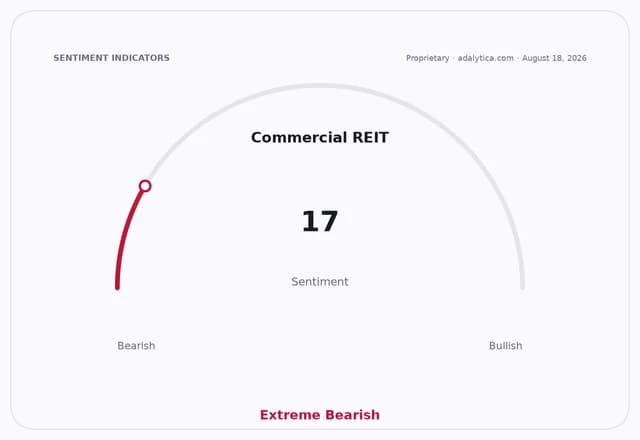
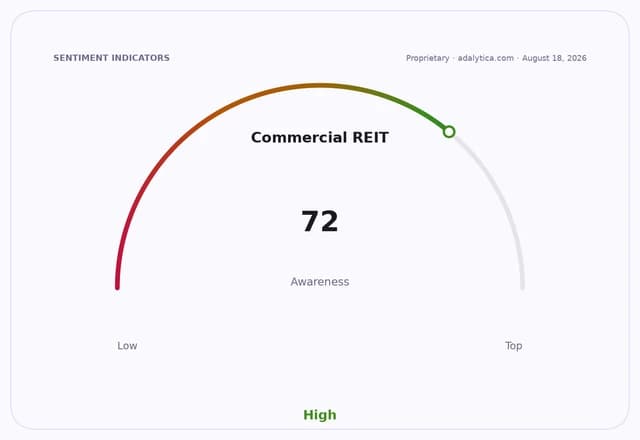
The broader REIT backdrop helps explain why the market keeps rewarding the best operators while punishing weaker ones. Commercial REIT sentiment in Adalytica’s gauge has dropped to 17, or Fear, even as awareness remains high, showing that investors are still paying attention to the sector but are far from enthusiastic. That’s not surprising with Treasury sentiment also stuck in Fear and long-duration assets still sensitive to rate expectations. For income stocks, the cost of capital matters as much as the dividend yield itself.
Realty Income’s appeal is that it has historically managed to grow through those cycles rather than merely survive them. A monthly payer with a multidecade streak of raises suggests a portfolio that can absorb higher borrowing costs, tenant turnover and macro noise better than the average REIT. Investors should care because a dependable dividend stream can be a powerful total-return engine over five, 10 or even 20 years, especially when payouts are reinvested.
The stock has also held up better than many commercial property names this year, though the recent technical picture has softened. Realty Income closed at $62.34, just below its 50-day moving average of $62.80 and above its 200-day average of $60.32, while its RSI reading near 22.6 points to deeply oversold conditions. That doesn’t tell you where the stock goes tomorrow, but it does suggest the market has gotten cautious after a strong run and is now demanding evidence that the dividend growth story can keep pace.
That evidence still comes down to the same long-term questions that matter for every REIT investor: can management keep funding acquisitions at attractive yields, protect occupancy and maintain access to cheap enough capital to support the payout? Realty Income’s recent filings point to continued activity on the acquisition and development front, which is exactly the kind of incremental growth that can sustain the dividend machine.
For long-term investors, the real story is simple. If you want current income plus the chance for that income to rise over time, Realty Income remains worth watching. In a market that is still anxious about rates and real estate valuations, a durable monthly dividend with a 31-year growth record is the kind of compounding engine that deserves a place on the buy-and-hold list.
| Entity | Gains | Losses |
|---|---|---|
| Realty Income shareholders | ▲Monthly income growth | ▼Short-term price swings |
| Income investors | ▲Rising cash flow | ▼Safety-seeking cash holders |
| REIT buyers | ▲Higher starting yields | ▼Growth-stock chasers |
| Borrowers and rate-sensitive REITs | ▲Lower valuation pressure if rates ease | ▼Higher financing costs if rates stay elevated |