Realty Income O at $63.48 after 673 monthly dividends

Realty Income’s 673 straight monthly dividends matter less as a streak than as a signal that the company can still fund a high-frequency payout model in a market where income investors are being pulled between rich stock valuations and elevated bond yields.
For shareholders, the key question is not whether the “Monthly Dividend Company” has kept its promise — it has — but whether the cash flow behind that promise remains durable enough to justify holding a mature net lease REIT when Treasury yields and broad equity appetite are both competing for capital.

Realty Income, which trades under the ticker O, was changing hands at $63.48 on Aug. 3, up from $55.71 at the end of August and near its recent highs. The shares sit above both the 50-day moving average of $62.35 and the 200-day moving average of $60.03, a sign that the market still assigns value to its income stream even after a strong run. RSI readings around 50 and a MACD that remains positive but has cooled suggest the stock is no longer stretched, but it is also not priced for distress.
That matters because Realty Income’s appeal is built on consistency, not explosive growth. A 673-month streak means nearly 56 years of uninterrupted monthly distributions, spanning recessions, rate shocks, and multiple property cycles. In a sector where leverage, tenant quality and refinancing costs can quickly change the dividend outlook, a record like that functions as a credibility premium. It tends to attract pension funds, retirees and other yield buyers looking for cash flow they can model with less uncertainty than in more cyclical property types.
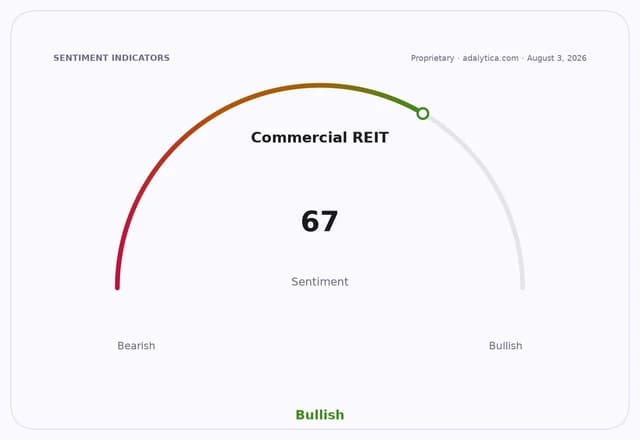
The broader backdrop also helps explain the market’s continued support. Real estate investment trusts have been buoyed by a rebound in property sentiment, with the VNQ ETF near 99.07, well above its 200-day average of 91.81. Adalytica’s commercial REIT sentiment reading is neutral at 67, but the recent jump in awareness and the strong 30-day improvement point to renewed investor focus on the sector. At the same time, Treasury-bond sentiment remains strong, underscoring the competitive pressure on REITs to keep payouts attractive in a higher-for-longer rate environment.
For Realty Income, that is both an opportunity and a risk. The bull case is straightforward: a long dividend history, investment-grade-style investor appeal, and a model centered on recurring rental income can keep capital flowing even when growth is modest. The bear case is that a long streak can become a burden if borrowing costs stay elevated, acquisition spreads narrow or tenant stress rises, leaving less room for dividend growth.
The stock’s recent firmness suggests investors still believe the company can navigate that balance. But the next test for income investors is not the fact of the monthly payout; it is whether Realty Income can keep raising enough cash flow to defend the streak without stretching the balance sheet or sacrificing future growth. As long as that remains intact, the dividend history will continue to matter — not as nostalgia, but as a valuation anchor in a market that still pays for certainty.
| Entity | Gains | Losses |
|---|---|---|
| Realty Income | ▲Income-investor loyalty | ▼Less room for payout mistakes |
| Income investors | ▲Predictable monthly cash flow | ▼Lower upside than growth stocks |
| REIT sector | ▲Renewed capital inflows | ▼Rate-sensitive valuation pressure |
| Treasury bonds | ▲Competitive yield appeal | ▼Relevance if REIT yields widen |