Realty Income Falls as Rates Pressure REITs
Realty Income’s appeal as a monthly income stock has been steady even as the shares have been hit by a broader selloff in dividend-sensitive REITs, with the market now forcing investors to weigh payout reliability against higher-for-longer interest rates and weaker sector sentiment.
That matters because Realty Income’s business model is built around predictable cash distributions, but the value of those distributions rises and falls with bond yields. When Treasury-backed income becomes more competitive, REITs usually lose some of their relative advantage, and that is showing up in price action across the group. Realty Income’s shares closed at $59.27 on Sept. 14, down from $63.46 in early July, while the 50-day average at $62.64 sits above the stock and the 200-day average at $60.68, a technical backdrop that suggests momentum has rolled over. The relative strength index at 13 points is deeply oversold, but oversold does not automatically mean cheap if rates remain elevated.
For income investors, the math still centers on the scale of the payout, not just the share price. At roughly $59.27 a share, a $2,000-a-month income target would require a large position in a REIT such as Realty Income, which is precisely why monthly dividend names tend to attract retirees and other cash-flow buyers. The bull case is straightforward: monthly distributions, a long dividend record and a portfolio tied to necessity-based tenants can make the stock a durable income vehicle. The bear case is just as clear: even well-run REITs are capital-intensive, and their valuations can compress when investors can get better risk-adjusted income from bonds.
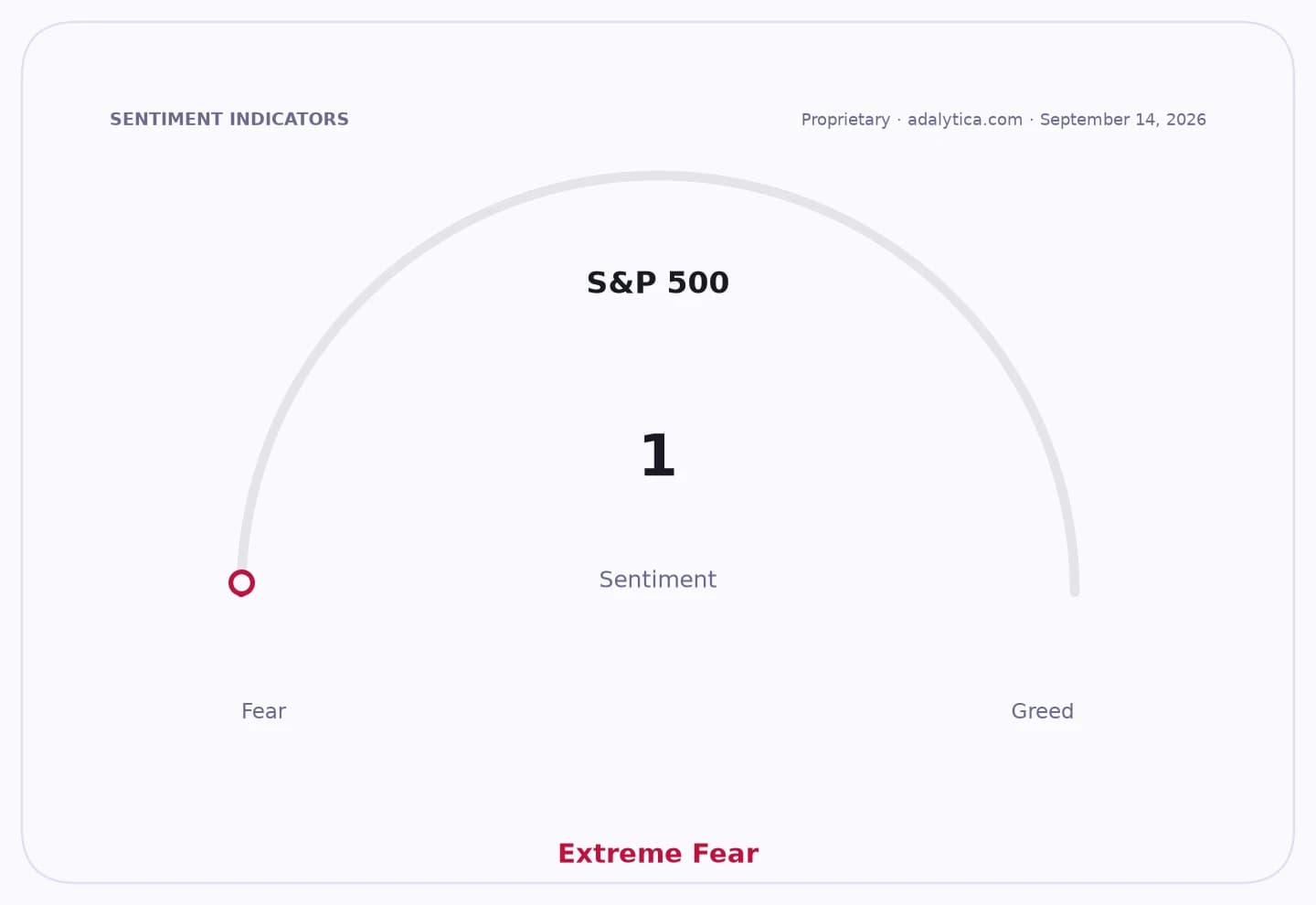
The pressure on Realty Income also fits a wider REIT rotation. Peer Federal Realty Investment Trust has dropped to $114.53 from $127.13 in late July, while the broader market mood is defensive, with Adalytica’s S&P 500 trade signals showing “Extreme Fear.” That kind of backdrop tends to favor cash and short-duration income over equity income, especially for sectors where borrowing costs and cap rates matter. A separate signal in U.S. Treasury bonds shows sentiment holding near neutral even as recent moves have underscored how quickly rate expectations can swing demand away from REITs.
That leaves Realty Income in a familiar but difficult position: still one of the market’s most recognizable monthly dividend names, but increasingly priced not just on its payout, rather on whether investors believe the income stream is rich enough to compete with fixed income. If Treasury yields stabilize or fall, the stock could recover quickly. If they stay firm, monthly income investors may keep collecting dividends while the shares remain under pressure.
| Entity | Gains | Losses |
|---|---|---|
| Monthly dividend investors | ▲Regular cash flow | ▼Near-term share-price upside |
| Treasury bond buyers | ▲Relative yield appeal | ▼Demand if yields fall |
| Realty Income (O) | ▲Patient income seekers | ▼Rate-sensitive valuation |
| REIT peers | ▲Sector focus on income | ▼Capital inflow in a high-rate backdrop |