Republicans Tie Debt Limit to Spending Cuts
Republican lawmakers are advancing proposals that would raise the federal debt limit only if paired with spending cuts, sharpening a fiscal fight just as the U.S. heads toward a borrowing threshold near $40 trillion and markets remain focused on the government’s long-term creditworthiness.
The economic significance goes beyond Capitol Hill theater. The debt ceiling itself does not reduce deficits, but the way Congress handles it can determine whether the Treasury can keep financing the government on time and at what cost. With the federal funds rate still around 3.63% and the 10-year Treasury yield near 4.65%, the U.S. is already paying materially more to service debt than in the low-rate era. Every increase in borrowing costs compounds the pressure from a larger debt stock, making a debt-ceiling standoff more consequential for fiscal planning, auction demand and investor confidence.

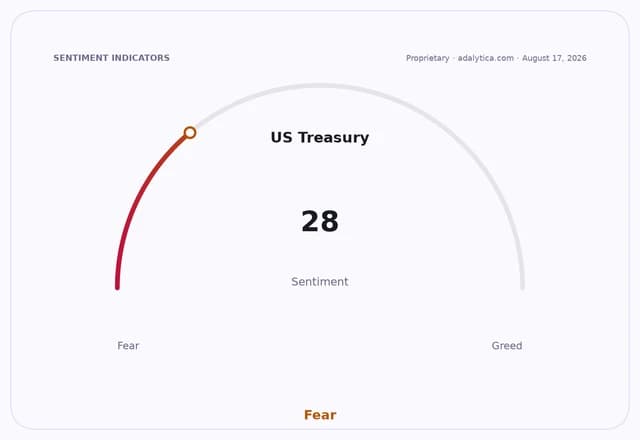
For bond markets, the immediate risk is not default in a baseline sense but policy-induced volatility. Treasury bills closest to the projected “X-date” can cheapen sharply if investors demand a higher risk premium, while longer-dated notes can swing on expectations for funding, growth and future issuance. That dynamic is already visible in broader market positioning: Adalytica’s U.S. Treasury Bonds Trade Signals show sentiment in fear territory even as awareness remains elevated, suggesting investors are watching fiscal risk more closely than usual. The 10-year yield has also risen from deeply depressed pandemic levels, reinforcing the market’s sensitivity to any signal that Washington may prolong funding uncertainty.
Equities are less directly exposed, but they are not immune. The S&P 500 has been trading near record highs, with SPY still well above its 200-day moving average, yet the index’s technical momentum can be vulnerable if Washington turns fiscal policy into a higher-for-longer uncertainty event. A prolonged debt-ceiling fight would likely favor defensive positioning, strengthen demand for cash and short-duration assets, and pressure sectors that depend on stable funding conditions and benign rate expectations.
The political logic is clear: tying a debt-limit increase to spending cuts gives Republicans leverage in budget negotiations and appeals to deficit hawks in their base. The economic trade-off is that the U.S. risks importing another self-inflicted source of uncertainty into an environment already defined by elevated rates, large Treasury issuance and still-uneven confidence in the dollar. Adalytica’s U.S. Dollar Trade Signals show extreme fear, underscoring that investors are sensitive to any erosion in Washington’s fiscal credibility, even if the currency remains broadly supported by the scale of U.S. markets.
Bullish arguments for the proposal rest on the idea that forcing fiscal restraint could slow debt accumulation over time and reassure creditors that Washington is serious about deficits. The bearish case is more immediate: linking routine borrowing authority to spending fights raises the odds of market disruption, higher bill yields, and a weaker Treasury term premium, while doing little to address the structural mismatch between revenues, entitlement spending and interest costs.
What investors will watch next is whether the bills become a negotiating tool or a genuine path to a bipartisan deal. If Congress uses the ceiling as leverage for cuts, the near-term market cost could rise before any fiscal benefit appears. If it fails to agree in time, the damage would show up first in Treasury funding markets, then in risk assets, and finally in the broader cost of capital for the economy.
| Entity | Gains | Losses |
|---|---|---|
| GOP fiscal hawks | ▲leverage in budget talks | ▼blame if markets wobble |
| Treasury bill investors | ▲potential higher yields | ▼x-date volatility |
| S&P 500 longs | ▲status quo if deal passes | ▼risk-off selling |
| U.S. dollar bears | ▲none | ▼fiscal risk narrative intensifies |