Russia Nods to Diplomacy, Easing Risk Premium
Russia’s assertion that it will not attack NATO countries is a reminder that, for all the noise around Europe’s security backdrop, the most dangerous outcomes are still being priced as tail risks rather than base cases.
That matters because markets do not need peace to rally — they need the odds of a wider war to stay low enough for companies, consumers and governments to keep planning, spending and investing. A lower probability of direct Russia-NATO conflict reduces one of the biggest geopolitical shocks hanging over energy supplies, defense budgets, shipping routes and the cost of capital across Europe.
The message from Moscow also comes with a second, more important implication: it says Russia remains open to dialogue “on an equal footing.” Investors should read that less as a breakthrough than as a signal that diplomacy is still part of the strategy, even if trust is thin and the war in Ukraine continues to dominate the relationship between Russia and the West.
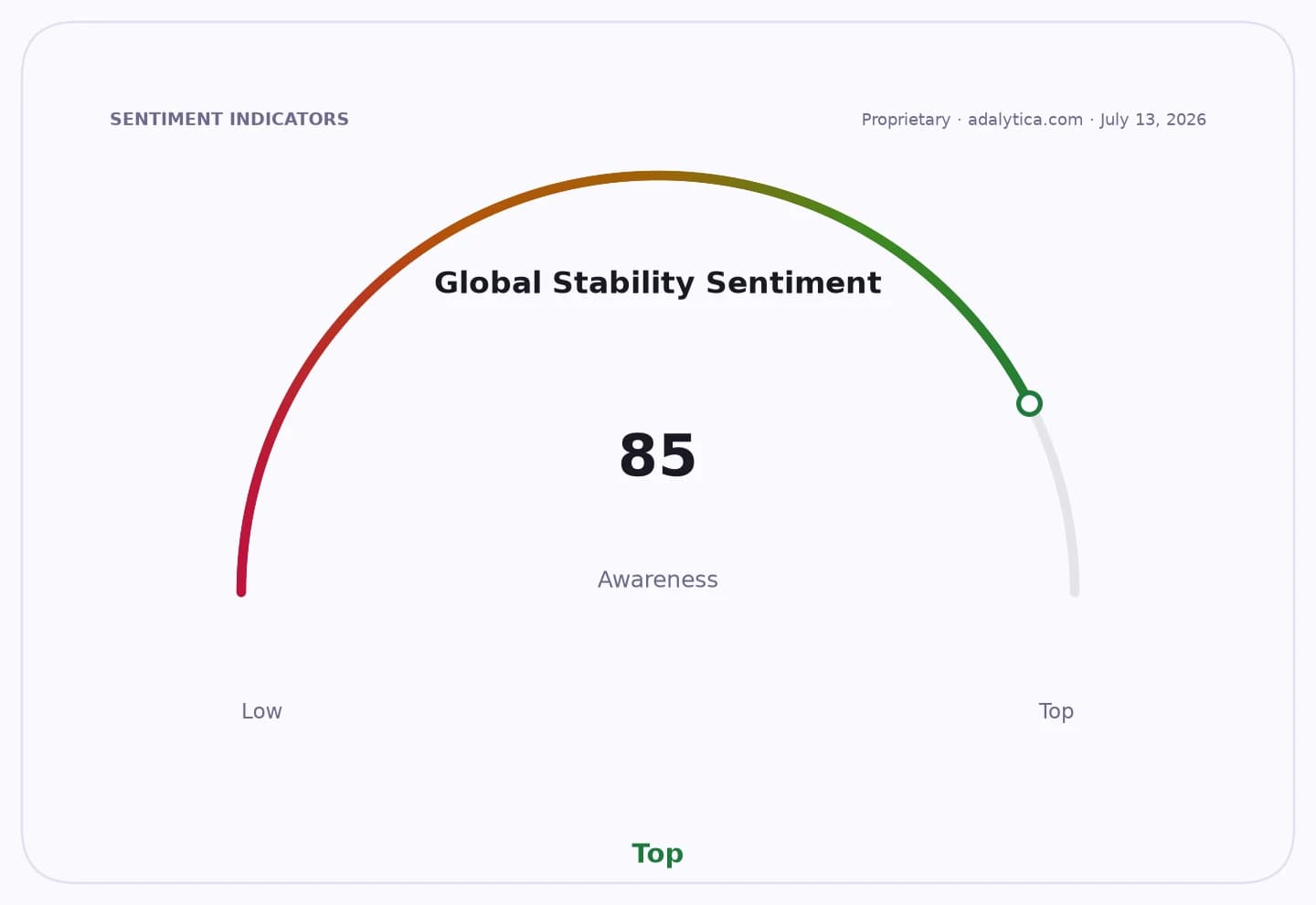
The market backdrop suggests that geopolitical fear has eased sharply, even if it has not disappeared. Adalytica’s Global Stability Sentiment sits at 15, deep in “Extreme Fear,” while awareness is elevated at 85, showing that investors are paying attention even as confidence remains fragile. That kind of setup can be constructive for risk assets if headlines stop worsening, because the absence of a new escalation can be enough to support stocks, credit and cyclicals.
You can see that caution in broad equity markets. The SPDR S&P 500 ETF Trust has climbed to 754.95 from 646.90 in March, a reminder that investors have been willing to look through geopolitical headlines when the macro picture does not deteriorate. The iShares MSCI EAFE ETF, which tracks developed markets outside the U.S., has also recovered to 104.33 from the low 90s in March, showing that international equities are benefiting when the fear premium fades. For long-term investors, that is the key lesson: markets often move more on the probability of escalation than on the rhetoric itself.
Still, investors should not confuse diplomacy with durability. Russia and NATO remain deeply distrustful, the war in Ukraine is unresolved, and Europe’s security posture has changed for good. Defense spending, sanctions risk and energy diversification are still structural themes, not temporary headlines. Even if direct confrontation looks unlikely, the region’s long-term investment map has already been redrawn.
For investors, the practical takeaway is straightforward: headlines like this can calm markets, but they do not erase the need for diversification. If you own broad index funds, quality multinationals or defensible dividend payers, you are already positioned to benefit if geopolitical risk keeps fading. If you are concentrated in Europe, energy, defense or transport names, the next phase may be less about panic and more about watching how much risk premium the market is willing to unwind.
In other words, this is not a story that changes the world overnight. But if Russia’s message helps keep a wider war off the table, that is exactly the kind of backdrop that lets compounding do its work. Worth watching, and worth treating as a reminder to stay invested for years, not days.
| Entity | Gains | Losses |
|---|---|---|
| Global equities | ▲Lower risk premium | ▼Fear-driven volatility |
| European stocks | ▲Relief from escalation risk | ▼Safe-haven demand |
| Defense makers | ▲Stable long-term demand | ▼Less immediate panic buying |
| Energy importers | ▲Reduced supply-shock risk | ▼Geopolitical hedge demand |