Russia Khabarovsk Test Lifts Defense and Energy
Russia’s reported deployment of the Khabarovsk to test a new nuclear weapon is a stark reminder that geopolitical escalation is not an abstract headline — it is a pricing input, and investors are already paying up for it across energy and defense.
The market’s first response is likely to be higher risk premia, not a clean one-day trade. When nuclear signaling intensifies, the immediate economic consequence is a widening in the range of possible outcomes for sanctions, commodity flows and military spending. That matters because the world is already operating with elevated war-risk assumptions: Brent and WTI have been vulnerable to supply-shock swings, while defense contractors are benefiting from a longer-duration rearmament cycle as governments rebuild inventories and harden deterrence.
That backdrop helps explain why the energy trade has stayed constructive. XLE has climbed to 63.68, well above its 50-day moving average of 57.09 and its 200-day average of 53.08, with RSI readings at 73.2, a sign of strong momentum rather than a fading rally. The move is not just about crude prices; it is about investors paying for geopolitical insulation. WTI itself is trading around 84.77 a barrel, with a forecast of 87.05, reinforcing the idea that oil remains sensitive to headline risk even when broader macro data are mixed.
Defense is the other obvious beneficiary, and the market has been voting with capital. ITA closed at 252.16, above both its 50-day average of 240.31 and its 200-day average of 227.56, while XAR ended at 290.43, also comfortably above its 50-day and 200-day trends. Those moves matter because they reflect more than short-term fear: they suggest investors expect sustained procurement, higher munitions demand and a structurally larger Western defense budget envelope. The stronger the nuclear rhetoric, the harder it becomes for policymakers to argue for restraint in spending on missiles, air defense, submarines and command-and-control systems.
This is why the market underestimates the second-order beneficiaries. If nuclear tension keeps rising, the obvious winners are not only the prime contractors but also the suppliers of propulsion, sensors, electronic warfare, secure communications and missile-defense components. The same logic applies to energy infrastructure and integrated producers that can monetize supply uncertainty while maintaining capital discipline.
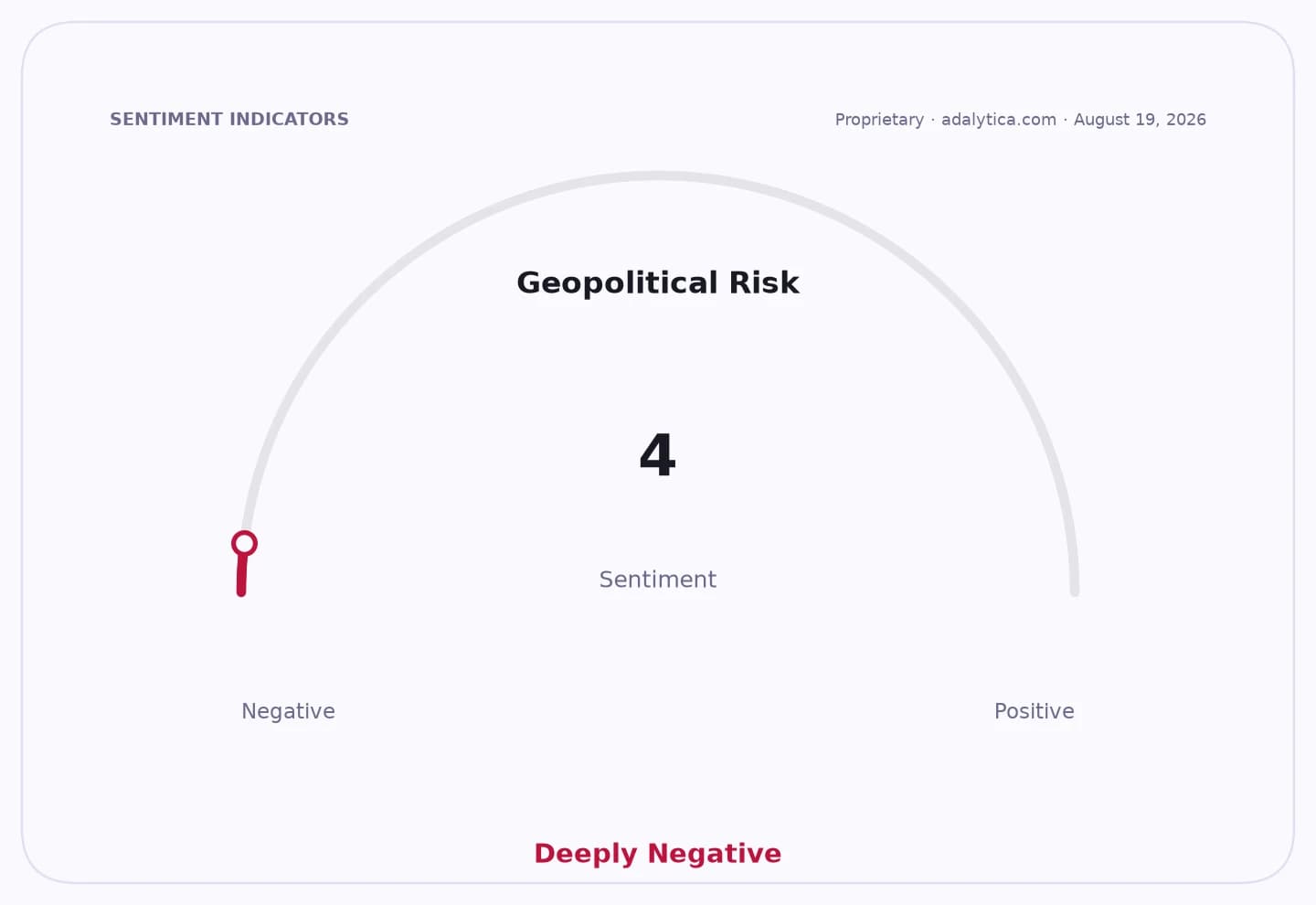
There is also a broader macro cost. Adalytica’s Global Stability Sentiment sits at 4.0, labeled Extreme Fear, showing how abruptly the geopolitical regime has shifted. That kind of fear tends to support hard assets, strengthen the case for energy exposure and keep defense multiples elevated longer than bearish investors expect. It also complicates central-bank work by keeping commodity inflation risk alive even as growth remains uneven.
My view: this is an inflection point for positioning, not a time to fade the move. The market is still too quick to treat nuclear escalation as a headline event instead of a capital-allocation event. If Russia is testing a new nuclear weapon, investors should be thinking about which balance sheets benefit from a permanently higher threat level. I believe that means staying overweight defense ETFs such as ITA and XAR, while keeping energy exposure through XLE and the large-cap producers that can turn volatility into free cash flow. In a world where deterrence is becoming more expensive, the companies selling the tools of deterrence remain the asymmetric trade.
| Entity | Gains | Losses |
|---|---|---|
| Defense contractors | ▲Higher procurement demand | ▼Budget restraint hopes |
| Energy producers | ▲Geopolitical oil premium | ▼Supply shock uncertainty |
| ITA/XAR holders | ▲Momentum and inflows | ▼Fading fear trade |
| Importers/consumers | ▲— | ▼Higher fuel and hedge costs |