Samsung Electronics falls on chip sector selloff

South Korea’s market selloff is being led by semiconductors, with Samsung Electronics slipping 2.2% as investors trimmed exposure to a sector still sensitive to trade friction, supply-chain risk and swings in the global AI hardware cycle.
The decline matters because Samsung is not just the country’s largest listed company by scale and influence; it is a proxy for South Korea’s export engine and for global chip demand more broadly. When Samsung weakens, it can pull on the Kospi, weigh on sentiment around Korea’s current-account surplus and remind investors how concentrated the market remains in memory chips, AI components and China-linked demand.

The move comes even as global chip shares have been volatile rather than outright broken. The VanEck Semiconductor ETF has retreated to 531.39 from a 2026 high above 655, while Nvidia, the bellwether for AI spending, closed most recently at 219.74 after trading as high as 225.16 this week. That combination suggests investors are still willing to own the AI theme, but are becoming more selective about valuation and near-term earnings durability.
Samsung’s chart has also lost momentum. The stock closed at 249,500 won on Wednesday, down sharply from 358,105 won in late June and below its 50-day moving average of 283,336.65 won. The pullback has pushed the stock well under its recent upper Bollinger Band and left it in a weaker technical position after a powerful rally earlier in the year. The 14-day RSI at 61.8 is not yet deeply oversold, implying room for further consolidation if macro or geopolitical pressure persists.
For investors, the key question is whether this is a pause in an AI-driven rerating or the start of a broader de-risking in Asian chip equities. The bull case remains that Samsung’s memory business and exposure to advanced AI infrastructure should benefit as global capital spending stays elevated. The bear case is that chip demand is still highly cyclical, geopolitical shocks can quickly affect multiples, and a stronger US dollar or tighter risk appetite can hit exporters and semis at the same time.
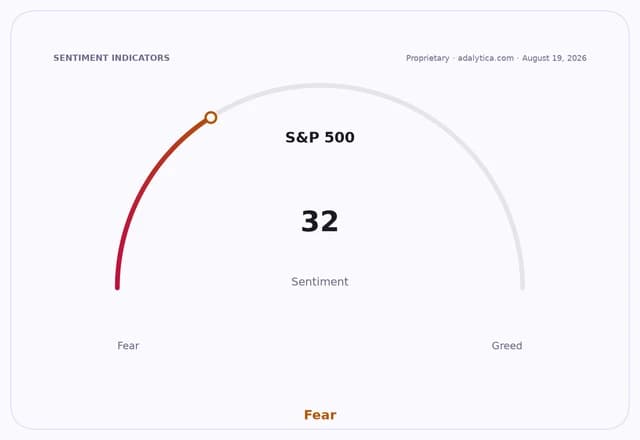
Adalytica’s S&P 500 trade signals still show neutral sentiment, but the US dollar snapshot points to extreme fear in currency trading, underscoring how quickly macro conditions can tighten around the semiconductor trade. In that environment, Korea’s chip-heavy market is likely to remain one of the most sensitive gauges of global risk appetite.
The next catalyst will be whether investors treat this as a temporary rotation or a warning that the sector’s second-half earnings expectations are too optimistic. For Samsung, the burden is to prove that AI-related demand can offset the cyclical parts of memory and that geopolitical headlines are not enough to derail the investment case.
| Entity | Gains | Losses |
|---|---|---|
| Samsung Electronics | ▲long-term AI demand story | ▼near-term valuation and momentum |
| Korean exporters | ▲weaker won support | ▼foreign-capital outflows |
| Nvidia and AI peers | ▲relative leadership if rotation is selective | ▼broader chip de-rating |
| Chip buyers | ▲lower input costs | ▼tighter supply confidence |