SEATO Lesson for Defense Stocks and Geopolitical Risk
The most important lesson from SEATO’s creation in Manila on Sept. 8, 1954 is that security alliances are never just about war — they are about capital, trade routes and the price investors pay when geopolitical risk rises.
Born out of Washington’s effort to contain communist expansion in Southeast Asia, the Southeast Asia Treaty Organization was a Cold War attempt to turn U.S. power into a regional shield. Eight signatories — the U.S., France, Britain, Australia, New Zealand, the Philippines, Pakistan and Thailand — pledged to “act to meet the common danger,” while a separate protocol extended protection to Laos, Cambodia and South Vietnam. But unlike NATO, SEATO stopped short of a true mutual-defense guarantee, leaving the pact dependent on consultation rather than automatic military response.
That weakness is exactly why the alliance mattered economically. SEATO was designed to reduce the odds of a wider regional war in a zone that sat near key sea lanes, export hubs and strategic chokepoints. Even when alliances are imperfect, they can still influence where money flows, how militaries spend and which countries become favored suppliers of ships, aircraft, munitions and logistics. Investors should read SEATO not as a failed relic, but as an early template for the modern defense trade: vague commitments may be enough to justify recurring procurement without eliminating risk.
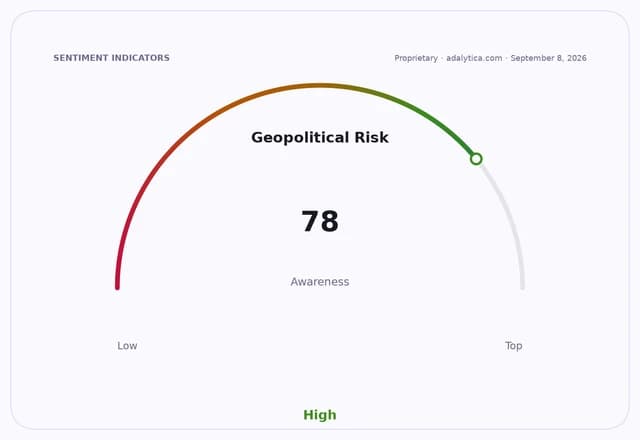
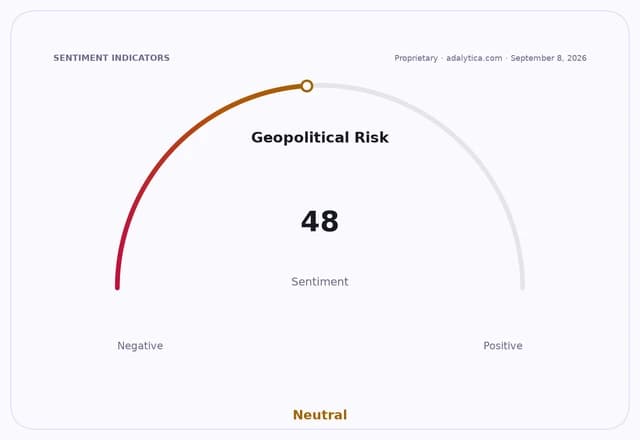
The relevance today is hard to miss. Global Stability Sentiment on Adalytica.com sits at 48, neutral, while awareness is elevated at 78, suggesting markets are paying attention even if they are not fully pricing a crisis. At the same time, the S&P 500 trade-signal snapshot shows “Extreme Fear,” and SPY closed at 770.19 on Sept. 4, above its 50-day moving average of 756.86 and 200-day moving average of 709.87. That combination says investors are wary of geopolitical spillovers even as the broad market remains technically firm.
The bigger narrative is that alliance politics are back as an investable theme. NATO’s warning to Moscow against attacking member states shows how collective-defense rhetoric is being sharpened again, while the SEATO example reminds us that markets reward credible deterrence, not just diplomatic language. The more persistent the threat environment, the more governments are pushed toward higher defense outlays, stockpiling, cyber capabilities and resilient supply chains — all of which support long-duration themes in defense primes, aerospace, industrial metals and infrastructure security.
For investors, the opportunity is not in betting on peace; it is in owning the businesses that get paid when peace looks fragile. Defense contractors, missile and radar suppliers, shipbuilders, military electronics names and ETF baskets tied to aerospace and defense can all benefit as governments respond to a more dangerous world with larger budgets. The market often underestimates how quickly “temporary” security concerns become structural spending.
SEATO itself ended in 1977, but the investment logic it revealed never went away: in geopolitics, weak alliances can still drive strong demand for weapons, logistics and strategic assets. I believe the best positioning now is to stay overweight the defense and security supply chain before the next escalation forces the market to catch up.
| Entity | Gains | Losses |
|---|---|---|
| Defense contractors | ▲Higher procurement demand | ▼Cyclical skepticism |
| Governments in allied blocs | ▲Stronger deterrence | ▼Budget flexibility |
| Security ETFs | ▲Inflow from risk-off buying | ▼Broad index cyclicals |
| Adversarial powers | ▲— | ▼More containment pressure |