Small Caps and Multi-Cap Funds for the Next Cycle

The last decade taught investors to love mega-cap winners, but the next one may belong to a far more balanced mix of large, mid and small companies.
That’s the real message behind the renewed interest in small-cap strategies and multi-cap funds like The Wealth Company’s new offering, which gives investors exposure across the market with a minimum SIP of just ₹250. The pitch is simple but important: the market leader of 2010 to 2025 may not be the market leader of 2026 to 2035, and investors who stay fixed on the last cycle risk missing the next one.

For long-term investors, that matters because market leadership does not stay in one place forever. Small caps have lagged badly in the recent era, and that has made them look like a structurally weak asset class to many people. But history says that is too narrow a view. Over longer stretches, smaller companies have often delivered strong returns when growth broadened beyond the biggest names and when investors were willing to own businesses earlier in their compounding journeys.
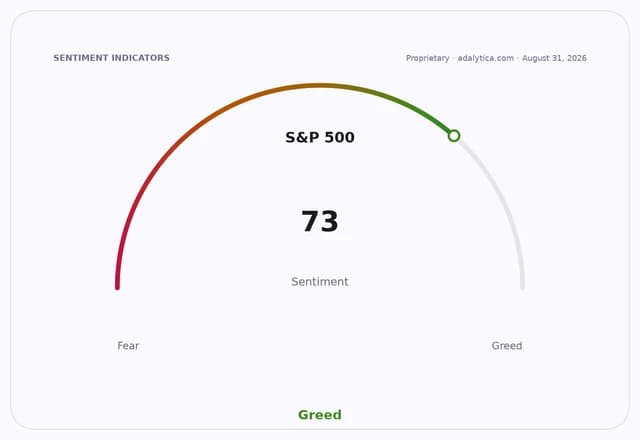
The current setup also hints at why diversification is more than a buzzword. The S&P 500, tracked in the Adalytica.com trade signals snapshot, still shows greed at 73 even as awareness sits in extreme fear territory at 12, a combination that often reflects a market where sentiment and participation are not fully aligned. Meanwhile, the U.S. dollar signals are neutral, leaving open the possibility that capital flows could shift again as investors reassess where growth is coming from. In that kind of environment, broad exposure can be more useful than trying to guess which slice of the market will dominate next.
The ETF data tells the same story. The Russell 2000 ETF, IWM, has recovered sharply from its late-2025 lows, but it is still trading well below the levels reached in its strongest stretches, with momentum indicators such as RSI easing back from overbought territory. That suggests small caps are not in a straight-line breakout, but they are also not being ignored. They are in the kind of volatile transition that often precedes a longer rotation.
That is why investors should think in decades, not quarters. Small-cap stocks can be more economically sensitive, more volatile and more dependent on financing conditions than large caps. But they also offer something the biggest companies often cannot: a longer runway for revenue growth, margin expansion and market share gains. If the next 10 years favor a broader set of industries, regions and business models, then a diversified approach could outshine the narrow winners of the last cycle.
The smartest takeaway is not to abandon large caps, but to stop assuming recent underperformance defines the future. Investors building wealth over 3 to 10 years and beyond should look at multi-cap funds, broad ETFs and diversified portfolios as a way to participate in whatever comes next. For patient investors, that makes small caps and diversified market exposure worth watching, and in many cases worth buying on weakness.
| Entity | Gains | Losses |
|---|---|---|
| Multi-cap funds | ▲Broader diversification | ▼Single-style concentration |
| Small-cap stocks | ▲Rotation and re-rating potential | ▼Recent underperformance narrative |
| Large-cap leaders | ▲Stability and cash flow | ▼Relative dominance if breadth improves |
| Long-term investors | ▲Exposure to the next cycle | ▼Chasing last decade’s winners |