Smithsonian Faces Federal Funding Threat

The Trump administration has threatened to curtail federal backing for the Smithsonian Institution, escalating a political clash that could affect one of the U.S. government’s most visible cultural and research assets.
In a letter to the Smithsonian board, Interior Secretary Doug Burgum and White House domestic policy chief Vince Haley said federal agencies “cannot continue, in good conscience,” to support the institution under its current leadership, including by lending artifacts for exhibitions, helping with procurement or awarding discretionary grants. The move turns a long-running ideological dispute over how American history is presented into a funding and governance issue with direct implications for museums, research and public education.
The Smithsonian operates 21 museums and galleries and the National Zoo, making it one of the largest public-facing cultural systems in the country. Any reduction in federal support would not only tighten budgets at the institution itself but could also complicate loan programs, acquisitions and research partnerships across the broader cultural sector. For a system that depends on federal relationships for access to objects, grants and administrative support, even the threat of retaliation can create operational uncertainty.
Trump has repeatedly criticized the Smithsonian for what he sees as an excessive focus on slavery and other darker chapters of U.S. history, while historians and civil-rights advocates say the administration is trying to roll back hard-won progress in how those subjects are taught and interpreted. The White House has also ordered signs to be installed outside the Smithsonian’s National Museum of American History to reflect its criticisms, and launched a review of several museums last year.
The latest letter goes further by alleging that the Smithsonian may have violated U.S. anti-discrimination laws through diversity-related practices, echoing Trump’s wider campaign against diversity, equity and inclusion initiatives in both the federal government and private sector. That broad push has already reshaped hiring, procurement and compliance decisions in multiple industries, and the Smithsonian dispute suggests the administration is willing to use funding leverage to extend that agenda into public institutions.
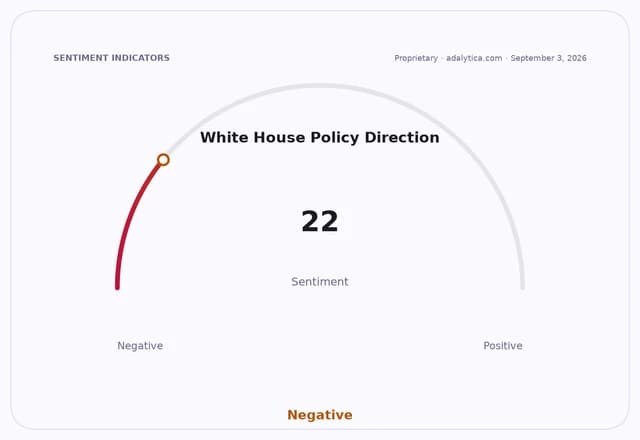
For investors, the immediate read-through is not a direct earnings impact on listed companies, but a reminder that federal spending is increasingly being used as a political instrument. Cultural institutions, contractors, grant recipients and service providers tied to government-supported organizations face higher policy risk when access to funding becomes contingent on ideological compliance. The threat also fits a broader market backdrop of heightened policy uncertainty, with Adalytica’s U.S. White House Policy Direction Sentiment gauge showing “Fear” and its S&P 500 trade signals flashing “Extreme Fear.”
The Smithsonian has not yet commented on the new letter. Its response, and whether the administration follows through with actual cuts rather than rhetoric, will determine how far the confrontation moves from culture-war theatre into budgetary damage. The larger question for investors and policymakers is whether the White House is setting a precedent for using federal support to pressure institutions over historical interpretation and diversity policy.
| Entity | Gains | Losses |
|---|---|---|
| Trump White House | ▲Political leverage | ▼Institutional trust |
| Smithsonian | ▲Public attention | ▼Federal support risk |
| Conservative critics of DEI | ▲Policy momentum | ▼Cultural influence |
| Museums and grant recipients | ▲None | ▼Funding certainty |