The dollar’s drop after softer June producer prices looks like a clean relief rally, but the bigger message for investors is that the disinflation narrative is only as strong as the next few inflation prints — and the market is starting to price in a future where it may not hold.
Soft PPI Keeps Dollar Weakness in Focus

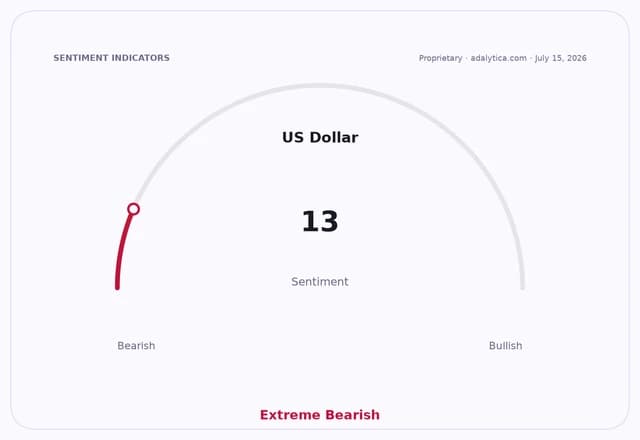
That matters because the dollar is the transmission mechanism for almost every major asset class. When the greenback weakens, global financial conditions loosen, Treasury yields can stay capped, and risk assets get room to run. But when the move is driven by one tame inflation report rather than a durable cooling trend, it leaves investors exposed to a violent reversal if pipeline costs start to reaccelerate. The setup now is especially delicate: the 10-year Treasury yield is still around 4.6%, U.S. dollar gauges are already flashing extreme fear in proprietary Adalytica.com data, and dollar exchange-traded fund UUP is slipping even as its 50-day and 200-day moving averages remain intact.
Sentiment IndicatorsⓘProprietary · adalytica.com · July 15, 2026
This is a snapshot — live sentiment, awareness and momentum for 130+ markets update continuously in the dashboard.Open AlphaPulse
The key risk is not the June print itself. It is what happens next. Producer prices are a leading indicator for the goods pipeline, margins and ultimately consumer inflation. A forecast July reading of the PPI index points to a 3.14% annual pace, while core CPI has already been running hot enough to keep policymakers alert. If tariffs, freight, commodities or wages feed through again, the disinflation impulse that markets have been trading all year could stall. That would matter immediately for rate expectations, for the dollar, and for sectors that have been leaning on easier financial conditions.
Investors should also pay attention to the cross-asset signal. UUP’s recent slide from 28.50 to 28.23 has come alongside a weakening RSI reading, which is conventional technical evidence of fading momentum, while the broader dollar index has pulled back from recent highs as well. EUR/USD has inched higher to 1.15, reinforcing the view that traders are leaning into a softer U.S. currency and a less aggressive inflation path. For now, that favors multinational earnings, commodities and emerging markets. But it also raises the stakes for any upside surprise in inflation, because crowded positioning could unwind fast.
US Dollar vs UUPadalytica.com
Explore this data interactively — full history, time series and cross-market comparisons.Open AlphaPulse
The market’s real mispricing is assuming disinflation is a one-way street. It is not. Producer prices can turn quickly, and the economy is still running hot enough in parts of the supply chain that a modest shock can ripple through goods prices, input costs and pricing power. That is why the next CPI and PPI releases will be more important than the last one: they will decide whether the dollar’s decline is the start of a new trend or just a pause before the Fed regains the upper hand.
My view is that investors should keep betting selectively on a softer dollar, but not as if it were guaranteed. Favor the beneficiaries of easier financial conditions — large-cap exporters, commodity-linked equities and international revenue names — while staying alert for the reversal trades if inflation momentum turns back up. The best opportunity is not to chase dollar weakness blindly, but to own the real winners of a fragile disinflation regime before the market remembers how quickly it can change.
| Entity | Gains | Losses |
|---|---|---|
| Multinational exporters | ▲FX translation tailwind | ▼Dollar hedge pressure |
| Commodity producers | ▲Easier global demand | ▼Stronger input-cost shocks |
| U.S. importers/retailers | ▲Lower import costs | ▼Margin squeeze if inflation reaccelerates |
| Dollar bulls | ▲Support from higher yields | ▼Momentum fade after PPI |