South Africa Power Recovery Relies on Coal
South Africa’s power recovery is being underwritten by an old energy workhorse: coal.
That matters because the country’s recent streak of far better electricity reliability is not yet mainly the result of a clean-energy system fully taking over. It is still being propped up by Kusile and Medupi, two giant coal-fired stations that have become crucial to stabilizing the grid as the country slowly builds a more diversified power mix.
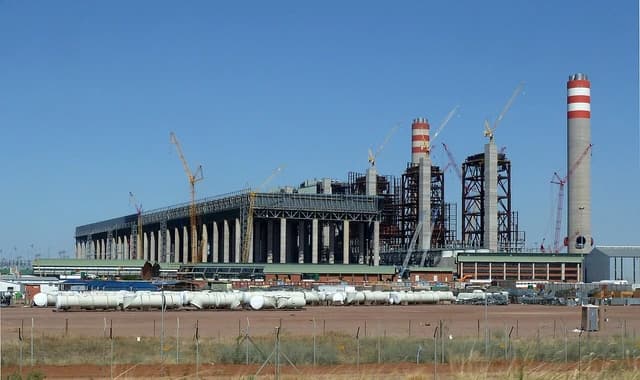
Eskom says Kusile and Medupi have been running at availability factors of about 90% and 85% since the start of the financial year, far above the utility’s overall fleet availability of 67.78% as of Sept. 10. Together, the plants account for 9,600 megawatts of installed capacity and are currently providing roughly 6,583 megawatts of available power, or a little more than 20% of Eskom’s available capacity.
For investors, the significance is straightforward: South Africa’s electricity improvement is real, but it is not yet structurally secure. The country has gone more than 480 consecutive days without load shedding, diesel spending dropped by more than 80% between April and early September, and Eskom’s energy availability factor is at a six-year high. Those are meaningful gains for an economy long held back by blackouts, because fewer outages support industrial output, consumer activity and the broader investment case for South African assets.
But the more interesting story for the long term is that the system is improving from a coal-heavy base even as the policy direction shifts decisively toward renewables and private generation. By the end of March, the government said more than 220 gigawatts of renewable projects were in development, with 36 gigawatts already in the grid connection process. Under the 2025 Integrated Resource Plan, most new capacity through 2039 is expected to come from renewables, while coal retirements are set to accelerate from 2029.
That creates a familiar tension for emerging-market power systems: the country needs dependable dispatchable generation now, even as it tries to build a cheaper, cleaner and more flexible system for later. Coal is still doing the stabilizing today, but it is also the part of the fleet most likely to shrink over time.
For investors, that opens two very different opportunity sets. Near term, any improvement in Eskom reliability supports the South African economy, especially energy-intensive industries and companies sensitive to power interruptions. Over a longer horizon, the real winners are likely to be firms tied to grid expansion, renewable development, transmission upgrades and private power generation. The risk is that the transition stalls before new capacity arrives in enough volume to replace coal on schedule.
So the big takeaway is not that coal has won a reprieve. It is that South Africa’s power turnaround still depends on coal’s reliability while the country builds the next system around it. That makes the electricity story worth watching closely, and for long-term investors, it argues for patience, diversification and a focus on the companies that can prosper as the grid gradually modernizes.
| Entity | Gains | Losses |
|---|---|---|
| Eskom / South Africa | ▲More reliable power supply | ▼Higher dependence on aging coal fleet |
| Coal plants Kusile and Medupi | ▲Central role in grid stability | ▼Long-term phaseout pressure |
| Renewable developers / private producers | ▲Bigger pipeline ahead | ▼Slower near-term replacement of coal |
| South African businesses and households | ▲Fewer outages, lower diesel use | ▼Continued exposure to transition risk |