South Africa leads SADC as regional risk rises

South Africa’s year at the head of the Southern African Development Community arrives at a moment when regional security risk is rising and the macro backdrop is turning more volatile for emerging markets, making Pretoria’s stewardship far more than a ceremonial rotation.
That matters economically because SADC’s 16 members are trying to manage overlapping pressures at once: conflict in Sudan and South Sudan, migration, fragile aid flows, and the constant drag of weak growth across parts of the region. A more coordinated bloc could help preserve trade routes, improve border management and reduce the kind of instability that scares off capital. A less effective one would leave the region more exposed to humanitarian shocks and capital flight just as investors are again reassessing risk in Africa.
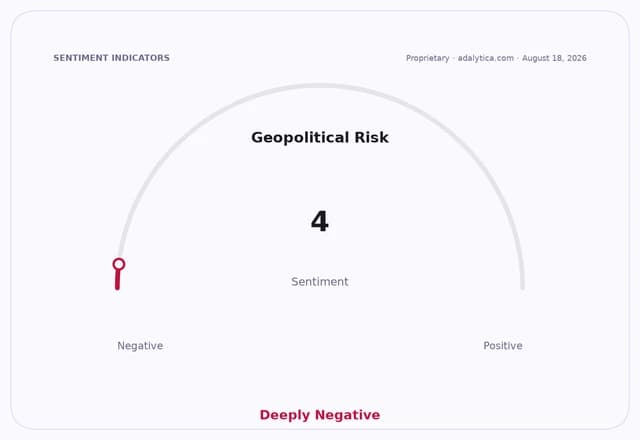
For markets, the timing is important. Adalytica’s Global Stability Sentiment has plunged to “Extreme Fear,” while U.S. dollar trade signals also sit in “Extreme Fear,” a combination that typically punishes frontier assets and rewards balance-sheet strength, hard currency earners and companies tied to essential services rather than discretionary growth. South Africa’s own market is already reacting to that split: the iShares MSCI South Africa ETF, EZA, has pushed to 67.53, above its 50-day moving average of 64.38 and slightly below its 200-day average of 66.95, with RSI readings near 75 indicating stretched momentum. Shell, by contrast, keeps grinding higher, closing at $91.62 and sitting above both its 50-day and 200-day moving averages, a sign that investors still prefer cash-generative energy exposure when geopolitics is unsettled. MTN, one of the region’s bigger telecom names, has also bounced back sharply, suggesting the market is willing to pay for infrastructure-like earnings streams that can endure political noise.
The narrative here is not just South Africa taking a rotating chair. It is South Africa being handed the responsibility of making the region more investable at exactly the point global money is becoming more selective. If Pretoria can nudge SADC toward better security coordination, migration control and political cohesion, the winners are likely to be logistics operators, banks, telecoms and energy firms with regional reach. Those businesses benefit from lower friction, fewer disruptions and a steadier operating environment.
The losers are the obvious ones: insurgent groups, bad actors exploiting weak borders, and investors betting on a broad risk-on rally in frontier Africa without demanding political and security discipline. The broader setup argues for selective positioning, not blanket optimism. In a world where fear is rising faster than growth, the opportunity is in the toll roads of the regional economy — the companies that collect fees, move data, move power and move goods no matter who is chairing the summit. South Africa’s leadership of SADC may not solve Africa’s security problems, but it could decide which assets get rerated first.
| Entity | Gains | Losses |
|---|---|---|
| South Africa / SADC | ▲Regional influence | ▼Pressure to deliver results |
| Banks, telecoms, logistics firms | ▲Lower operating friction | ▼Disruption costs |
| Shell and energy exporters | ▲Safe-haven demand | ▼Risk-off selling in cyclicals |
| Frontier-risk traders | ▲Selective opportunities | ▼Broad emerging-market exposure |