South Korea Faces Higher Rates After Fed Hike
The Federal Reserve’s first rate increase in 3 years and 2 months is forcing South Korea’s policymakers and banks to confront a wider policy gap, stronger dollar pressure and the likelihood of higher domestic borrowing costs.
The Fed lifted its benchmark rate by 0.25 percentage point to 3.75% to 4.00%, taking the U.S.-South Korea policy spread back to 1.00 percentage point after the Bank of Korea cut rates to 3.00% in July and August. With the Fed leaving open the possibility of another hike this year, the move raises the stakes for Seoul’s rate path, the won and credit conditions across the local economy.
A wider rate gap tends to weigh on the won by encouraging capital to flow toward higher-yielding dollar assets. The won was already under strain, and the currency closed at 1,385.95 per dollar on Sept. 18, still below its 50-day moving average of 1,411.65 and under its 200-day average of 1,464.72, while momentum gauges such as RSI readings pointed to a recent recovery from oversold levels. That matters for Korea because a weaker won can feed imported inflation and complicate the central bank’s balancing act.
The bond market is also in the crosshairs. Korea’s fixed-rate mortgage pricing is tied to bank bond yields, and the average five-year AAA-rated bank bond yield hit 4.655% on Sept. 15, the highest this year. The variable-rate COFIX index, a key benchmark for floating mortgages, was 3.18% in August, its highest since December 2024. If market rates keep climbing, lenders will face higher funding costs that are likely to pass through into household and corporate loan rates.
That creates a direct risk for South Korean borrowers at a time when authorities are trying to support financial stability without reigniting housing and inflation pressures. The Bank of Korea has already tightened twice in a row, but officials may prefer to wait and assess the lagged effect of those moves before adding more pressure on debt-laden households.
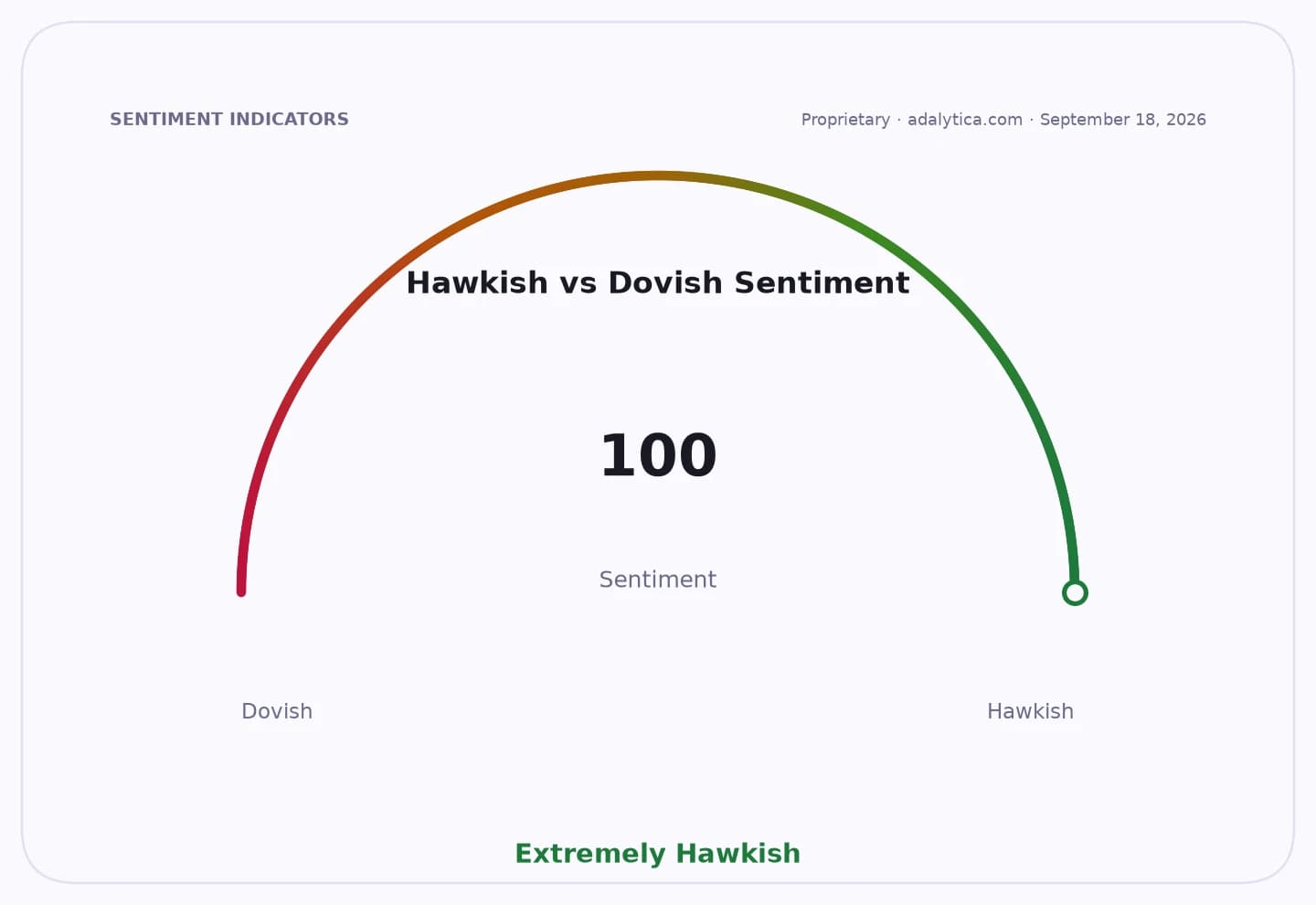
Adalytica’s hawkish-vs-dovish Fed policy sentiment gauge surged to 100, underscoring how aggressively markets are now positioning for a tighter U.S. policy backdrop. The forward-guidance sentiment reading also rose to 63, suggesting investors are treating the Fed’s message as materially more restrictive even after the hike itself.
For investors, the immediate question is whether Korea’s rates, banks and currency can absorb another round of U.S. tightening without sharper stress in credit markets. The next catalysts are the Bank of Korea’s policy stance, further Fed communication and any move by Korean authorities to stabilize bond and foreign-exchange markets.
| Entity | Gains | Losses |
|---|---|---|
| U.S. dollar holders | ▲Higher yield support | ▼None |
| South Korean borrowers | ▲None | ▼Higher loan costs |
| Korean banks | ▲Wider loan spreads possible | ▼Higher funding costs |
| Bank of Korea | ▲Policy flexibility if it waits | ▼Won stability and inflation pressure |