S&P 500 Rebounds 1.5% as Meta, Microsoft Jump
The S&P 500’s 1.5% jump was the day’s most important market signal: investors rushed back into megacap technology, restoring risk appetite and pulling Wall Street back toward record territory.
That matters because the market’s leadership still runs through the biggest names in tech. When Meta and Microsoft each rise more than 5%, the index does not just get a boost in points — it gets a credibility reset. After a sharp pullback in parts of the growth complex, the rebound suggests investors are still willing to pay up for AI infrastructure, cloud spending and platforms with the strongest earnings power. The Dow closing at a record reinforces the same message: broad market demand has not disappeared, even if performance remains concentrated.
The move also fits with the technical setup. The S&P 500 has pushed back above its 50-day moving average, while the latest reading shows RSI in the low-50s, a sign the index has recovered from oversold conditions without yet looking stretched. Nasdaq-linked exposure has also steadied, even though QQQ remains below its 50-day average, which tells me the market is repairing damage rather than declaring the entire growth trade healed. That distinction matters for investors: this is not yet a euphoric breakout, but it is a sign that buyers are still defending the secular AI and megacap thesis.
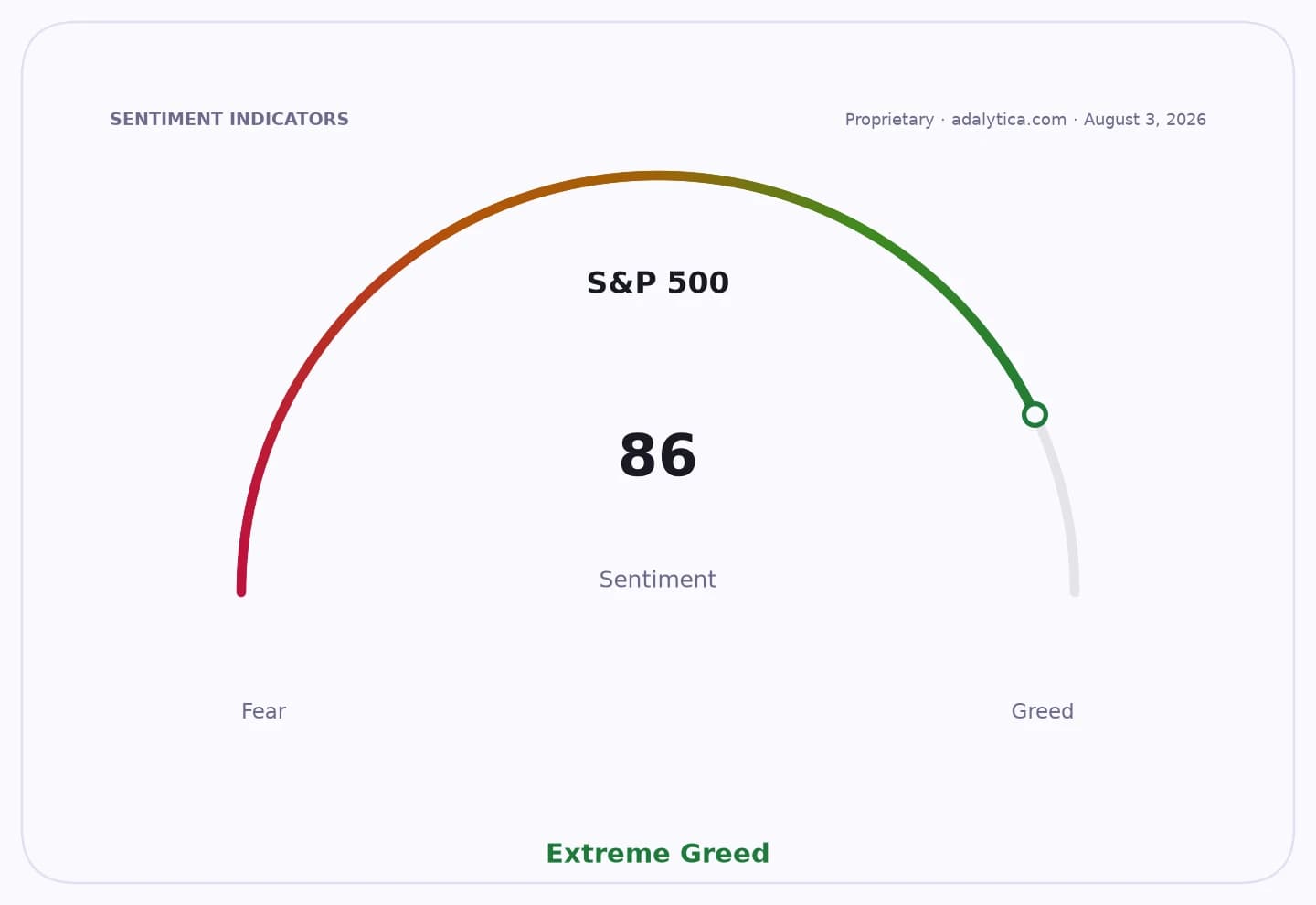
Adalytica’s S&P 500 trade signals show sentiment at “Extreme Greed” and awareness at the maximum reading, underscoring how fast positioning has swung back after a weaker stretch. For investors, that is both a warning and an opportunity. Crowded trades can get volatile, but they also tend to work when the underlying earnings story remains intact. The dollar is flashing the same kind of urgency, with Adalytica’s US Dollar trade signals also at “Extreme Greed,” pointing to a market environment still being driven by capital seeking safety, yield and relative growth strength.
The corporate side of the story adds a second investable thread. Credit Corp’s 12% profit increase, helped by US debt buying, is another reminder that higher-for-longer rates and consumer credit stress can create winners as well as losers. Debt collectors and credit-recovery names often benefit when distressed balances remain available to buy at attractive prices. In a market still obsessed with AI and megacap capex, that is the kind of overlooked cash-flow story investors should not ignore.
Australian share futures were little changed, which suggests the Wall Street rally may not immediately spill over into Asia-Pacific in a straight line. But the broader takeaway is clear: capital is still chasing scale, earnings visibility and balance-sheet strength. That favors the largest tech platforms, select financials with counter-cyclical credit exposure, and the infrastructure layers supplying the AI buildout.
My view is that the market is underestimating how durable this leadership can be. As long as megacap earnings keep delivering and the bond market does not force a sharp rerating, the next leg of this rally should continue to reward the same winners: AI compute, cloud infrastructure, semiconductor supply chains and the firms that profit from financial stress rather than fear it. If you are positioned for the next phase of the cycle, stay anchored to the megacap rebound — but look for the second-order beneficiaries where the market is still mispricing cash flow.
| Entity | Gains | Losses |
|---|---|---|
| Meta, Microsoft | ▲Megacap rebound | ▼Short-term bearish bets |
| S&P 500 bulls | ▲Index momentum | ▼Volatility traders |
| Credit Corp | ▲US debt-buying profits | ▼Distressed debt sellers |
| Nasdaq laggards | ▲Selective catch-up trade | ▼Weak balance sheets |