Taiwan Reports 14 Chinese Ships Near Island
Taiwan’s military said it intercepted 14 Chinese ships and sent aircraft and warships to monitor activity around the island, the latest reminder that Beijing is keeping pressure on the self-ruled territory even as regional markets try to look past the risk. The immediate economic significance is not the ships themselves, but the way repeated military activity around Taiwan raises the odds of a broader disruption to trade, shipping, insurance costs and technology supply chains that run through the Strait.
For investors, the flare-up matters most because Taiwan sits at the center of global semiconductor manufacturing and a key maritime corridor linking Northeast Asia with global markets. Any sustained escalation can lift risk premia across Asian assets, support haven demand and keep foreign investors cautious about exposures tied to cross-strait stability. It also reinforces why Taiwan risk remains embedded in valuations for chipmakers, exporters and regional funds even when headlines fade.
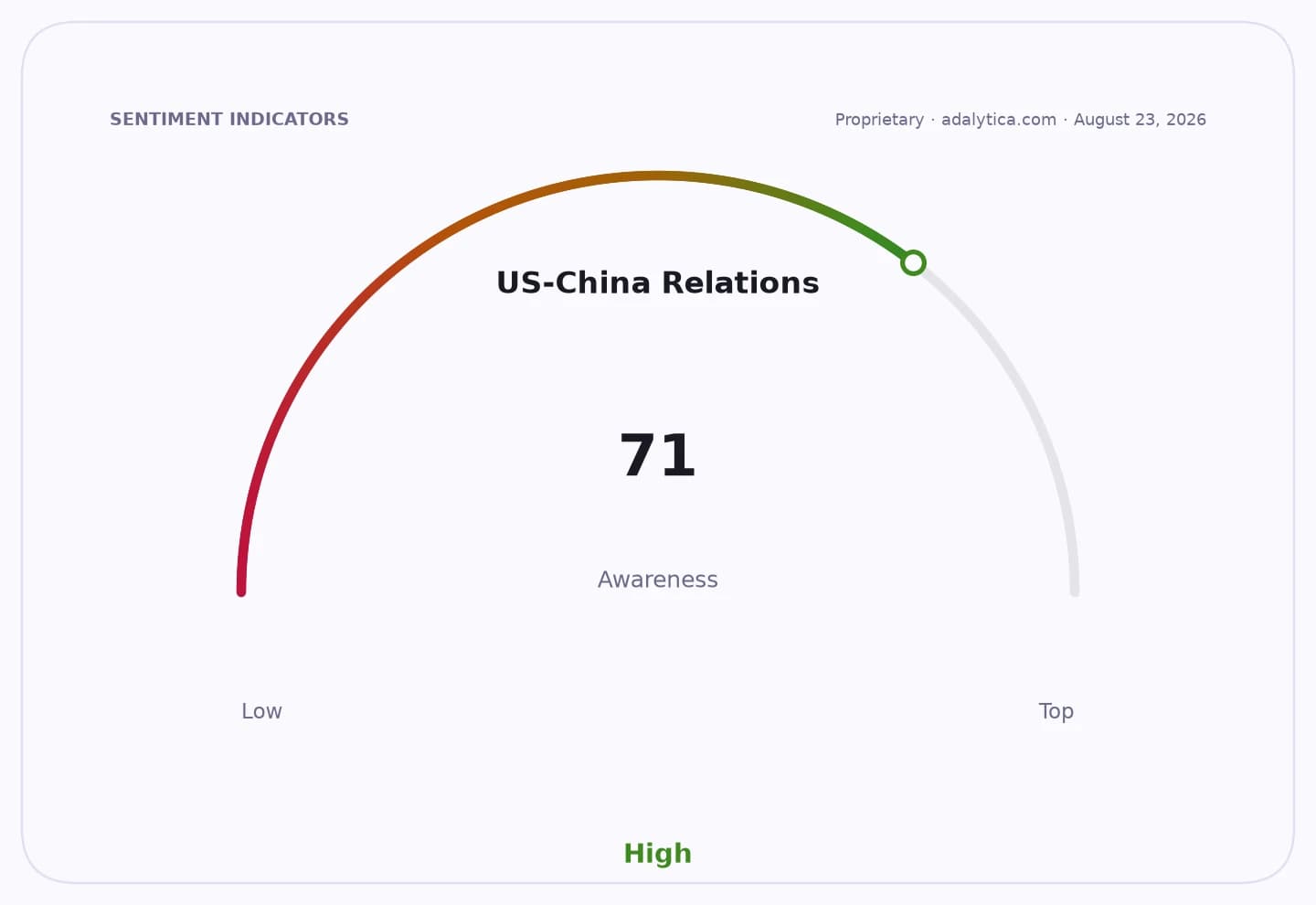
The latest patrol comes against a backdrop of renewed U.S.-China friction. An Adalytica.com measure of U.S.-China relations sentiment jumped to 79, with awareness at 71, suggesting market attention to the relationship has risen sharply over the past week. A separate global stability gauge remained neutral at 43, but the recent move higher in bilateral tension scores points to a market that is again pricing geopolitical noise rather than assuming calm.
That backdrop helps explain the mixed behavior in Taiwan-linked assets. Taiwan Semiconductor Manufacturing Co. has held above its 50-day and 200-day moving averages, with the stock closing at $418.95 on Friday, but it is still well below its recent peaks after a volatile run that included a sharp July selloff. The technical picture suggests resilience, yet also shows how quickly investor appetite can turn when geopolitical risk overlays an already stretched equity market.
China equity proxy FXI remains weaker by comparison, with the fund trading at $35.86, below its 200-day average of $36.67. That underperformance reflects the broader discount investors continue to assign to Chinese assets amid policy uncertainty, slowing growth and persistent geopolitical risk. EWT, the Taiwan-focused ETF, has also been volatile, though it has stabilized near $104.30 after rebounding from a late-July slide. The contrast underscores a familiar trade: investors are willing to own Taiwan’s semiconductor franchise, but they demand compensation for the geopolitical backdrop.
The bullish case is that these encounters stay below the threshold of meaningful disruption, allowing Taiwan’s economy and chip supply chain to keep operating while markets treat each episode as headline risk. The bearish case is that repeated probes, even without direct confrontation, gradually normalize higher military pressure, forcing companies and investors to incorporate more supply-chain redundancy, more shipping caution and a higher geopolitical discount.
For now, the story is less about immediate market damage than about persistence. The more often China tests Taiwan’s defenses, the more investors are forced to think about tail risks that can quickly turn into pricing risks, especially in semiconductors, regional shipping and Asia-exposed equities.
| Entity | Gains | Losses |
|---|---|---|
| Taiwan government | ▲Domestic support for vigilance | ▼More security pressure |
| China | ▲Strategic pressure on Taipei | ▼Greater market distrust |
| TSMC and Taiwan tech | ▲Safety premium in demand | ▼Higher geopolitical discount |
| FXI / China equities | ▲Short-term volatility traders | ▼Long-only investors |