Taiwan Pacific Meeting Raises Geopolitical Risk

Taiwan’s participation in an annual political meeting of Pacific countries is carrying more economic and strategic weight at a time when cross-strait tensions are already feeding investor concern about regional stability and supply-chain risk.
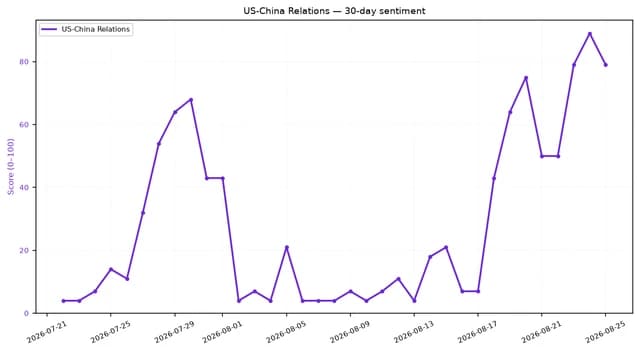
The diplomatic appearance matters because Taiwan is trying to widen its international space even as Beijing intensifies pressure to isolate the island. That broader contest has direct market consequences: it shapes perceptions of security risk across the Taiwan Strait, influences foreign investment confidence, and adds a geopolitical premium to assets tied to the region. With US–China relations sentiment in Adalytica’s gauge at 79, or “Greed,” and global stability sentiment at 82, markets are leaning toward optimism, but the intensity of attention also shows how quickly sentiment could turn if the situation deteriorates.

For Taiwan, the meeting is part of a larger push to present itself as a reliable, peace-seeking partner in the Pacific while reinforcing deterrence at home. President Lai Ching-te has framed record defense spending as an investment in peace, and Taipei has paired that message with new military systems and exercises. The combination underscores a familiar but increasingly costly strategy: maintain enough diplomatic visibility to keep partnerships alive, while spending heavily to make coercion more expensive for Beijing.
China is unlikely to view the Pacific engagement as benign. Beijing has long treated Taiwan’s participation in international forums as a political challenge to its “one China” position, and it routinely pressures smaller countries to limit Taipei’s access. That puts Pacific states in a difficult position, balancing economic ties to China, security cooperation with the US and Japan, and the practical value of retaining links with Taiwan on trade, public health and technology.
For investors, the immediate relevance is less about the meeting itself than the signal it sends about policy direction. Taiwan is doubling down on resilience, not compromise, which supports demand in defense, electronics security and certain infrastructure segments, but it also suggests that cross-strait risk will remain a structural feature of the investment case. Semiconductor supply chains remain the central point of exposure: even limited diplomatic or military escalation can unsettle pricing for insurers, shippers and technology manufacturers dependent on Taiwan’s production base.
The bullish case is that Taiwan’s stronger diplomacy and defense posture help preserve a status quo that markets can price. The bearish case is that every visible assertion of sovereignty invites a sharper response from Beijing, raising the odds of military signaling, sanctions pressure or economic retaliation. For now, the Pacific meeting highlights a simple reality: Taiwan’s geopolitical relevance is rising, and with it the risk premium attached to the island and the wider region.
| Entity | Gains | Losses |
|---|---|---|
| Taiwan | ▲Diplomatic visibility | ▼China pressure risk |
| Pacific states | ▲Engagement options | ▼Beijing backlash |
| Defense sector | ▲Higher spending | ▼Peace dividend |
| Semiconductor investors | ▲Status quo stability | ▼Cross-strait escalation |