Tencent Holdings is back in the danger zone, with the stock slipping 3.9% to about $46 and trading below its 7-day, 20-day and 50-day moving averages as heavy volume suggests institutions are still selling into weakness.
Tencent stock falls below key moving averages
That matters because the move is not just a routine pullback. When a large-cap technology name loses its short-term trend on volume more than twice the recent average, it usually means investors are reducing exposure rather than simply taking profits. For long-term holders, that kind of distribution can reset sentiment fast, especially in a stock that has already been under pressure for months.
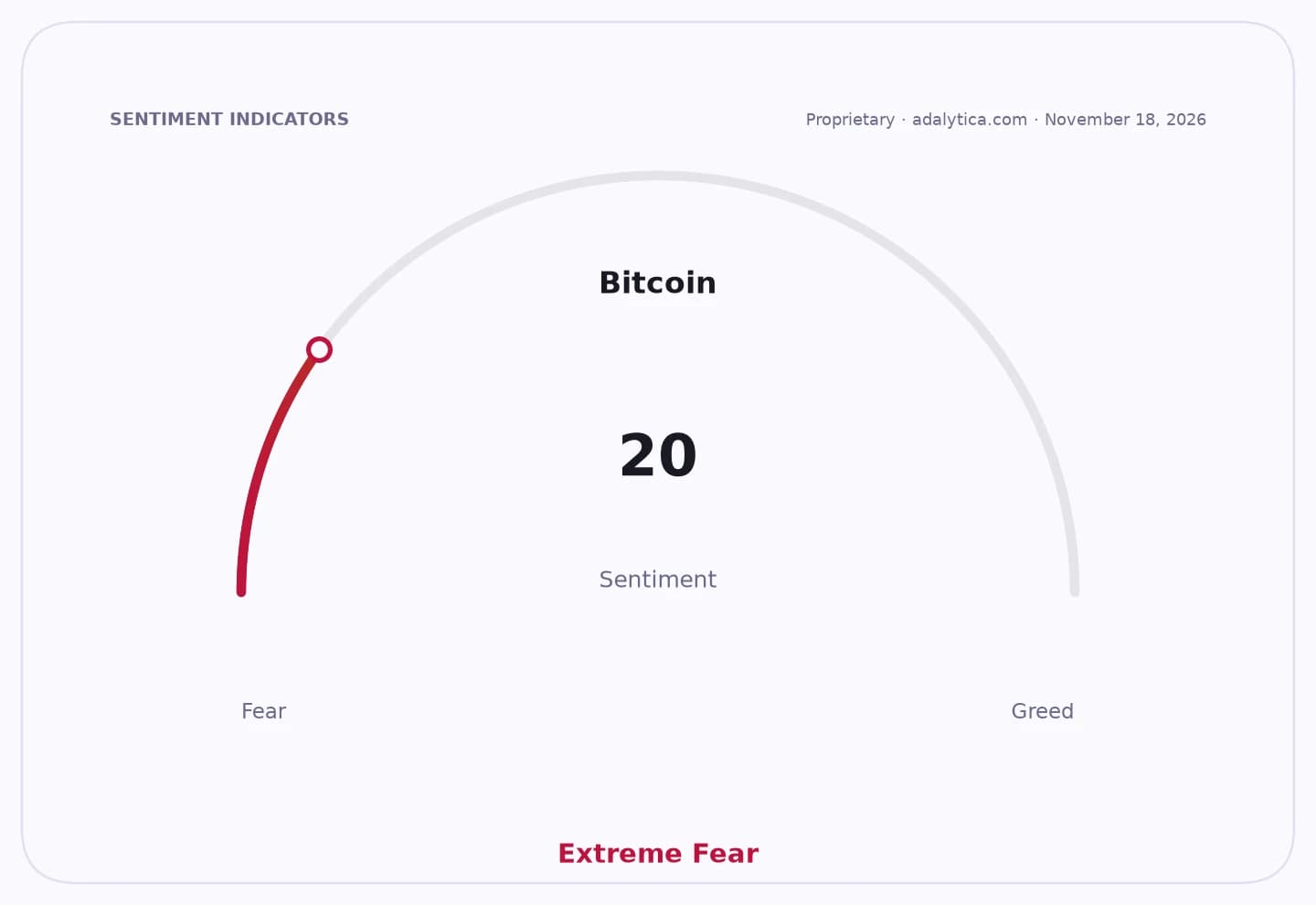
Sentiment Indicators
The technical picture is split. Tencent’s relative strength index is 27.8, which puts it in oversold territory and leaves room for a reflex bounce. But oversold does not mean safe. Momentum remains weak, with MACD still negative, and the stock is sitting just below the lower Bollinger Band, a sign the decline is stretched but not yet repaired. In plain English, buyers may step in soon, but the chart still belongs to sellers.
The derivatives market is sending the same mixed message. Binance perpetual futures show a negative funding rate, meaning shorts are paying longs, which often happens when bearish positioning becomes crowded. Yet taker flow still leans toward selling, with sell volume exceeding buy volume, so aggressive traders are still hitting bids. Open interest has also risen, which tells you conviction is building on both sides rather than fading.
For investors, the key question is whether this is a tradable oversold bounce or the start of another leg lower. The first level to watch is the pivot around $46.73, followed by resistance near $47.60. If Tencent can reclaim those levels with better buying volume, the stock could work off its oversold condition and stage a relief rally toward $49.16. If it loses support around $45.17, the next stop is closer to $44.30, and the risk is that momentum traders keep pressing the downside.
The broader backdrop still matters. Tencent is not being priced like a business with no future; it is being priced like a company whose near-term growth narrative is under scrutiny, especially around AI spending, tech-sector risk appetite and the market’s willingness to pay for Chinese internet exposure. That makes every earnings update and every sign of capital discipline more important than usual. In a market where fear is still elevated, as Adalytica’s S&P 500 trade signals show, investors are less forgiving of weak tape and more selective about where they put fresh money.
For long-term investors, that is exactly why Tencent remains a watchlist name rather than a panic sell based on one ugly session. Companies with strong ecosystems, recurring engagement and optionality from AI and digital services can recover sharply once selling pressure exhausts itself. But the burden is on the stock now: it needs to prove buyers are willing to defend these levels before the next durable advance can begin.
| Entity | Gains | Losses |
|---|---|---|
| Short-term traders | ▲Potential oversold bounce | ▼Risk of squeeze if $46.73 reclaims |
| Sellers | ▲Lower prices, momentum confirmation | ▼Crowded short positioning |
| Long-term investors | ▲Possible better entry point | ▼Mark-to-market pain in the pullback |
| Tencent bulls | ▲Mean-reversion opportunity | ▼Trend remains bearish until support holds |