Tesla’s towering market value is increasingly tied not just to cars, batteries and robotics, but to a supply chain that runs through a remote South African mining town that can make or break access to critical minerals. For investors, that is the uncomfortable takeaway: Elon Musk’s $25 trillion long-shot valuation depends on industrial inputs and geopolitical stability in places far from Austin, Shanghai or Silicon Valley.
Tesla Faces Critical Minerals Supply Risk
The strategic vulnerability is economic as much as geographic. Tesla is pushing ahead with autonomy, new battery chemistry and expanded manufacturing, but those ambitions require a steady flow of mined materials, refined metals and industrial components that are sensitive to labor, logistics and political risk. A disruption in one small town in South Africa can ripple through upstream supply, raising costs, delaying production and complicating margins across Tesla’s global footprint.
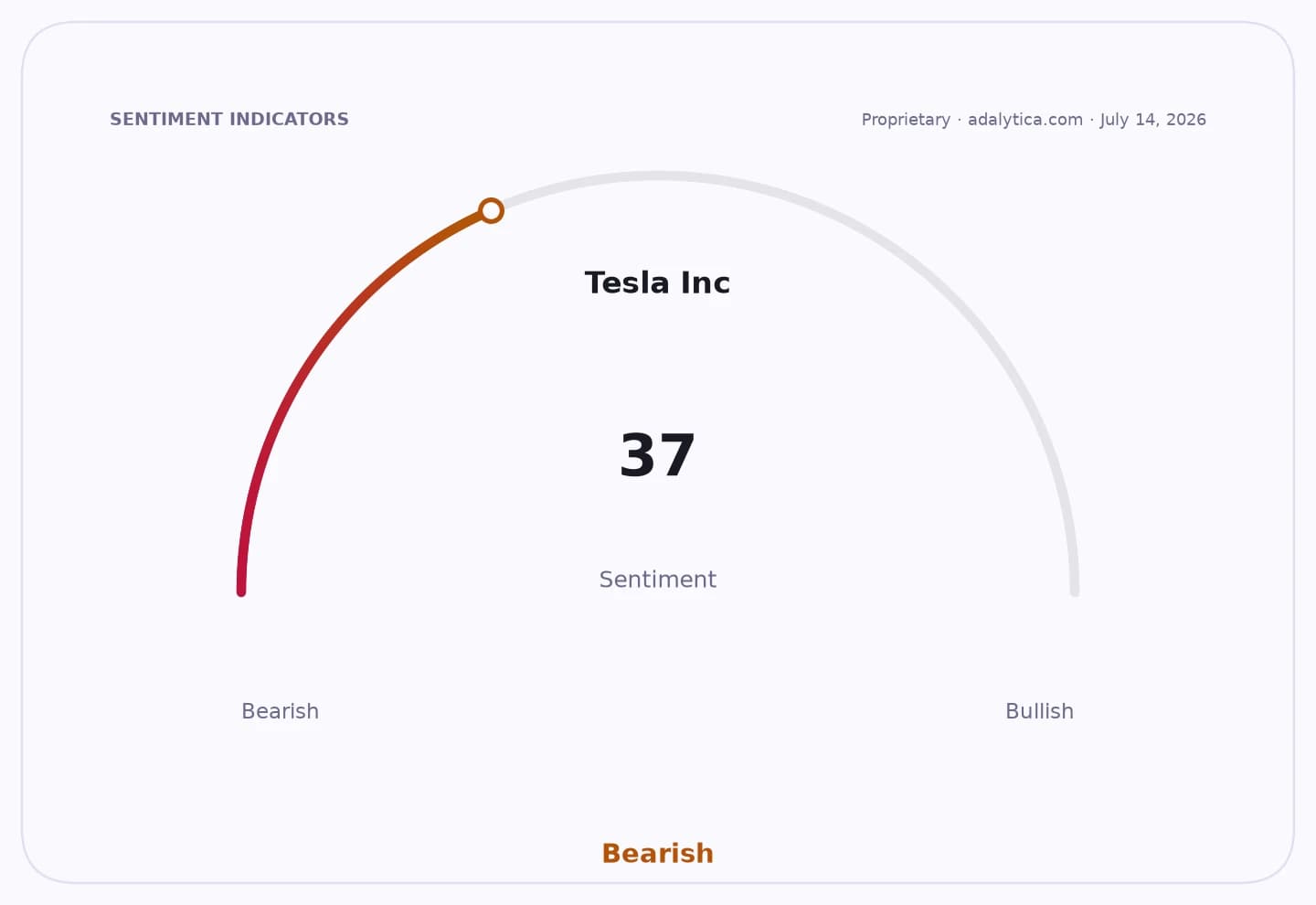
Sentiment IndicatorsⓘProprietary · adalytica.com · July 14, 2026
This is a snapshot — live sentiment, awareness and momentum for 130+ markets update continuously in the dashboard.Open AlphaPulse
That matters because Tesla’s stock already trades like an option on future growth. The shares closed at $395.20 on July 14, below their 50-day moving average of $409.91 and 200-day average of $417.75, while RSI readings near 54 and a slightly negative MACD show the stock is no longer in the extreme overbought zone that marked earlier rallies. Adalytica’s Tesla Earnings Sentiment snapshot also shows sentiment at 37, neutral, with awareness at 11, described as extreme fear, suggesting investors are still uneasy about the company’s near-term setup even after a 7-point one-day sentiment rise.
The dependence on far-flung mining centers also highlights a broader market theme: the AI and electrification trade is only as strong as the physical supply chain behind it. Tesla is not alone. GM and Ford are also exposed to tariff shifts, policy changes and industrial bottlenecks, but Tesla’s premium valuation leaves less room for execution mistakes, especially if critical mineral supply tightens or becomes more expensive.
For investors, the risk is not just a single mine or town, but the intersection of resource nationalism, labor unrest, safety failures and transport constraints across Africa’s mining belt. Any shock that slows output of inputs used in EVs, batteries or electronics can pressure Tesla’s cost structure and force a reassessment of timelines for its next growth phase.
That makes the next catalysts straightforward: supply-chain developments, commodity pricing, and Tesla’s own updates on manufacturing ramps, battery technology and capital spending. If the company is to justify its scale, it will need more than software promises — it will need the minerals to keep building.
| Entity | Gains | Losses |
|---|---|---|
| Tesla | ▲Long-term AI/EV upside | ▼Supply-chain and margin risk |
| South African mining town | ▲Investment inflows | ▼Safety and disruption exposure |
| Mineral suppliers | ▲Higher strategic demand | ▼Volatility from policy/shocks |
| Tesla bulls | ▲Growth narrative | ▼Execution delays and cost pressure |