Elon Musk and Tesla are facing a new kind of pressure campaign that could widen the political risk premium around the stock just as investors are trying to gauge how much of the company’s valuation is tied to Musk’s public profile rather than vehicle demand.
Tesla Faces Musk-Related Political Risk
Capytistas, an anti-oligarchy activist group, says it has spent nearly a year assembling more than 3,500 documents on billionaires with combined wealth of about $1.4 trillion, and plans to publish over 150 residential addresses in a campaign it says is meant to expose the concentration of wealth and political influence. Musk is the first target, with the group citing his prominence and political involvement, including his temporary role in the Trump administration’s DOGE effort and more than $700 million in federal-election spending since 2023, according to the material reviewed by WIRED.
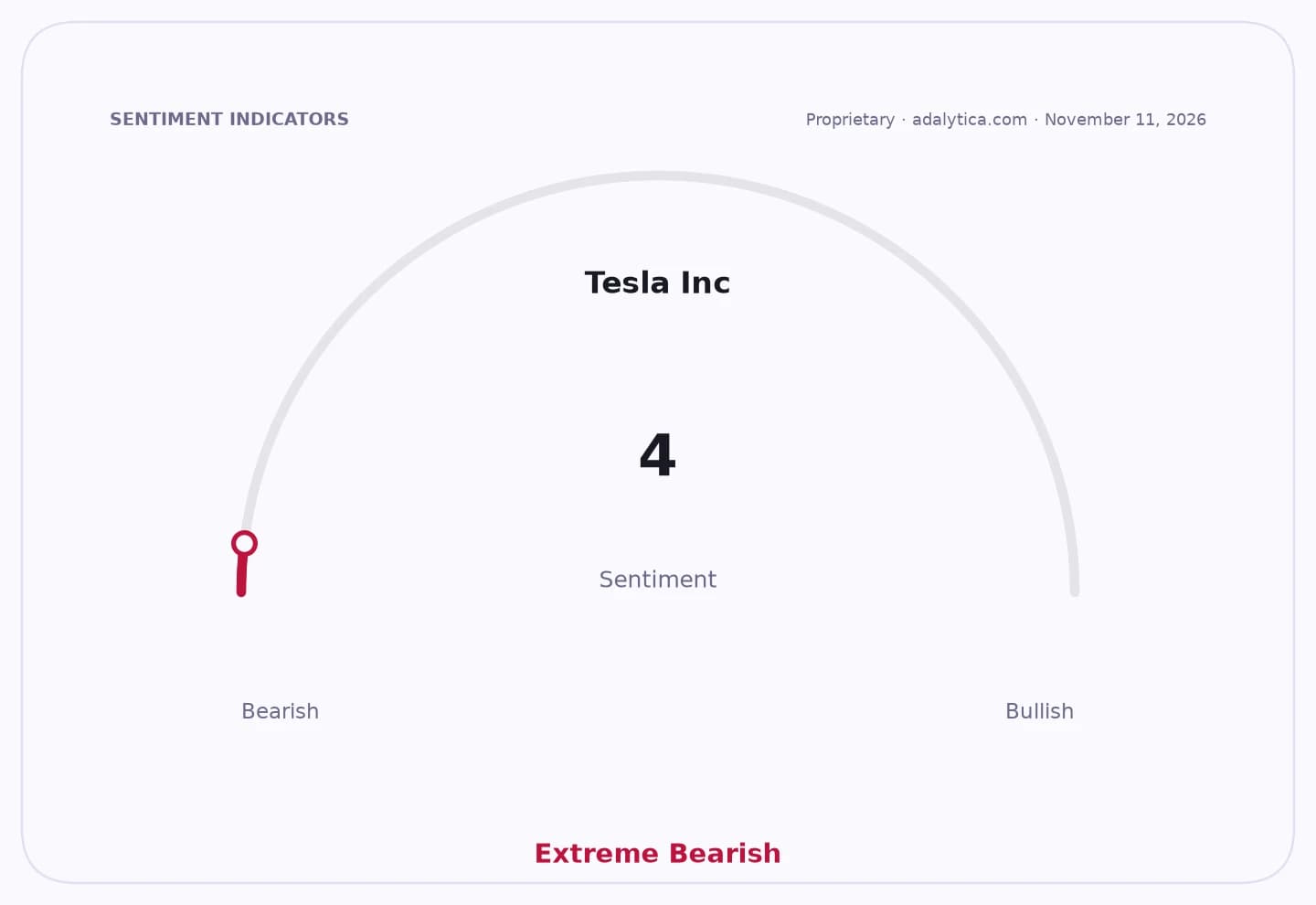
Sentiment Indicators
That matters because Musk is not just Tesla’s chief executive; he is the company’s most important brand asset and its biggest source of headline risk. The activist campaign follows a year in which Tesla has already been hit by protests and vandalism in at least nine U.S. states, according to federal documents cited by WIRED, underscoring how quickly political polarization around Musk can spill into operations, security costs and consumer sentiment. For a company already under scrutiny for governance and execution, any escalation in personal targeting of the CEO can translate into a wider discount on the stock.
The market has reason to care. Tesla shares have been volatile and technically fragile, with the stock closing at $378.05 on Nov. 9, below its 200-day moving average of about $383.51, while the 50-day average sat near $372.72. That puts the name in a battleground zone rather than a clean uptrend, and it shows why investors are likely to react more to reputational shocks than to routine product headlines. If activism against Musk intensifies, the downside is not limited to optics: it can affect deliveries, employee morale, regulatory attention and the willingness of institutions to pay up for a stock that still trades on narrative as much as fundamentals.
The broader investment lesson is that Tesla remains one of the market’s most exposed “key-man” equities. Bulls continue to argue that autonomy, software and robotics can justify a premium multiple, but that thesis becomes harder to sustain when the CEO is simultaneously a political lightning rod and the target of organized anti-billionaire campaigns. In that sense, Capytistas is not just an activist nuisance; it is another reminder that Musk-driven volatility is now part of Tesla’s operating environment.
For investors, the asymmetric play is not to chase the headline, but to recognize what it reveals: Tesla’s valuation is still hostage to Musk’s political footprint. That keeps risk elevated for TSLA relative to the broader market and argues for caution until the company proves it can separate its long-term AI and mobility story from the CEO’s increasingly combustible public profile.
| Entity | Gains | Losses |
|---|---|---|
| Capytistas | ▲Media attention | ▼Legal and safety risk |
| Musk/Tesla bulls | ▲Little near-term gain | ▼Higher reputational risk |
| Tesla shareholders | ▲— | ▼Valuation discount risk |
| Protest/security vendors | ▲Higher demand | ▼— |