Tesla shares at $311.21 after July 31 selloff

Tesla’s market value is being driven less by near-term fundamentals than by whether investors keep treating it as an AI platform story, even as the company’s latest results show a business still exposed to volatile demand, margins and supply-chain risk. The disconnect is why Tesla’s shares can still trade at a premium to the rest of the car industry while moving like a high-beta momentum name.
That tension matters because Tesla is now one of the clearest examples of the “Mag 7” problem: the group still trades as a basket in index funds and passive flows, but the companies underneath it no longer share a single investment case. Tesla’s valuation depends on robotics, autonomous driving and software optionality, while its filings still warn that “rapidly evolving trade and fiscal policy and geopolitical conflicts” can hurt costs, demand and profitability.
The stock’s recent trading shows how much investor conviction can change. Tesla closed at $311.21 on July 31, after plunging to $298.32 a day earlier from $419.77 on July 6. The shares remain well below the 50-day moving average of $390.76 and the 200-day average of $411.60, while the RSI reading of 18.1 points to deeply oversold conditions after the selloff. The stock’s MACD remains negative, underscoring that momentum has broken down even after a rebound.
By contrast, the broader market still looks far more complacent. The S&P 500 was at 747.03 on July 31, near its 50-day average of 744.22, with Adalytica’s S&P 500 trade signals showing “Extreme Greed.” That split highlights how much Tesla has detached from the index-level AI trade that has lifted the market’s largest technology names.
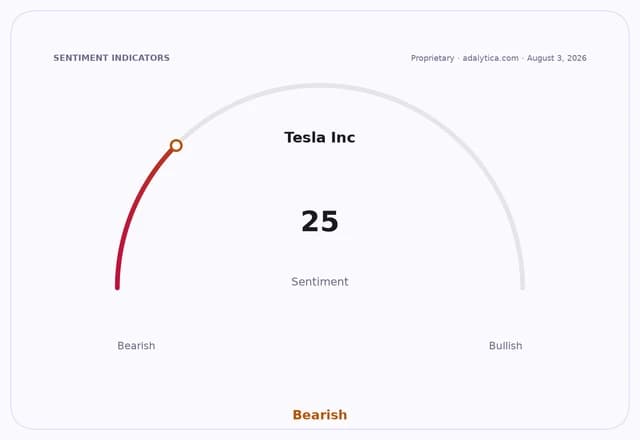
Tesla’s own sentiment gauge is far less enthusiastic. Adalytica’s Tesla Earnings Sentiment snapshot shows “Fear” at 25, with awareness still at 71, suggesting investors are watching the story closely even as conviction cools. That matters for holders because Tesla is still priced like a growth-and-disruption winner, but the evidence in the stock and in the company’s filings points to a business under pressure to prove its next leg of growth.
The broader narrative is that Tesla is no longer being valued primarily as an automaker, but it also has not yet delivered the scale of AI monetization needed to justify a tech-style multiple on fundamentals alone. That leaves the shares vulnerable to any disappointment in deliveries, margins or autonomous-driving progress, while keeping them heavily exposed to sentiment shifts around AI.
For investors, the key catalyst is whether Tesla can turn that narrative into measurable revenue and profit in the next update. Until then, the gap between the stock’s story and its operating reality is likely to keep volatility high.
| Entity | Gains | Losses |
|---|---|---|
| Tesla bulls | ▲AI optionality | ▼Fundamental clarity |
| Tesla bears | ▲Valuation reset risk | ▼Momentum rebounds |
| Mag 7 leaders | ▲Index support | ▼Group narrative unity |
| Passive index holders | ▲Mega-cap exposure | ▼Stock-specific volatility |