Tesla stock valuation and long-term growth outlook
Tesla still looks like one of the market’s great long-term compounding stories, but investors need to expect a much more mature business than the one that turned early believers into millionaires. The key question for the next decade is not whether Tesla can keep growing — it almost certainly can — but whether it can justify today’s rich valuation while slowing from its old torrid pace.
That matters because Tesla’s stock has already done the heavy lifting. A $1,000 investment 15 years ago would have ballooned into roughly 282 times that amount, an extraordinary record that helped push the company’s market value to about $1.4 trillion at one point. But over the past five years, the stock has been far less forgiving, reflecting slower growth, margin pressure and increasingly fierce competition.

For long-term investors, the most important math is what comes next. A simple projection using an 18% annual return suggests $1,000 could become about $5,234 over 10 years. That kind of outcome would still be impressive, but it would also be far below Tesla’s earlier run — and that’s the central shift investors should understand. The easy gains may already be behind the company, even if the long runway remains.
The reason Tesla can still compound meaningfully is that it is no longer just an EV maker. It is trying to build multiple businesses with outsized upside, including robotaxis, the Cybercab, energy storage and Optimus humanoid robots. Those are not small side projects; they are the kinds of optionality that can create another phase of growth if Tesla executes well. The company’s large cash cushion also gives it room to invest aggressively while competitors are forced to play defense.
At the same time, the risks are real and increasingly visible. Tesla’s operating profit margin has been shrinking, the stock has recently traded around 152 times forward earnings, and Chinese rival BYD and others are pressuring the EV market. That combination makes it much harder to call Tesla “cheap,” even if the business remains exceptional. When a company is valued for perfection, even good growth can disappoint shareholders.
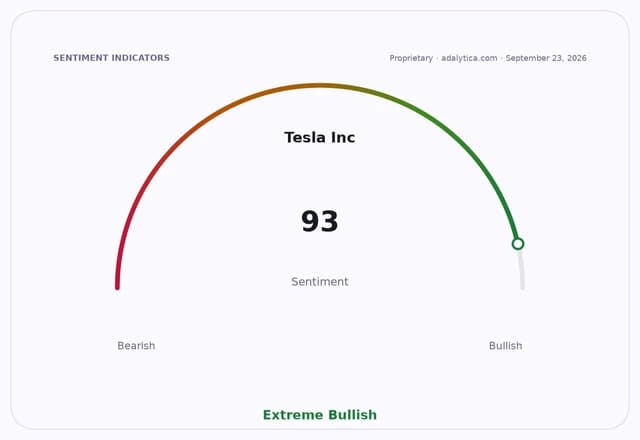
Recent trading also shows how divided investors are. Tesla shares have been volatile, with the stock moving from the low $380s to the mid-$370s in recent sessions, while conventional technical indicators such as the 50-day moving average and RSI readings have suggested a market still searching for direction. Meanwhile, Adalytica’s Tesla earnings sentiment has flashed “Extreme Greed,” a reminder that enthusiasm can rise quickly even when the fundamentals are still being proved out.
Tesla’s latest financial filings underscore that tension. Revenue is still growing, but the market is no longer paying only for car sales. It is paying for a future in software, autonomy and energy. That is why Tesla remains one of the most interesting stocks to own for the long haul — but also one of the most difficult to value with confidence.
For investors, the right takeaway is not to chase the stock because it once made people rich, nor to dismiss it because the returns may slow. Tesla still has the ingredients for substantial compounding over the next decade, especially if its newer businesses begin to matter more. But the bar is much higher now. If you own it, think in years, not quarters. If you are buying today, size it as a high-conviction growth holding, not a sure thing.
| Entity | Gains | Losses |
|---|---|---|
| Long-term Tesla shareholders | ▲New growth platforms | ▼Easier upside from the past |
| Tesla | ▲Robotaxi, energy, AI optionality | ▼Margin pressure |
| BYD and EV rivals | ▲Market-share fight | ▼Tesla's scale advantages |
| New buyers | ▲Potential compounding over years | ▼High valuation risk |