Crypto’s newest growth story is not about replacing Wall Street; it is about borrowing Wall Street’s legal rights, custody rules and market plumbing to make tokenized stocks credible enough for mainstream capital.
Tokenized Stocks Could Benefit Coinbase and Robinhood
That matters because the real investment case for tokenized equities is not the buzz of trading stocks on-chain, but whether holders actually own something that behaves like a share when markets seize up, custodians fail or liquidity vanishes. The SEC’s temporary Innovation Exemption, issued Sept. 17, effectively turns that question into the core of the experiment: tokenized securities venues can operate only if they provide the same rights as the underlying shares, work inside regulated custody arrangements and stay within a bounded framework the regulator can watch.
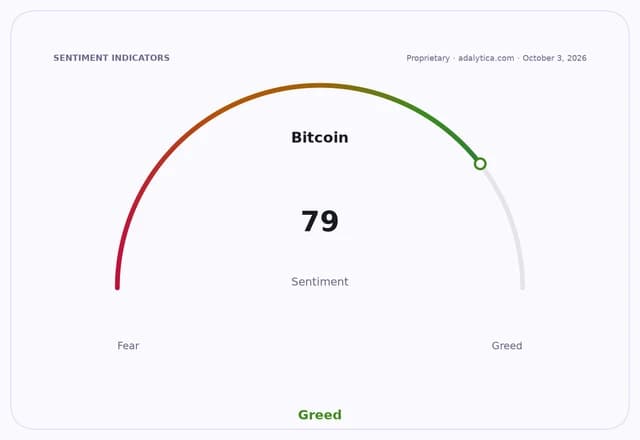
Sentiment IndicatorsⓘProprietary · adalytica.com · October 3, 2026
This is a snapshot — live sentiment, awareness and momentum for 130+ markets update continuously in the dashboard.Open AlphaPulse

This is where the opportunity gets interesting for investors. If tokenized stocks work, they could become a distribution layer for traditional equities inside crypto-native platforms, giving bitcoin, ether and DeFi-heavy portfolios a path into non-crypto exposure without leaving the digital-asset ecosystem. That is a potentially meaningful shift because crypto benchmarks remain concentrated, leaving many portfolios overexposed to the same macro drivers. Tokenized equities could widen the opportunity set and create a new on-ramp for equity demand.
But the market is being asked to pay for a promise, not a proven product. The exemption does not establish deep liquidity, durable price discovery or a permanent legal framework. It is a five-year, temporary and conditional bridge. The SEC also made clear that venues need to notify issuers before listing third-party tokenized shares, underscoring that this is coexistence with the existing market structure, not a rebellion against it.
The timing is crucial. Higher yields make the hurdle for speculative assets much tougher. The five-year Treasury yield moving above 5% in September for the first time since 2007, alongside the Fed’s latest 25-basis-point hike, raises the cost of carrying risk and forces investors to compare tokenized stocks not just with crypto, but with government debt. In that environment, products that can credibly combine equity exposure, blockchain settlement and regulated ownership could attract capital precisely because they sit at the intersection of yield, diversification and access.
That is why the winners are not necessarily the token issuers first, but the infrastructure providers around them. Coinbase, Robinhood and bitcoin-linked funds such as IBIT are already trading as investors price the next phase of crypto’s evolution: from a closed ecosystem into a marketplace for real-world assets. Coinbase’s stock has recovered sharply from its spring lows, while Robinhood has regained upward momentum, reflecting the market’s willingness to re-rate platforms that can monetize tokenization, custody, trading and distribution. If tokenized stocks scale, the toll roads around the trade — brokerage apps, custodians, settlement rails and liquidity providers — may capture more value than the tokens themselves.
The second-order effect is even bigger. Tokenized equities would not just add another product line for crypto platforms; they would blur the boundary between traditional finance and digital assets. That opens the door to faster settlement, programmable corporate actions and cheaper cross-market distribution, even if those efficiencies are not guaranteed. It also creates a regulatory test case that could shape how far tokenization spreads into bonds, funds and other assets.
For investors, the message is simple: the market may be underestimating how quickly tokenized stocks can become a mainstream wrapper for existing assets, but it is equally underestimating how much legal rights and custody will determine who wins. The best position is not to chase the wrapper blindly, but to own the platforms and infrastructure that stand to earn fees every time capital moves between Wall Street and crypto. This is still an experiment — but if the SEC’s pilot succeeds, it could become one of the most important distribution shifts in modern markets.
| Entity | Gains | Losses |
|---|---|---|
| Coinbase, Robinhood | ▲New trading and custody flows | ▼Pure-play crypto speculation |
| Tokenized stock issuers | ▲Wider distribution | ▼Regulatory uncertainty |
| Crypto-native investors | ▲Equity access on-chain | ▼Illusory exposure without rights |
| Traditional brokers/exchanges | ▲Potential new fee streams | ▼Disintermediation risk |