Professional training providers are benefiting from a labor market that is still hiring at a steady pace, even as unemployment remains low by historical standards and workers keep moving in search of better pay, security and credentials.
Training Stocks Gain on Resilient Labor Market
That backdrop matters economically because a tight-but-normalizing job market tends to support demand for retraining, certification and career-switch programs. The latest data show the U.S. unemployment rate at 4.2% in June, with nonfarm payrolls at 158.984 million and projected to edge up to 159.1709 million in July, suggesting hiring is still expanding rather than rolling over.
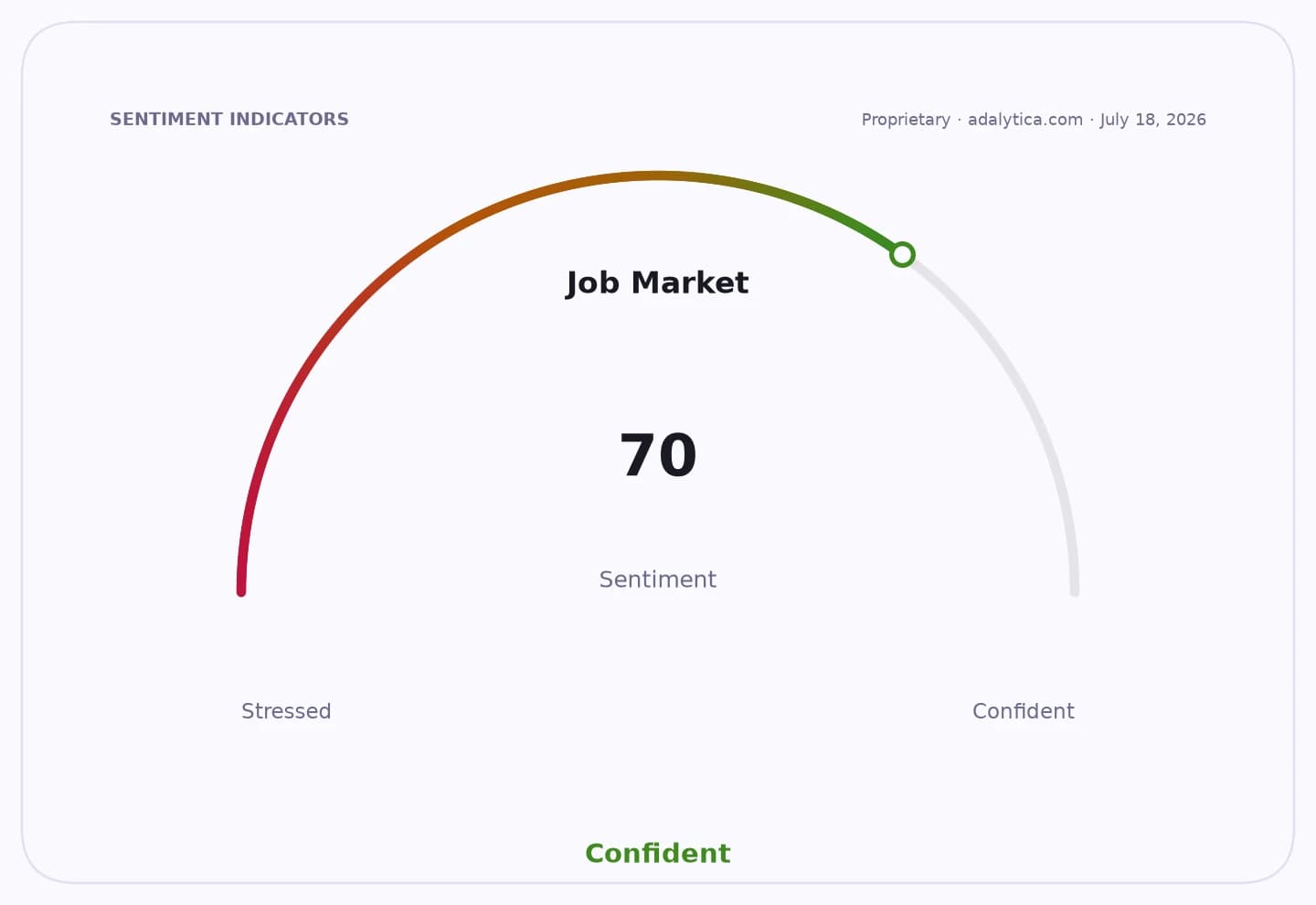
Sentiment IndicatorsⓘProprietary · adalytica.com · July 18, 2026
This is a snapshot — live sentiment, awareness and momentum for 130+ markets update continuously in the dashboard.Open AlphaPulse
For professional education companies, that can translate into more enrollments from both job seekers and employed workers trying to protect their prospects. Strategic Education, which trades as STRA, and Lincoln Educational Services, or LINC, have both been showing the kind of operating momentum that often tracks a market for skills training: STRA’s shares have climbed to 76.53 from 73.68 in mid-August and briefly touched 85.72 on July 13, while LINC has surged from 21.52 in November to 42.95 on July 17 after reaching 55.68 earlier in July.
The move in LINC has been especially sharp, and its recent trading pattern suggests investors are still pricing in strong demand for job-ready training even after a pullback. The stock hit a 52-week-style high near 55.68 on July 7 before giving back much of the gain, while STRA has held above its 50-day moving average for much of the year, though it has slipped back below that level in recent sessions.
UNRATE vs PAYEMS — macro contextadalytica.com
Explore this data interactively — full history, time series and cross-market comparisons.Open AlphaPulse
The economic story is not just about employment levels, but about the quality of jobs and the pressure to stay employable. Job-seeker sentiment remains mixed, with Adalytica’s Job Market Sentiment snapshot showing a neutral 70 reading but fear still embedded in awareness measures, while consumer confidence tied to recession risk remains deeply negative at 19. That combination points to a market where workers may be employed, but still anxious enough to keep investing in credentials.
Company filings back up the trend. STRA said its education technology and services segment revenue rose 30.4% in 2024, helped by growth in Sophia Learning subscriptions, employer-affiliated enrollment and Workforce Edge partnerships. LINC said first-quarter revenue jumped 22.5% to $144.0 million, with new student starts up 19.5% and average student population rising 18.2%.
The investor implication is straightforward: if labor demand stays firm and unemployment remains near 4%, professional training companies can keep monetizing the need to upskill, reskill and pivot careers. The risk is that any cooling in payroll growth, or a sharper turn in job security, would quickly hit enrollment demand and expose how dependent the sector is on workers’ willingness to pay for mobility.
With the July unemployment report due next and payroll growth expected to continue, the next catalyst for the sector is whether the labor market stays resilient enough to keep training demand elevated into the second half.
| Entity | Gains | Losses |
|---|---|---|
| Professional training firms | ▲Higher enrollment demand | ▼Less urgency if job market cools |
| Workers/job seekers | ▲Better credentials and mobility | ▼Tuition and time costs |
| Employers | ▲Larger talent pool | ▼Higher training and retention expenses |
| Short sellers | ▲— | ▼Momentum-driven upside in STRA and LINC |