Trump China bank sanctions threat hits ETFs
Donald Trump’s refusal to rule out sanctions on Chinese banks is extending a geopolitical overhang for markets already sensitive to any escalation in U.S.-China financial pressure, with Chinese stocks and internet shares trading weakly as investors weigh the risk of a broader squeeze on cross-border funding and trade.
The immediate market issue is not whether Washington has acted, but that it has kept the threat alive. For investors, that means the discount on China-related assets remains anchored less to fundamentals than to policy risk — and that risk now includes the possibility that banks could be pulled into the dispute, not just exporters, technology firms or companies tied to Iran.
That matters because sanctions on major Chinese lenders would be far more disruptive than sector-specific tariffs or export controls. Banks sit at the center of trade settlement, dollar funding and payment channels. Any move to restrict their access to the U.S. financial system would raise transaction costs for Chinese companies, complicate trade finance and risk spillovers into credit markets, even if the measures were narrower than a full financial embargo.
The pressure point is already visible in exchange-traded funds tracking Chinese equities. The iShares China Large-Cap ETF, FXI, fell to $35.24 on Thursday from $35.56 two days earlier, while the KraneShares CSI China Internet ETF, KWEB, dropped to $26.10 from $26.41 over the same stretch. Both funds remain below their 200-day moving averages, a conventional technical sign that longer-term momentum is still weak. KWEB’s RSI reading of 24.4 puts it in oversold territory, underscoring how defensive positioning has become in the China growth complex.

The macro backdrop is also unhelpful. Tensions over sanctions tied to Iran have spilled into a broader test of how far Washington is willing to go in penalizing Chinese firms that do business with countries under U.S. restrictions. Beijing has said it will take all necessary measures to protect its interests if secondary sanctions are widened to include Chinese companies, setting up another round of policy brinkmanship with potential consequences for trade flows, bank funding and emerging-market risk appetite.
For China, the danger is not only direct sanctions exposure but the chilling effect on corporate and financial behavior. Firms may delay transactions, reroute payments or reduce dollar dependence if they believe U.S. measures are becoming more unpredictable. For U.S. policymakers, the leverage is obvious: the threat of sanctions can pressure Beijing without immediate broad trade penalties. But the downside is equally clear — a harder line risks adding volatility to global capital markets at a time when investors are already pricing in a fragile geopolitical environment.
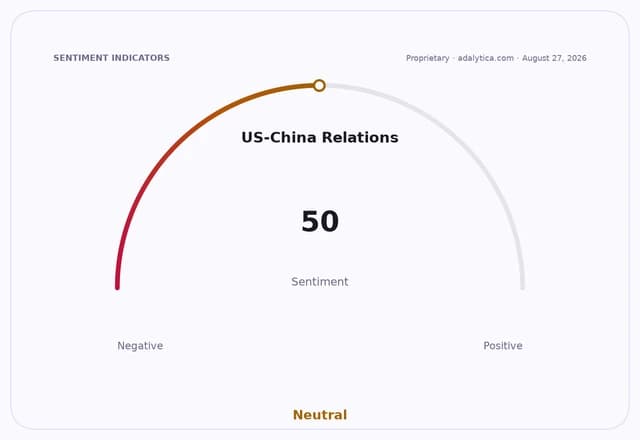
Adalytica’s US-China Relations Sentiment gauge shows neutral readings but very high awareness, reflecting how closely investors are tracking the issue. China policy sentiment remains in extreme fear, suggesting markets are braced for escalation even before any formal action is announced.
The next catalyst is whether Trump converts ambiguity into a concrete sanctions package or leaves the threat as leverage. Until then, China banks, their counterparties and investors in China-focused ETFs are likely to remain hostage to headline risk rather than earnings or valuation.
| Entity | Gains | Losses |
|---|---|---|
| U.S. policymakers | ▲Sanctions leverage | ▼Policy uncertainty risk |
| Chinese banks | ▲None yet | ▼Higher funding risk |
| China-focused ETFs | ▲Short-covering bounces | ▼Valuation discount |
| Dollar-based lenders/trade finance | ▲Relative demand | ▼Cross-border friction |