Trump Poll Shows Midterm Headwind for Republicans
President Donald Trump is turning into a drag on Republican prospects in the 2026 midterms, with a new Financial Times/Focaldata poll showing that 46% of respondents think his return to power has made it harder for conservatives to win November races.
That matters because the White House is no longer just a vote-winner for the GOP base; it is increasingly an electoral risk in the places that decide control of Congress. The poll found that even 30% of Republican voters say Trump’s record has made it harder for their party’s candidates, while only 26% of Republicans say it has made things easier. For investors, that is a warning that the policy path out of Washington may be less secure than Trump’s allies would like, especially if Republicans lose enough seats to blunt his agenda or scramble his legislative leverage.
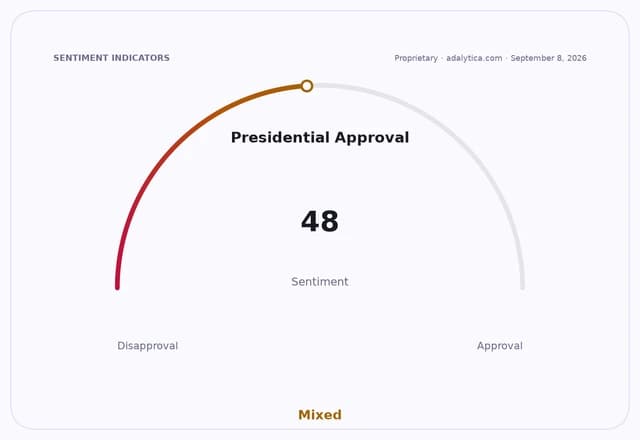
The same survey found 43% of people overall believe a Trump endorsement is more likely to hurt a Republican candidate than help. Among Republicans, less than half — 48% — said an endorsement would be useful, underscoring how uneven his brand has become. Trump’s overall approval stands at just 33%, and even among Republicans support has slipped to 72% from 80% at the start of his second term.
That erosion is already reshaping campaign strategy. Some GOP candidates are quietly stripping Trump references from their websites, while others are telling his team they do not want him campaigning in their districts. One senior Republican working on a competitive House race told Politico, “he cannot come,” while another operative said candidates are trapped in a no-win setup: mention Trump too much and you lose swing voters, but stay out of his good graces and you risk alienating the base.
The economic significance is straightforward: if Trump’s endorsement becomes a liability in swing districts, Republicans’ odds of holding the House or expanding their Senate map worsen. That raises the probability of legislative gridlock, weaker odds for sweeping tax or deregulatory measures, and more uncertainty around the White House’s ability to deliver on spending, tariffs and industrial policy without pushback from a Congress that may be less obedient than expected.
The risk is compounded by Trump’s own campaign instincts. He has signaled he wants to be front and center in the final 30 days, even as strategists complain he is focusing on issues voters do not care about, from a new White House ballroom to “beautification” in Washington, D.C. His dismissal of inflation concerns and opposition to local data-center construction has only sharpened the gap between the president’s message and the issues dominating suburban and independent voters.
Investors should read that as a political volatility trade, not just a polling story. A weaker Republican midterm showing would lift the odds of policy drift, while a stronger showing would preserve Trump’s ability to press ahead with his economic agenda. But this poll says the market may be underestimating the chance that Trump’s brand becomes a midterm headwind rather than a force multiplier.
The actionable takeaway is simple: watch the midterm map as a policy-risk barometer. If Trump keeps dominating the GOP message, the party may pay a price in marginal districts — and that would matter for sectors that depend on Washington staying aligned with business, from defense and energy to infrastructure and industrials.
| Entity | Gains | Losses |
|---|---|---|
| Democratic candidates | ▲Stronger anti-Trump contrast | ▼ |
| Swing-district Republicans | ▲ | ▼Trump-linked backlash |
| Trump-endorsed GOP agenda | ▲Base mobilization | ▼Suburban independents |
| Market sectors tied to policy certainty | ▲Gridlock protection | ▼Legislative momentum |