TSMC Gains on AI Chip Demand as Memory Lags
TSMC is drawing the market’s attention as investors rotate toward companies tied to AI chip demand, while memory names including SK hynix and Samsung Electronics are losing relative momentum after a sharp run-up.
That split matters because the current semiconductor rally is being led by the parts of the supply chain with the clearest pricing power and the most direct exposure to advanced logic and high-bandwidth memory, not by every chip maker indiscriminately. For investors, the message is that the market is beginning to separate structural winners from cyclical beneficiaries, a shift that can change valuation premiums quickly.
TSMC’s U.S.-listed shares closed at $429.15 on Aug. 12, near the top of their recent range and above the 50-day moving average of $425.55. The stock’s relative strength index was 56.5, easing from overbought levels earlier in the summer, while the MACD remained close to a bullish crossover. That suggests the shares are still being supported by institutional demand even after a powerful rally.
The company’s latest July revenue report, released Aug. 10, showed revenue rising 44.7% from a year earlier, underscoring that demand for leading-edge foundry capacity remains intact. TSMC also disclosed on Aug. 11 that its board approved a joint venture with Sony Semiconductor Solutions for next-generation image sensors, a reminder that the Taiwanese chipmaker is continuing to widen its technology and customer reach beyond the main AI cycle.
By contrast, the memory trade appears more fragile after an earlier surge. SK hynix, long viewed as one of the biggest beneficiaries of AI server demand because of its high-bandwidth memory exposure, has seen its share price retreat from a peak above 46 to 35.05 on Aug. 12. Samsung Electronics, the much larger and more diversified Korean tech bellwether, has also lagged the strongest foundry names in recent weeks. That divergence reflects the market’s preference for companies with tighter supply and more visible earnings conversion.
The broader narrative is that the industry’s profit pool is still expanding, but it is not being shared evenly. AI data centers are driving demand for advanced logic wafers at TSMC, while memory makers face a more uneven mix of near-term volatility and cyclical supply questions. Even where memory demand is healthy, investors are asking how much of the upside is already priced in after one of the fastest sector rallies in years.
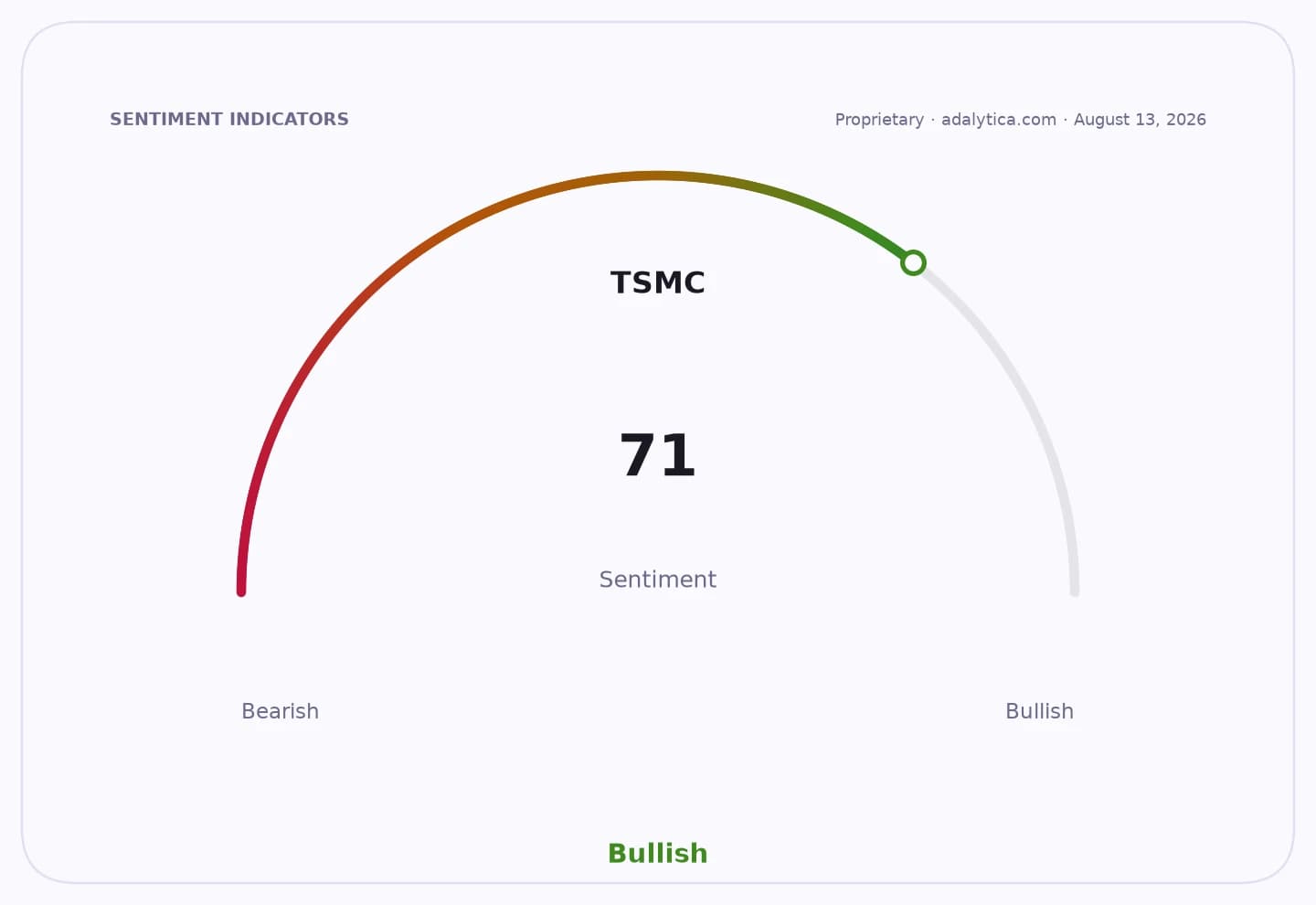
Adalytica’s earnings sentiment gauge for TSMC sits at 71, in “Greed,” and has risen 50 points over the past week, indicating strong investor attention rather than complacency. But that also raises the risk of sharper moves if guidance, capex plans or customer order patterns disappoint. For now, the market is rewarding the company closest to the AI bottleneck and treating memory as a second-order trade.
The next catalyst will be whether the rally broadens beyond TSMC and a handful of AI-linked suppliers, or whether investors continue to concentrate capital in the names with the best visibility into leading-edge capacity. If memory pricing and demand keep improving, SK hynix and Samsung could recover ground. If not, the “Samsung of technology” comparison will look increasingly dated as TSMC remains the dominant premium story in semiconductors.
| Entity | Gains | Losses |
|---|---|---|
| TSMC | ▲AI wafer demand | ▼valuation sensitivity |
| SK hynix | ▲memory pricing rebound | ▼profit-taking after rally |
| Samsung Electronics | ▲broad chip-cycle recovery | ▼relative investor attention |
| AI chip buyers | ▲capacity access | ▼higher foundry costs |