TSMC widens lead in Q2 foundry revenue
Global foundry revenue hit a record in the second quarter, but the bigger story for investors is that TSMC widened its lead over Samsung even as the chip manufacturing market grew at the fastest pace in several quarters.
TrendForce said revenue at the world’s top 10 foundries climbed 11.5% from the first quarter to about $53.49 billion, lifted by strong demand for AI server GPUs and custom AI chips, alongside early iPhone inventory builds and the first meaningful revenue contribution from TSMC’s 2-nanometer process. TSMC alone generated roughly $40.2 billion in quarterly revenue, up 12.1% from the prior quarter, pushing its share to 72.5% from 72.3%.
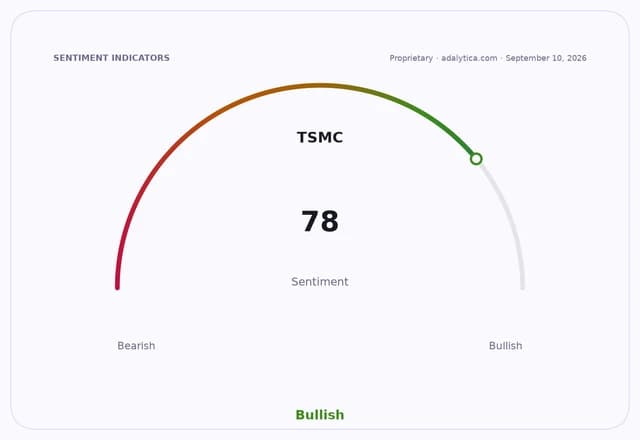
That dominance matters because foundry economics are increasingly tied to the most advanced nodes, where pricing power, utilization and customer concentration all favor the largest player. TSMC’s 3-, 4- and 5-nanometer lines were described as running at full capacity, a sign that artificial intelligence spending is still cascading through the semiconductor supply chain even as broader consumer electronics demand remains uneven. The company’s 2-nanometer ramp also matters strategically: it extends TSMC’s technology lead at a time when customers are paying up for performance and power efficiency.
Samsung, by contrast, posted second-quarter foundry revenue of $3.26 billion, up just 1.8% from the first quarter. Its share fell to 5.9% from 6.5%, widening the gap with TSMC to 66.6 percentage points from 65.8 points. For investors, the issue is not just market share but trajectory: Samsung remains a distant second and has yet to show it can capture a comparable mix of AI-driven and leading-edge demand.
The competitive picture is getting more interesting below the top two. China’s SMIC jumped to third place with revenue up 20% quarter on quarter to about $3.0 billion, narrowing the distance to Samsung. UMC also grew 12.7% to $2.18 billion, while GlobalFoundries rose 9.3% to $1.79 billion. Those gains reflect a broader cyclical upturn, but they also show the market is becoming more segmented: the biggest gains are accruing to firms with either leading-edge exposure or strong capacity utilization in mature nodes.
For semiconductor investors, the key implication is that AI demand is not lifting all foundries equally. TSMC is capturing the premium end of the cycle, while Samsung is seeing slower share gains despite an improving industry backdrop. The next catalyst is the third quarter, when TrendForce expects seasonal flagship smartphone shipments and higher production of next-generation AI and HPC platforms to add momentum. If that proves right, the gap may remain wide unless Samsung can improve execution at advanced nodes.
| Entity | Gains | Losses |
|---|---|---|
| TSMC | ▲AI demand, pricing power | ▼Limited diversification |
| Samsung Foundry | ▲Modest revenue growth | ▼Market share loss |
| SMIC | ▲Share gains, faster growth | ▼Technology-gap concerns |
| GlobalFoundries/UMC | ▲Utilization gains | ▼Less exposure to AI premium |