TSMC Advances Next Node as AI Demand Stays Strong
TSMC is moving its next flagship manufacturing node forward, a sign the AI chip boom is pulling the world’s most important foundry into an even faster investment cycle just as demand for advanced semiconductors keeps outrunning supply.
That matters because the company sits at the center of the global compute stack. When TSMC accelerates a leading-edge node, it does not just shorten a product roadmap; it pulls forward capital spending across lithography, materials, packaging and data-center silicon, and it gives Nvidia, Apple, AMD and other design houses a clearer path to denser, more power-efficient chips.
The market has been underestimating how quickly AI infrastructure spending is becoming a multi-year industrial cycle rather than a one-off earnings burst. TSMC’s shares have stayed well above both the 50-day and 200-day moving averages, and the stock closed at $433.24 on Sept. 11 after a sharp rebound from a late-July slide, showing investors still want exposure to the foundry even after a year of heavy outperformance. ASML, the key supplier of extreme ultraviolet tools, and Applied Materials, another critical equipment vendor, have also seen the equity market reward the same theme: the more advanced the node roadmap, the larger the order pool for the picks-and-shovels suppliers.
The economic significance is straightforward. Faster node introduction implies more aggressive capex and a tighter race to secure capacity for the highest-margin AI and mobile chips. TSMC’s August revenue rose 10.1% from July and 53.3% from a year earlier to NT$514.81 billion, underscoring that demand is not just holding up — it is accelerating. That kind of growth supports Taiwan’s industrial output, reinforces Asia’s semiconductor export engine and keeps pressure on rival fabs trying to close the process gap.
It also matters in a world where long-dated U.S. yields are still high enough to make capital discipline a real constraint. The 10-year Treasury sits near 4.95%, a backdrop that should normally punish long-cycle tech spending. Instead, TSMC and its suppliers are telling the market that AI demand is strong enough to justify continued front-loading of investment. That is bullish for equipment makers, specialty materials firms, advanced packaging players and energy infrastructure tied to data-center expansion.
The geopolitical overlay only raises the stakes. China’s push to accelerate domestic AI development increases the strategic value of every node advance at TSMC, because process leadership remains one of the few durable moats in semiconductors. The faster TSMC moves, the harder it becomes for would-be challengers to catch up, and the more indispensable the company becomes to the global AI supply chain.
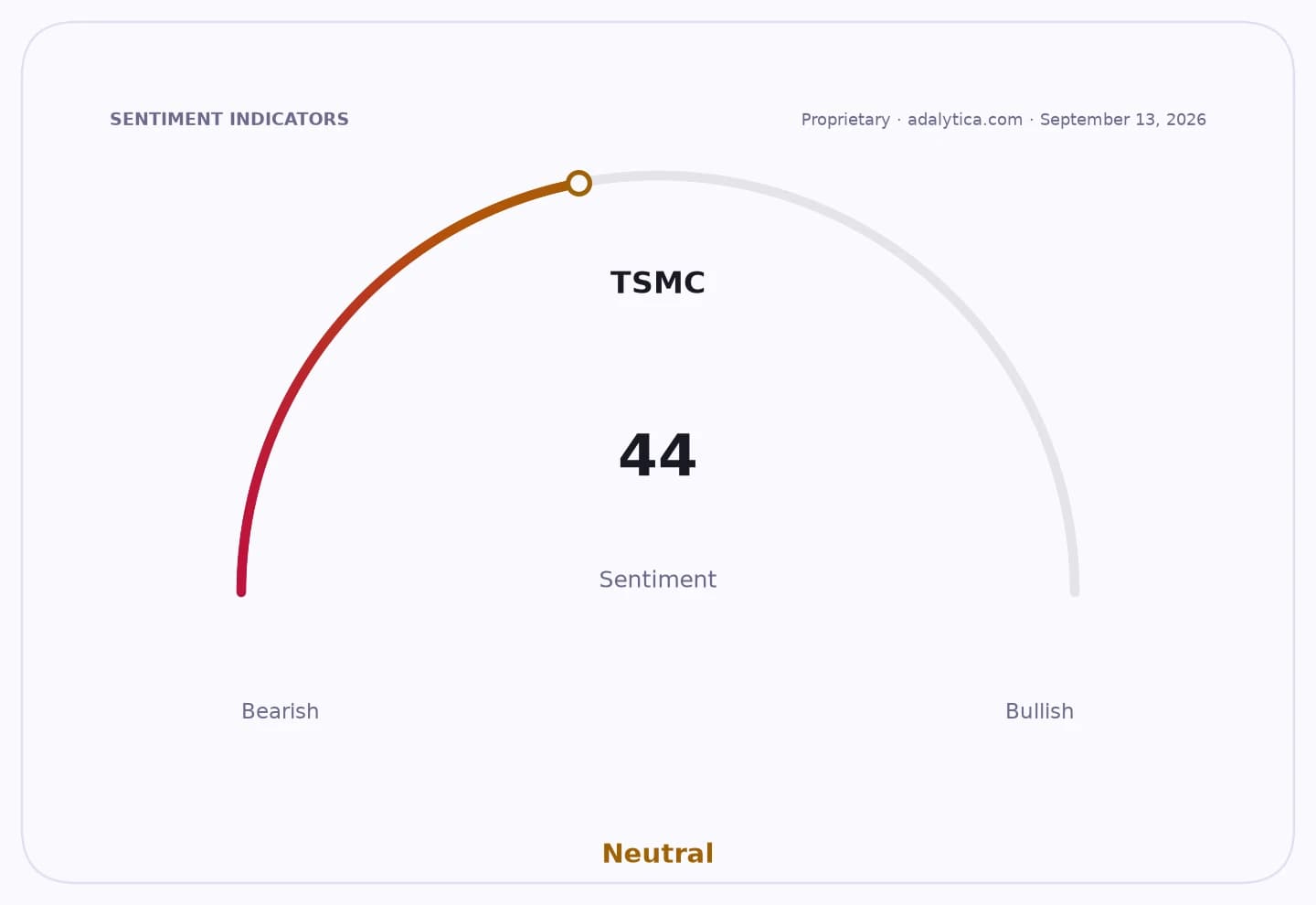
Adalytica’s TSMC earnings sentiment gauge has slipped to neutral even as awareness remains in “extreme greed,” a combination that often appears when investors are watching the story but have not fully priced the next leg of capital spending. That is exactly where opportunity can emerge.
My thesis is simple: if TSMC is bringing its top node forward, the real winners are not just the foundry’s shareholders, but the entire industrial base selling the tools, substrates and power systems required to make advanced chips possible. For investors, that means staying positioned in TSMC for the core compute platform, while also owning the infrastructure layer through ASML, Applied Materials and similar semiconductor equipment leaders. The next catalyst is not a single product launch; it is the confirmation that the AI capex supercycle is still accelerating.
| Entity | Gains | Losses |
|---|---|---|
| TSMC | ▲Faster node leadership | ▼Longer R&D burden |
| ASML | ▲More EUV demand | ▼Tool supply strain |
| Applied Materials | ▲Higher equipment orders | ▼Cyclical valuation risk |
| Rival fabs | ▲Pressure to catch up | ▼Process gap widens |