Turkey jobs pledge weighs on TUR ETF outlook
Turkey’s promise to create 2.1 million additional jobs over the next two years lands at a delicate moment for an economy still trying to keep unemployment from drifting higher.
That matters because employment is the clearest transmission channel from policy into household spending, bank credit quality and ultimately growth. With the jobless rate forecast at 4.02% in September from 4.1% in August, the labor market is not under acute stress — but it is soft enough that even modest disappointments can quickly filter into consumption, tax receipts and sentiment around Turkey’s recovery.
Nonfarm payrolls are still edging up, with payroll employment rising to 159,075 in August from 158,913 in July, while job openings slipped to 7,271 in July from 7,537 in May. That combination points to a labor market that is creating jobs, but not with the kind of momentum usually associated with a broad, demand-led expansion. In other words, the headline employment target is as much a policy objective as an economic one: it signals Ankara wants to keep the recovery politically and socially durable even as growth cools.
For investors, the stakes are straightforward. A stronger labor market would support retailers, consumer lenders, industrials and local-currency assets by reinforcing domestic demand. A weaker one would amplify pressure on earnings, especially for companies exposed to discretionary spending and employment-sensitive credit portfolios. Turkey’s market-traded ETF, TUR, has already reflected that uncertainty, with its price sliding to $37.28 from a recent $42.55 high and sitting below both its 50-day and 200-day moving averages, while RSI readings in the low 30s show a market that remains technically fragile rather than convinced by the recovery story.
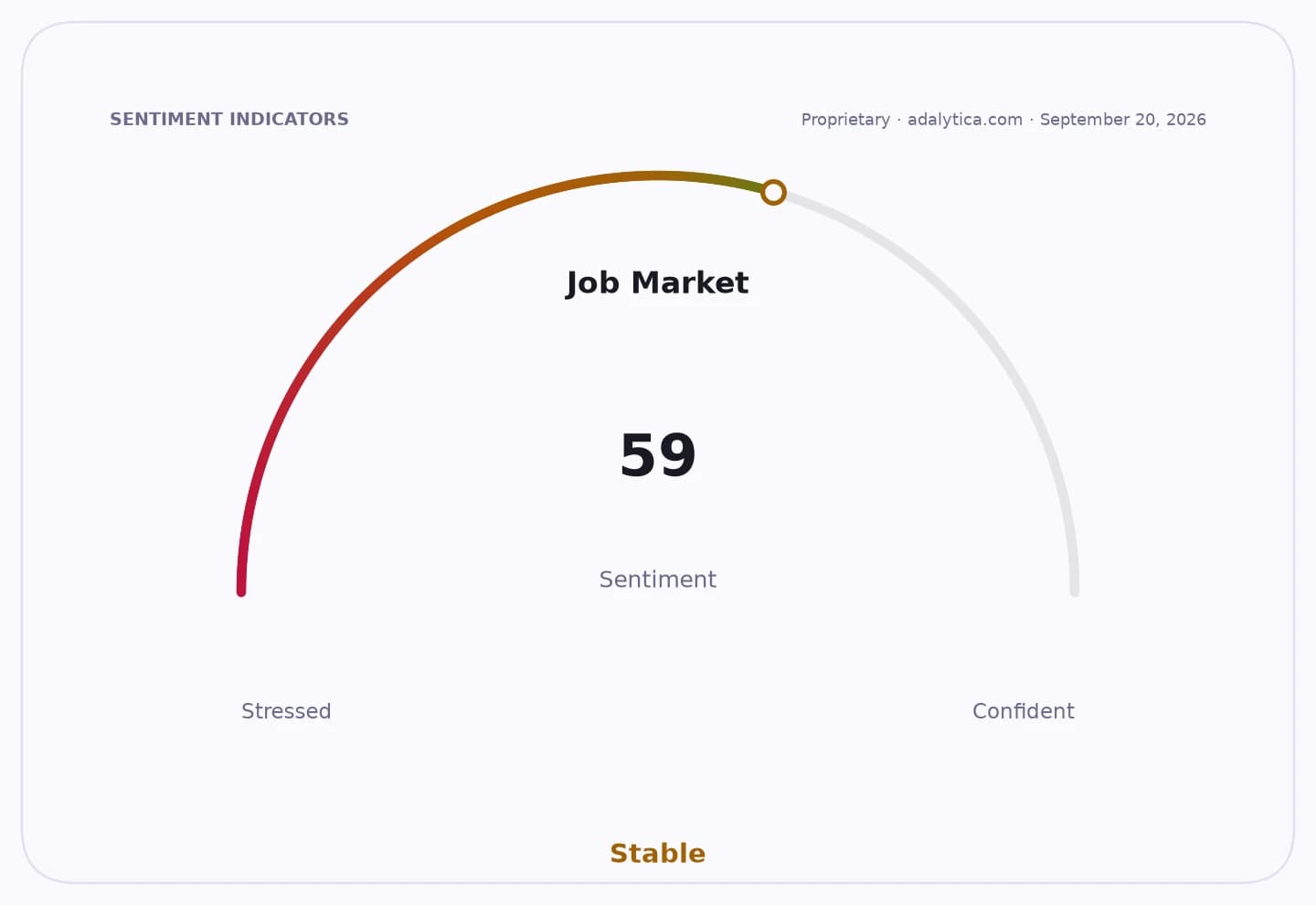
Adalytica’s Nonfarm Payrolls Sentiment gauge underscores the caution: sentiment sits at 10, labeled “Extreme Fear,” even as job-market sentiment has rebounded to neutral. That split tells you investors are not pricing in a clean acceleration in hiring; they are waiting for proof that policy can convert targets into sustained wage income and consumption.
The broader narrative is that Turkey is trying to thread the needle between labor-market stability and macro discipline. If the 2.1 million-job pledge becomes visible in payrolls, the upside is not just political — it could unlock a more durable rerating across domestic cyclicals and consumer-linked names. If it falls short, the market will likely treat the target as aspirational rhetoric rather than investable momentum. For now, the smarter position is to watch whether employment data starts validating the promise before chasing the story.
| Entity | Gains | Losses |
|---|---|---|
| Turkish workers | ▲More hiring opportunities | ▼Wage pressure if growth slows |
| Domestic retailers and lenders | ▲Stronger consumer demand | ▼Softer credit quality if jobs lag |
| Turkey ETF (TUR) bulls | ▲Labor-market confirmation | ▼Technical weakness and uncertainty |
| Jobless-claim skeptics | ▲Lower unemployment risk | ▼Missed upside if hiring accelerates |