U.S. consumer sentiment falls as unemployment stays low

Americans are getting more fearful even as unemployment stays low, a sign that the economy is being pulled apart by concentration at the top and stagnation at the bottom.
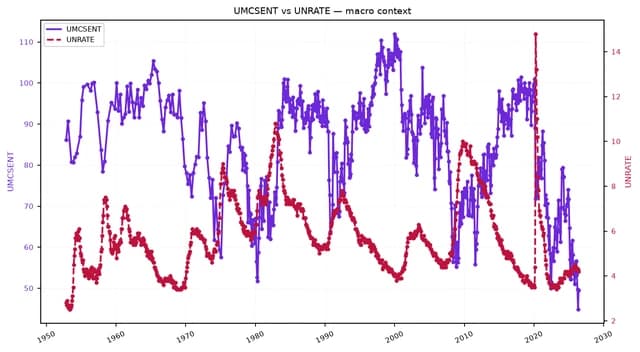
That split matters because consumer confidence is the engine of the U.S. economy, and the latest University of Michigan sentiment reading is pointing in the wrong direction. The gauge fell to 49.5 in June from 65.2 in April and is forecast to slide again to 43.99 in July, while the jobless rate edges down to 4.1% from 4.3%. In other words, the labor market is still holding up, but households do not feel they are sharing in the recovery.
That is the Brandeis problem in modern form. A state can post respectable macro numbers and still become economically brittle when wealth, political influence and spending power concentrate in a narrow slice of society. The data context points to exactly that kind of imbalance: while jobs remain near full employment, the consumer mood has collapsed, and Adalytica’s U.S. Congressional Gridlock sentiment is flashing Extreme Fear even as awareness of the issue remains high. The message for markets is simple: social strain is turning into policy strain, and policy strain eventually shows up in valuations.
Investors should treat that as a warning, not a footnote. When confidence weakens faster than payrolls, households become more selective, lower-income spending gets squeezed first, and the market starts to lean harder on the wealthiest consumers and the largest companies. That helps explain why megacap stocks and index-heavy strategies can keep outperforming even as broad sentiment deteriorates: the market is increasingly tied to the cash flows of the affluent, the AI capex cycle and the balance sheets of the powerful. SPY remains above its 200-day moving average, but the recent swings in RSI and MACD show a market still digesting that uneven reality.
The investable implication is that the winners are likely to be the toll roads of the new economy: firms exposed to premium consumption, asset management, private wealth, payments, cloud infrastructure and defense-adjacent public spending. Goldman Sachs, Morgan Stanley, BlackRock and Charles Schwab stand to benefit if wealth keeps concentrating and more capital flows into fee-bearing platforms. By contrast, discretionary retailers, small-cap consumer names and rate-sensitive borrowers are more exposed to a public that feels poorer than the headline employment data suggests.
The larger narrative is not just inequality; it is the market pricing of inequality. If confidence keeps eroding while the job market merely cools instead of cracks, Washington will face louder pressure to tax, regulate or redistribute. That would reinforce the case for owning businesses that capture flows from capital concentration rather than relying on mass-market demand. I believe the market is still underestimating how durable this bifurcation can be, and that makes select financials, infrastructure and AI-enabled platforms the better long-term place to be positioned now.
| Entity | Gains | Losses |
|---|---|---|
| Wealthy households | ▲Asset appreciation | ▼Political backlash |
| Megacap financials | ▲More fee-bearing assets | ▼Broader consumer weakness |
| Premium consumer brands | ▲Rich-customer spending | ▼Mass-market demand |
| Small-cap retailers | ▲— | ▼Squeezed spending power |