U.S. consumer spending stays resilient as labor holds
U.S. consumer spending is being underpinned by firmer household fundamentals, with a still-resilient labor market and broad money growth helping keep demand intact even as credit conditions and fiscal strains remain a drag on lower-income households.
That matters because consumption remains the main engine of the U.S. economy. If households keep spending, it helps cushion growth, supports corporate revenues and reduces the odds that the economy slips into a sharper slowdown. The latest data point to a labor market that is cooling only gradually: unemployment has edged down to 4.1% in July from 4.3% in May, while the broader money supply measure M2 has continued to expand, rising to 23.2 trillion in July from 23.0 trillion in May.
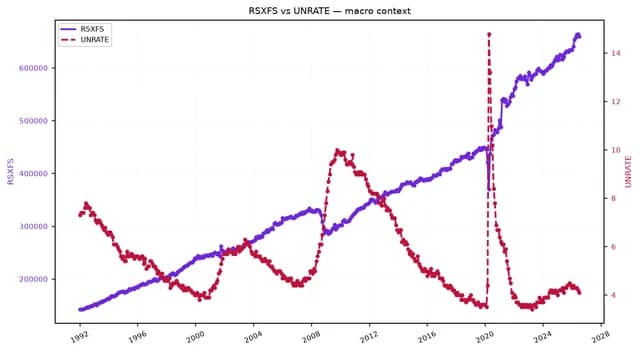
Consumer spending itself is still growing, albeit without the kind of explosive momentum seen during the post-pandemic surge. The RSXFS spending series rose to 660,047 in July from 616,540 in May 2025, and is forecast to increase again to 665,993.6 in August, suggesting households remain willing and able to absorb higher prices and service demand. That resilience is important for a soft-landing narrative: it implies consumption is being supported by income, not just by borrowing or temporary stimulus.
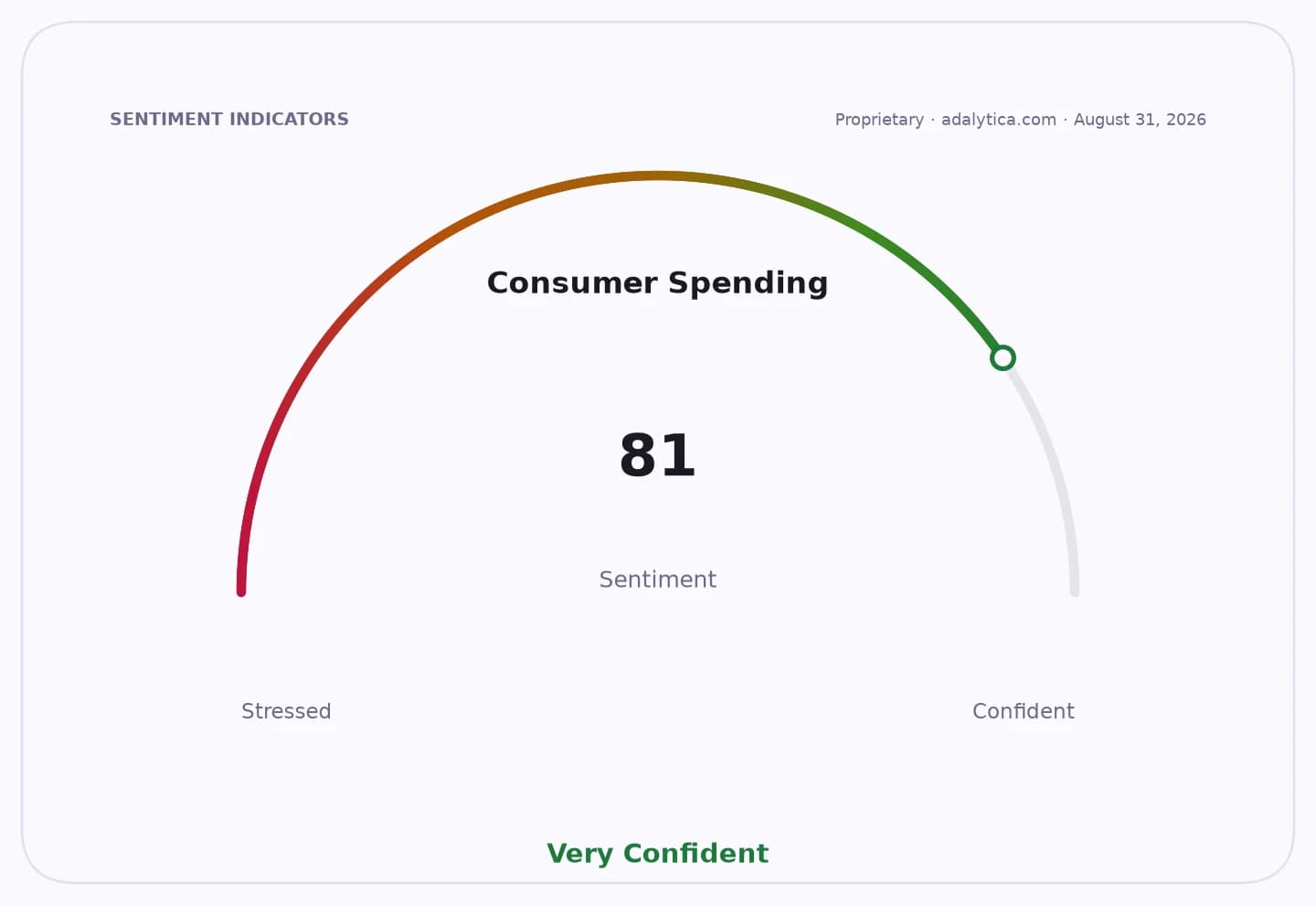
The composition of that spending matters for investors. Stronger household balance sheets tend to favor consumer discretionary, travel, leisure and select retail names, while a more cautious credit backdrop can pressure lenders and issuers exposed to revolving debt. Adalytica’s consumer spending sentiment gauge sits at 81, or “Greed,” with awareness at 93, indicating elevated attention around the topic; but credit card usage sentiment is only 19, or “Fear,” underscoring that consumers may be spending more selectively and relying less comfortably on credit than in prior upswings.
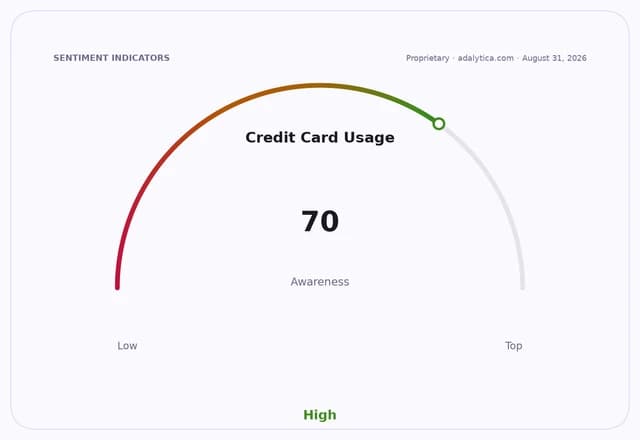
That split tells the broader story. On one hand, wage income, employment and money growth are still doing enough to sustain demand. On the other, the strain visible in credit sentiment suggests the spending base is not uniformly healthy, leaving lower- and middle-income households more exposed if labor conditions weaken further or if borrowing costs stay restrictive. For policymakers, the implication is straightforward: preserving household purchasing power remains central to maintaining growth, especially as debates over fiscal discipline and spending efficiency intensify in other parts of the world.
For investors, the near-term question is whether the consumer can keep carrying the economy without another leg of labor-market deterioration. If unemployment remains close to 4% and real incomes hold up, retailers and services firms should benefit from steady volumes. If job growth softens more quickly than expected, the gap between strong spending sentiment and weak credit sentiment could close fast, exposing more cyclical parts of the market.
| Entity | Gains | Losses |
|---|---|---|
| U.S. consumers | ▲steadier spending power | ▼borrowers with thin savings |
| Retailers and services firms | ▲resilient demand | ▼if labor market cools |
| Consumer lenders | ▲loan growth from spending | ▼if credit stress rises |
| Policymakers | ▲softer recession risk | ▼less room to ignore household strain |