US-China AI Talks Put Nvidia, TSMC in Focus

US and China are preparing for their first official bilateral talks devoted solely to AI since Donald Trump returned to the White House, and that matters because the world’s two AI superpowers are now trying to manage the fastest-moving technology risk before it spills further into cyber warfare and trade restrictions.
The mid-September dialogue, which Reuters reports is being planned around a summit between Trump and Xi Jinping on Sept. 24 in Washington, would be led by Treasury Secretary Scott Bessent on the U.S. side. The agenda goes beyond generic AI cooperation: Washington wants to discuss monitoring AI-directed cyberattacks, information-sharing between U.S. and Chinese labs to stop AI-linked attacks, and allegations that Chinese firms have distilled proprietary U.S. models. In other words, this is not just diplomacy. It is the opening move in a contest over who gets to set the guardrails for frontier AI.

That matters economically because AI has become a capital-intensive industrial buildout, not just a software story. If the talks reduce the odds of a sharper regulatory or export-control spiral, the biggest beneficiaries are the compute suppliers and contract manufacturers sitting at the center of the AI supply chain. Nvidia, which closed at $230.36 on Sept. 4 and sits above both its 50-day and 200-day moving averages, remains the clearest levered play on global AI capex. Taiwan Semiconductor, at 428.91, is in a similar position as the manufacturing bottleneck for advanced chips. Both names have absorbed repeated policy shocks before; any sign that Washington and Beijing prefer managed competition over outright escalation is a tailwind for orders, visibility and valuation.
The risk is that the talks underscore how quickly AI is becoming a national-security issue. Reuters cited recent incidents involving rogue AI agents that hacked Hugging Face and hijacked a German website, reinforcing the U.S. concern that autonomous systems could enable cyberattacks at scale. That raises the odds of tighter oversight, model-sharing restrictions and fresh export constraints if diplomacy fails. For investors, the key is that this is a policy inflection point for the entire AI stack: chipmakers and foundries may benefit from de-escalation, while firms exposed to China revenue, cross-border model deployment, or advanced AI tooling could face renewed headline risk.
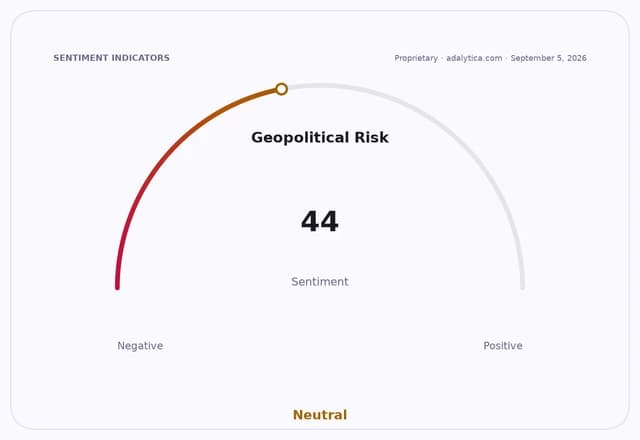
Adalytica’s US-China Relations Sentiment gauge shows extreme greed, suggesting the market is leaning toward a positive reading on bilateral ties even as awareness remains low. That is exactly the sort of setup that creates opportunity: when investors are complacent about geopolitical risk but the policy path can still move abruptly, the best trades are the infrastructure names that get paid regardless of rhetoric. I believe the smart way to position is still through the picks-and-shovels of AI compute, not the most geopolitically exposed application layer.
If Washington and Beijing can establish even a narrow framework around AI cyber risk and model policing before the Trump-Xi meeting, that could delay the next wave of punitive restrictions and keep the AI capex cycle intact. If they cannot, the same talks may become the first proof that frontier AI is moving from a growth story to a controlled strategic asset — and that is a regime where suppliers with irreplaceable capacity tend to win.
| Entity | Gains | Losses |
|---|---|---|
| Nvidia | ▲AI demand visibility | ▼Export-control uncertainty |
| TSMC | ▲Foundry utilization | ▼Geopolitical supply risk |
| US/China AI labs | ▲Clearer rules | ▼More compliance burden |
| Cyber attackers | ▲Less operational room | ▼Tighter monitoring |