US-China AI talks support Nvidia, TSMC, Microsoft
The United States and China have opened a direct channel on artificial intelligence, a modest but economically important step that could reduce the risk of a tech accident turning into a broader geopolitical crisis just as the two sides race to control the chips, models and standards that will shape the next decade.
For investors, that matters because AI is no longer a narrow software story. It is a capital-intensive industrial buildout tied to semiconductors, cloud infrastructure, energy, defense and export controls. Any mechanism that lowers the odds of an abrupt escalation in the US-China rivalry can support the valuation premium on the companies most exposed to the AI supply chain, while also keeping alive the risk that Washington and Beijing continue competing without fully breaking the system.
That is the balancing act the two governments are trying to manage. US Treasury Secretary Scott Bessent and Chinese Vice Premier He Lifeng did not resolve the fight over advanced chips, rare earths or model access in their eight-hour meeting in New York, but they agreed to start talks on AI and to activate a bilateral trade board ahead of the Trump-Xi meeting this week in Washington. The immediate goal is to keep the summit from derailing. The bigger prize is preventing a false alarm, cyber incident or autonomous-system error from being misread as an attack.
Washington wants a notification mechanism for AI-related incidents that could affect national security. China has not publicly accepted that framing, but both sides agreed to begin identifying common objectives and common threats. That is not a treaty and it does not create hard rules. But in a rivalry where escalation can happen faster than diplomacy, even a narrow hotline is valuable.
The economic logic is clear. The US and China are pouring AI into military systems, intelligence networks, critical infrastructure and cybersecurity. At the same time, they are tightening export controls, competing for semiconductors and pushing rival standards. In that setting, a bilateral communication line is less about harmony than about avoiding a market-moving shock. If a technical failure or automated response is mistaken for hostile action, the result could be fresh sanctions, new chip restrictions, or retaliation that hits supply chains from Taiwan to rare earths.
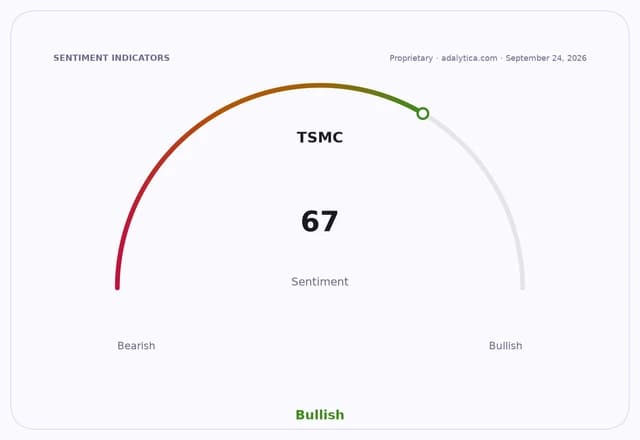
That is why the talks matter well beyond foreign policy. They create a small but real buffer around the AI buildout that has powered spending across the sector. Nvidia and Taiwan Semiconductor Manufacturing sit at the center of that investment cycle, while Microsoft remains one of the biggest capital allocators in cloud AI. Their shares have already reflected that growth, and conventional technical indicators on all three names show they remain in broad uptrends despite recent volatility. TSMC, for example, has held well above its 200-day moving average, while Microsoft and Nvidia are trading above their long-term trend lines even after pullbacks.
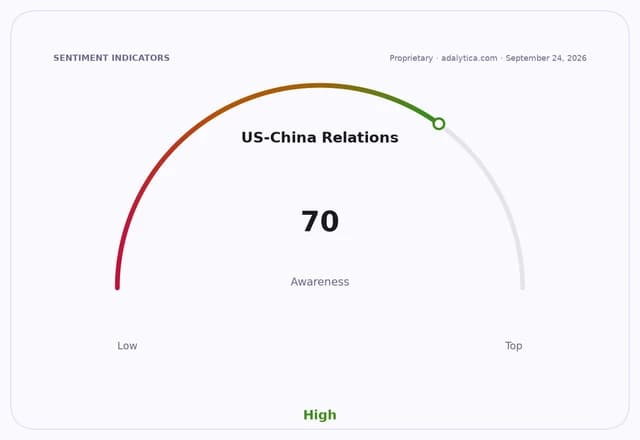
The market’s bigger concern is not that the talks end competition. It is that competition becomes unmanaged. Adalytica’s US–China relations sentiment gauge jumped to “Extreme Greed,” a reminder that traders are leaning hard into a de-escalation narrative. That may be premature. The two sides are still divided over chips, AI model distillation, rare earths and the scope of any security framework. But the fact that both governments now see value in an AI-specific channel suggests the rivalry is becoming institutionalized rather than chaotic.
That is a subtle but important distinction for capital. Institutionalized rivalry still means controls, tariffs and strategic decoupling. It also means more visible rules, which is better for long-duration investment in the picks-and-shovels of AI infrastructure. Data centers, power systems, networking gear, advanced packaging and foundry capacity all benefit when the market can assume the buildout continues even as Washington and Beijing spar over access.
The second track being discussed — a new trade board and a limited list of non-sensitive goods that could move at reduced tariffs — also matters, though less dramatically. It would not solve the bigger trade war, but it could preserve a protected corridor for low-tech goods, energy, agriculture and medical devices. For companies and investors, that is another sign the two sides want pressure-release valves without conceding strategic ground.
| Entity | Gains | Losses |
|---|---|---|
| Nvidia, TSMC, Microsoft | ▲Lower escalation risk | ▼Less short-term volatility premium |
| AI infrastructure suppliers | ▲Continued capex visibility | ▼Faster policy uncertainty if talks fail |
| US and China governments | ▲Crisis-management channel | ▼Less freedom to weaponize incidents |
| Export-control hawks | ▲More diplomacy, fewer abrupt moves | ▼Reduced pressure for immediate escalation |