US-China Chip Trade Risks Hit SOXX and FXI

China’s reliance on the US for advanced semiconductors and related specialty products is becoming more costly and more volatile for both sides, with fresh trade and export-control risk rippling through chipmakers, currency markets and China-linked equities.
That dependence matters because the most strategically sensitive products in the US-China trade relationship are also some of the most economically important. Semiconductors sit at the center of artificial intelligence, cloud computing, consumer electronics and industrial automation, making access to US technology a supply-chain and growth issue, not just a geopolitical one. When that channel narrows, the impact shows up quickly in inventories, margins, capital spending and investor positioning.

The latest filings from major chip suppliers underscore the risk. AMD warned in its most recent 10-Q that tighter US export controls could leave it unable to sell inventory and could trigger further charges if licenses are delayed or denied. Micron and Qualcomm made similar disclosures about trade barriers, supply constraints and higher costs, while Apple flagged tariffs and restrictions on components, rare earths and raw materials as a material risk to its operations.
That is why the market has been so sensitive to every signal on US-China trade. The SOXX semiconductor ETF has swung violently this summer, surging above 650 in late June before dropping as low as 465 in late July, then recovering to about 520 by Aug. 21. The 200-day moving average is still far below the current level, but the ETF has also come off overbought readings seen earlier in the summer, with its RSI easing from 83.1 on July 13 to 42.1 most recently. That points to a market still digesting the policy shock rather than one that has resolved it.
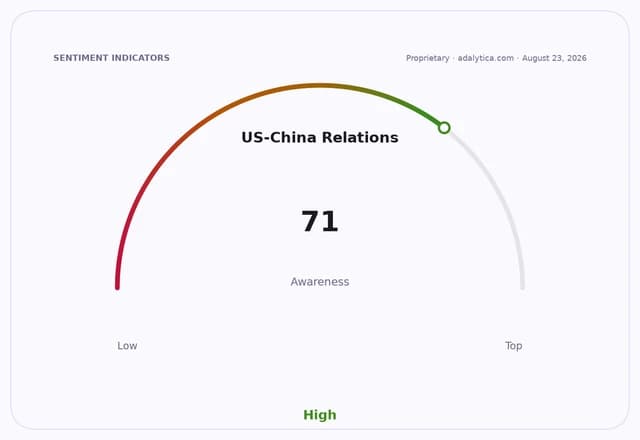
China-focused equities have also been caught in the crosscurrents. The FXI China large-cap ETF has hovered around 35.86, below its 200-day moving average near 36.67, suggesting investor caution toward the mainland economy and its trade-sensitive sectors. By contrast, the latest Adalytica US-China Relations Sentiment snapshot jumped to 79, while global stability sentiment remains only neutral, reflecting a market that sees easing tension as possible but not durable.
The macro backdrop is equally important. US industrial production, using the INDPRO series, has been relatively flat around 102.99 in July and is forecast to edge up to 103.34 in August, while another trade-linked series, RSXFS, is near 660,047 after a long climb. That combination suggests trade restrictions are landing at a time when global manufacturing remains functional but not strong enough to absorb a prolonged shock without price and margin effects.
For investors, the key issue is not just whether Washington tightens controls further, but which companies sit at the intersection of policy and profitability. US chipmakers with China exposure face a direct hit to sales and inventory management if licensing slows. Chinese buyers and assemblers face slower access to high-end components. Portfolio managers are likely to keep favoring names with less China revenue sensitivity, stronger domestic demand and more diversified end markets.
The bull case is that trade friction remains manageable and supply chains adapt, allowing AI demand to keep carrying semiconductor earnings. The bear case is that export controls broaden, retaliation intensifies and the specialty products China depends on become harder to source, forcing another round of earnings revisions and valuation compression.
What happens next will depend on whether the latest improvement in US-China relations sentiment holds or fades back into the pattern of sharp reversals seen this year. For now, the market is pricing a fragile truce, not a durable reset.
| Entity | Gains | Losses |
|---|---|---|
| US chipmakers | ▲pricing power in restricted markets | ▼China sales and inventory risk |
| Chinese buyers | ▲near-term supply continuity if licenses hold | ▼access to advanced components |
| SOXX holders | ▲rebound if trade fears ease | ▼drawdown if controls tighten |
| FXI investors | ▲policy relief if tensions de-escalate | ▼valuation pressure from trade exposure |